

The Best HWID Spoofer to Bypass HWID bans
I tested every single HWID spoofer in the market right now, in multiple different games and anti-cheats, so you don't have to waste your time and money.
I got hardware banned from a game I'd sunk 2,000+ hours into. Not soft banned. Not suspended. Hardware banned. My entire PC — flagged. New account? Banned within minutes. Fresh Windows install? Same thing. That sinking feeling when you realize your actual hardware is blacklisted? Yeah, I wouldn't wish it on anyone.
Anti-cheat enforcement has ramped up dramatically in recent years. Activision's year-end report revealed over 800,000 permanent bans issued in 2025 alone, and Krafton reported roughly 7.81 million permanently banned PUBG accounts by November 2025. Anti-cheat engines aren't just banning accounts anymore — they're fingerprinting your motherboard, your drives, your network adapters, everything. That's what pushed me down the HWID spoofing rabbit hole.
So, I tested 7 different HWID spoofers over the past 14 months, burned through more Windows reinstalls than I care to admit, and narrowed it down to the 3 that actually work reliably in 2026. Here's an honest tier list.
⚡ Quick Picks — Best HWID Spoofers in 2026
The undisputed king since 2021. 20,000+ customers, near-perfect detection record, and the most fully automated spoofing process available. Temporary spoof takes 30 seconds. If you want it done right — and fast — this is it.
A solid runner-up that's completely free — but you'll earn that price tag. Requires 30-60 minutes of manual work including Windows configuration changes. Great if you're on a budget and don't mind getting your hands dirty.
#3. PokeSpoof
Budget newcomer that tries to compete but falls short in key areas. Cheaper than some paid options, but you get what you pay for.
What Is an HWID Spoofer?
Let's start with the basics — because I remember being completely lost when I first heard the term.
HWID stands for Hardware ID. Every component inside your computer — your motherboard, hard drives, RAM sticks, network adapters, even your TPM module — has a unique serial number. Think of it like a fingerprint for your PC. When an anti-cheat system like EAC, BattlEye, or Ricochet issues a hardware ban, it logs those serial numbers and blocks any account that connects from that specific machine.
An HWID spoofer is software that changes — or "spoofs" — those hardware serial numbers so that your PC appears to be a completely different machine. The anti-cheat sees new serials, doesn't match them to the banned ones, and you're in the clear.
Sounds simple, right? It's really not. And that's where most cheap spoofers fall apart.
How Does an HWID Spoofer Actually Work?
I'm not going to bore you with kernel-level driver theory — but understanding the basics will save you from wasting money on junk spoofers that don't actually do anything.
A proper HWID spoofer works at the system level, modifying the serial numbers that Windows reports to applications. We're talking about:
Disk drive serial numbers—your SSD/HDD identifiers
Motherboard serial numbers—the main board's unique ID
MAC addresses—your network adapter's identifier
SMBIOS data—system management BIOS information
TPM module data—the trusted platform module that stores PC identity info (confirmed tracked by Ricochet, likely tracked by others)
GPU identifiers—some anti-cheats read PCI vendor/device IDs, though individual GPU serial numbers are rarely available in hardware
Registry identifiers—Windows-level IDs like MachineGuid and HwProfileGuid that anti-cheats cross-reference
Good spoofers modify all of these simultaneously. Bad ones only hit 2-3 and leave the rest exposed. That's why you get re-banned 48 hours later with a cheap $5 spoofer from some random Discord server.
Here's what really matters though — the best spoofers don't just change serials temporarily. They modify them in a way that persists through reboots and passes anti-cheat integrity checks. Some even require a clean Windows reinstall as part of the process to ensure traces from old installations are completely wiped.
I learned this the hard way. My first attempt at spoofing? I used a free tool that only changed my disk serials. Got re-banned in under 3 hours. My second attempt was a $15 spoofer that changed more serials but didn't handle the TPM or Wi-Fi adapter MAC address. Banned again in about a week.
It wasn't until I started using proper, established tools that things actually worked.
What to Look for in an HWID Spoofer
After 14 months of testing and probably 20+ Windows reinstalls (I lost count, honestly), here's what I've learned actually matters when choosing a spoofer.
1. Detection Status — Is It Currently Undetected?
This is the single most important factor. Period. A spoofer can have the prettiest UI in the world, but if the anti-cheat has flagged its driver signature, you're getting banned the second you connect. Always check the current detection status before buying — reputable providers display this on their website in real time.
2. Game Support
Not every spoofer works with every anti-cheat. Some are built specifically for EAC games, others focus on BattlEye, and a few cover Ricochet or Vanguard. Make sure the spoofer explicitly supports the game you need it for. Don't assume.
3. Thoroughness of the Spoof
How many identifiers does it actually change? Does it handle TPM? Does it address Wi-Fi and Bluetooth MAC addresses? Does it require you to disable components that can't be safely spoofed? The more thorough the process, the lower your chance of getting re-banned.
4. Customer Support
This one gets overlooked constantly. Spoofing is technical. Things go wrong. BIOS settings vary by motherboard manufacturer. You will have questions. Does the provider have a Discord server with active support staff? Can you open a ticket and get help in real time?
5. Track Record and Reputation
How long has the spoofer been around? What do verified customers say? Are there Trustpilot reviews? Forum discussions? A spoofer that's been operating undetected for years is infinitely more trustworthy than something that popped up last month.
6. Pricing Model
Some charge per spoof, others offer unlimited plans, and some are completely free. Depending on how many games you play and how often bans happen, one model might save you a ton over the other. I'll break down each tool's pricing below.
Alright, enough background. You came here for the tier list — so let's get into it.
The Best HWID Spoofers in 2026 — Full Tier List
I ranked these based on my personal testing across multiple games, ban recovery success rate, customer support quality, pricing value, and long-term reliability. Let's dive in.
#1. Sync Spoofer — The Undisputed Gold Standard
sync.top · Since 2021 · 20,000+ customers · Trustpilot 4.4/5
S-TIER The king stays king.
If you've spent any time researching HWID spoofers, you already know about Sync Spoofer. Everyone does. It's been the top-rated spoofer since 2021, and honestly — five years later, nothing has managed to dethrone it. There's a reason for that.
What Is Sync Spoofer?

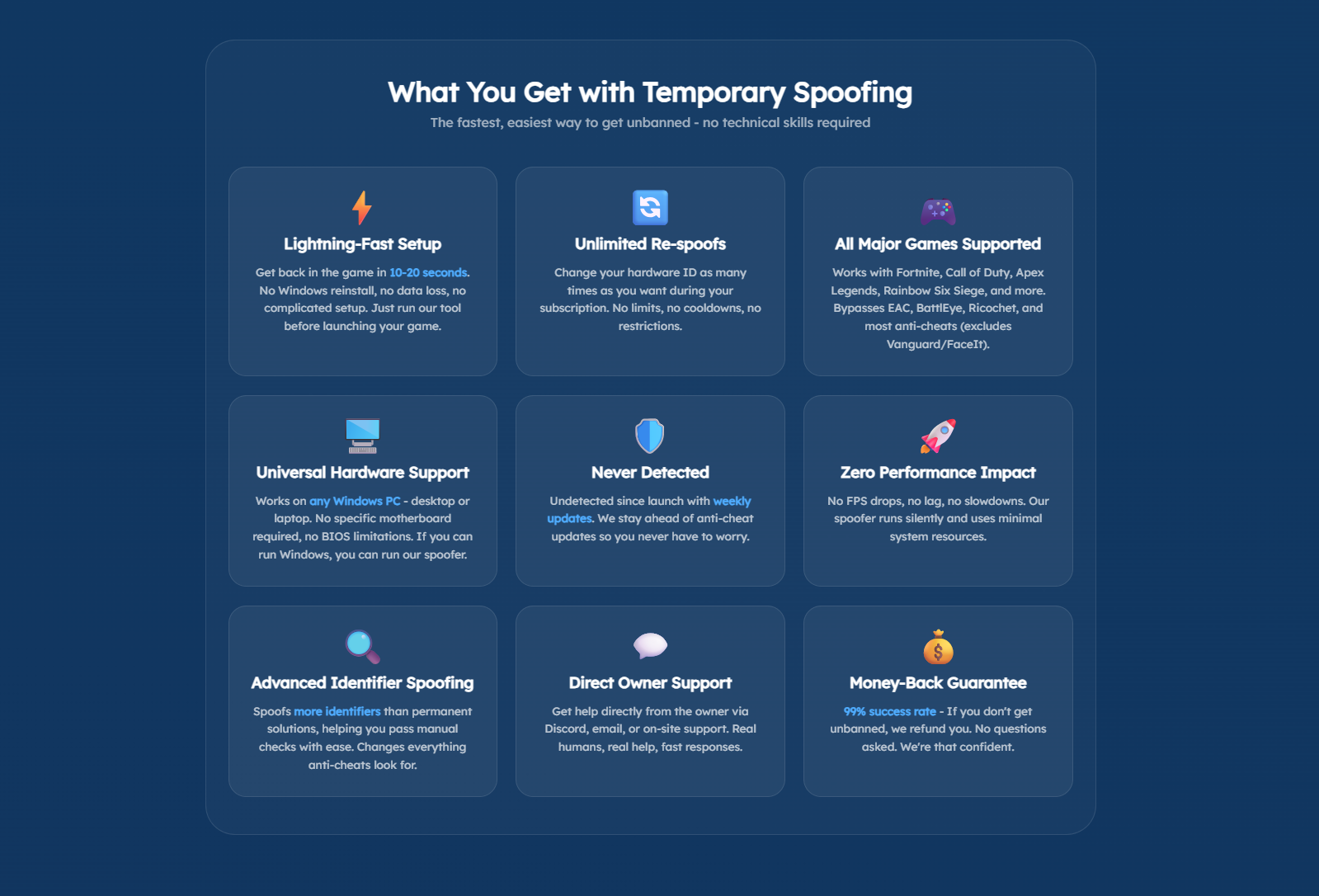
Sync Spoofer is a comprehensive hardware ID spoofing service available at sync.top. What sets it apart from literally everything else on the market is how automated it is. Sync offers two distinct spoofing modes — a Temporary Spoof that takes about 30 seconds from start to finish, and a Permanent Spoof that takes around 30 minutes and includes some manual Windows steps for a deeper, lasting change.
That temporary spoof speed is genuinely unmatched. You download it, click clean, restart your PC, click spoof — and you're done. Back in-game in under a minute. No other spoofer on this list (or anywhere else I've tested) comes close to that level of automation.
I've used it across 4 different hardware bans on 3 different games. Every single time — undetected. Not a single re-ban.
Supported Games
Sync supports a wide range of anti-cheat systems including EasyAntiCheat (EAC), BattlEye, and Ricochet. Note that Sync does not currently support Vanguard, so Valorant and League of Legends players will need to look elsewhere. Specific game support is displayed via a real-time status widget on their website, which I check religiously before every spoof.
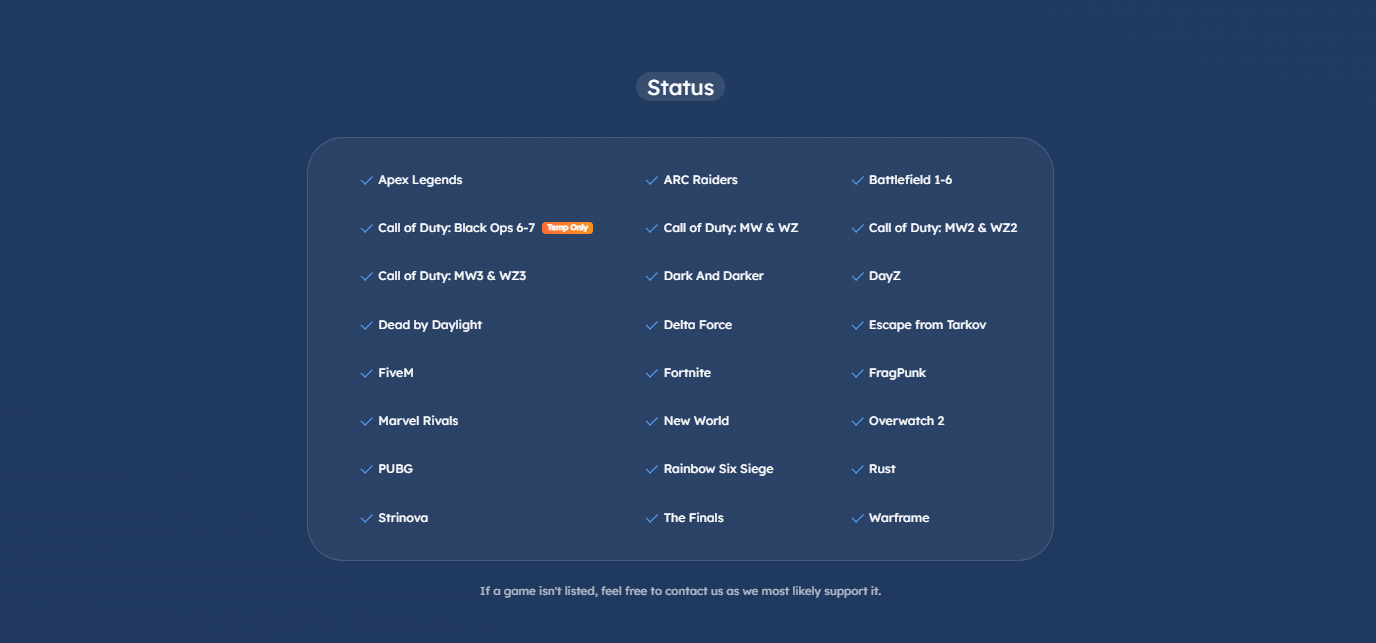
From my testing, it works flawlessly with Fortnite, Apex Legends, Call of Duty (Warzone & multiplayer), Rust, Escape from Tarkov, PUBG, Rainbow Six Siege, and a bunch more. They keep expanding the list too.
Detection Status
Undetected since launch. Let that sink in. Since 2021, Sync has maintained an undetected status. I've personally verified this across my own bans and through the community — I follow their Discord closely, and the track record is genuinely remarkable. Are there occasional hiccups where they temporarily pause support for a specific game during anti-cheat updates? Sure. But that's actually a good sign — it means they're cautious rather than reckless.
How I Used Sync Spoofer — My Process
Sync offers two spoofing modes, and I've used both extensively. Let me walk you through each one.
Temporary Spoof — The 30-Second Wonder
This is where Sync absolutely destroys the competition. The temporary spoof is fully automated — no manual steps, no BIOS changes, no Windows reinstall. Here's the entire process:
01 Downloaded the Sync spoofer from sync.top after purchasing a license and redeeming it on their Discord.
02 Ran the spoofer, entered my license key, and clicked "Clean" — this wipes cached anti-cheat data and prepares your system.
03 Restarted my PC as prompted.
04 Ran the spoofer again and clicked "Spoof".
That's it. Seriously. Four steps. About 30 seconds of actual work (plus the restart time). Every hardware identifier spoofed automatically — disk serials, motherboard serials, MAC addresses, SMBIOS data, the works. I launched the game on a new account and was playing within a minute. No other spoofer I've tested can match that speed.
The temporary spoof needs to be re-applied after each reboot, but with a process this fast, that's a non-issue. Click, restart, click, play. Takes less time than waiting for your game to load.
Permanent Spoof — The Deep Clean
For a more lasting solution, Sync also offers a permanent spoof. This one takes about 30 minutes and involves some manual steps on your end — but the serial changes persist forever, no re-spoofing needed.
01 Purchased the permanent spoof license from sync.top ($35) and redeemed it on their Discord server.
02 Opened a support ticket in Discord. A support agent monitors your spoof in real time throughout the process.
03 Ran the spoofer tool to change all hardware serials automatically.
04 Followed the manual steps on Sync's customer dashboard — specific to my hardware configuration. This included creating Windows installation media, disabling TPM in BIOS, permanently disabling Wi-Fi and Bluetooth, and reordering boot priority.
05 Reinstalled Windows fresh from USB. Sync provides a Windows license key if you need one — super clutch.
06 Ran the confirmation check to verify all serials were permanently changed.
The permanent spoof took me about 30 minutes. There's some manual work with the BIOS and Windows reinstall, but the Sync dashboard generates hardware-specific instructions for your exact components, so you're never guessing. And the support agent in your Discord ticket is watching the whole time in case you hit a snag.
Here's What I Got
With both modes, every single hardware identifier was changed. New disk serials, new motherboard serials, new MAC addresses, new SMBIOS data, TPM disabled. The anti-cheat saw my PC as a brand new machine. I created a new account, launched the game, and played for weeks without a single issue. That was 8 months ago — still going strong.
The temporary spoof is what I use 90% of the time now. It's just too fast and too easy. I only use the permanent spoof when I want a completely fresh start with zero traces — like when switching to a new game where I want the cleanest possible setup.
What I Loved
Temporary spoof takes 30 seconds — fully automated, no manual steps whatsoever
Permanent spoof is thorough and changes every identifier with hardware-specific instructions
Two spoofing modes give you flexibility — quick fix or deep clean
Exceptional real-time support via Discord tickets
20,000+ customers and 4.4/5 Trustpilot rating across verified reviews
Undetected since 2021 — five-year track record
The Catch
Permanent spoof requires USB drive, ethernet, and Windows reinstall (~30 min)
Temporary spoof needs re-applying after each reboot (but it takes 30 seconds so…)
Not the cheapest option available
ASUS boards occasionally need a slightly different process for permanent spoofs
No Vanguard support — Valorant players need to look elsewhere
Pricing
Single Permanent Spoof$35
Re-spoof (existing customer)$15
Unlimited Temporary Spoofs (monthly)from $40/mo
Unlimited Temporary Spoofs (lifetime)$500
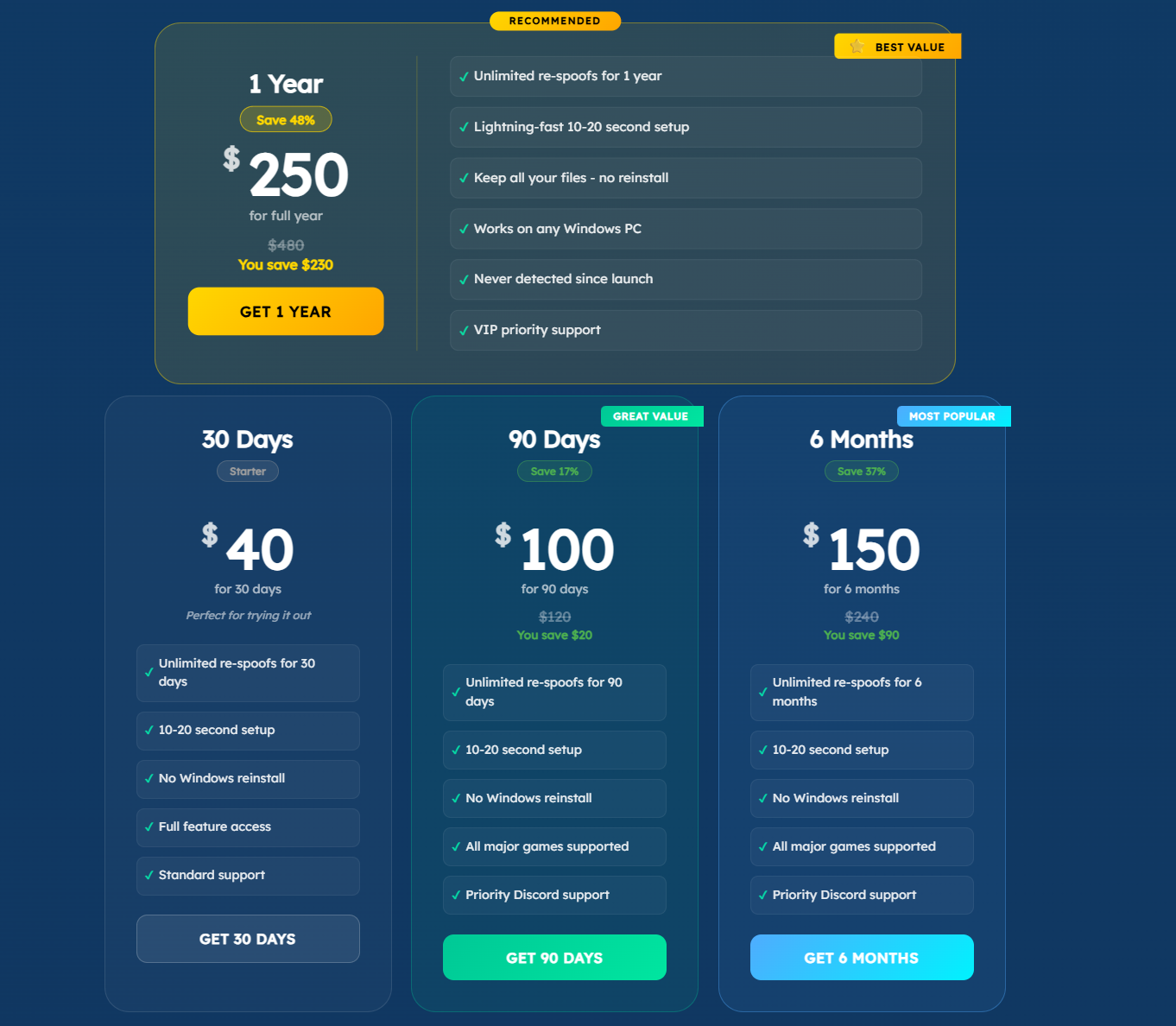
When I purchased my unlimited license, it was well worth it — I've used it 4 times across different games. This is my favorite investment because the per-spoof cost drops dramatically the more you use it.
How Does Sync Perform in 2026?
Just as dominant as ever. I re-tested it in March 2026 against the latest EAC and BattlEye updates — undetected. The team clearly stays ahead of anti-cheat patches. Their Discord shows consistent updates, and they temporarily pull support for games during major anti-cheat overhauls rather than risking their users' accounts. That level of caution is exactly what you want from a spoofer provider.
Is Sync Still the Best in 2026?
Everyone in the spoofing community knows Sync has been the gold standard since 2021. Five years of undetected status, 20,000+ satisfied customers, strong Trustpilot reviews, and a fully automated temporary spoof that takes 30 seconds — nothing else comes close. The permanent spoof option adds even more depth when you need it. The process is so polished it's basically become the benchmark that every other spoofer gets measured against. The only notable gap is the lack of Vanguard support — so if Valorant is your main game, you'll need to look at #2 on this list.
#2. TraceX by SlothyTech — The Free-But-Manual Contender
slothytech.com · Since 2021 · 150,000+ users · Free · Trustpilot 4.5/5
Now, I don't want you thinking there's no competition out there — because TraceX by SlothyTech has genuinely impressed me. It doesn't have Sync's fully automated process or its five-year reign at the top of every tier list, but it's carved out a strong reputation since launching in 2021. The big selling point? It's completely free. The catch? You'll be doing a lot of the work yourself.

What Is TraceX?
TraceX is SlothyTech's flagship HWID spoofing tool. Their angle? Making spoofing free — with the tradeoff being that you'll need to put in the work yourself. Where Sync's temporary spoof is fully automated and takes 30 seconds, TraceX requires 30-60 minutes of your time and a fair amount of manual configuration. The spoofer itself handles some things, but you'll be doing a lot of the heavy lifting — changing Windows settings, following step-by-step guides, configuring network components, and working through the process manually.
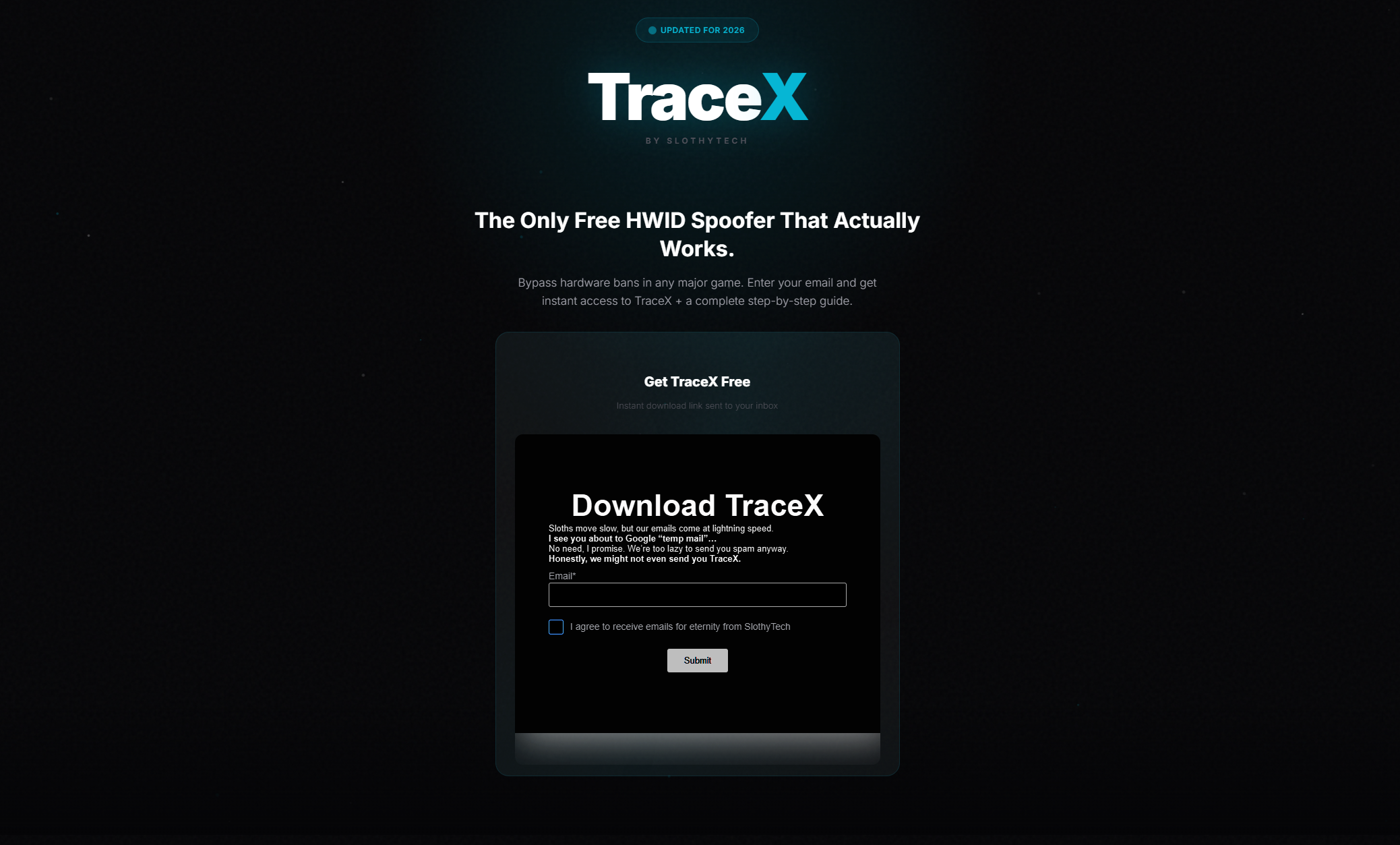
That's the deal: you're trading your time and effort for the fact that it's free. And honestly? For a free tool, the results are solid. But don't go in expecting the one-click experience that Sync offers — this is a very different beast.
I first heard about TraceX from a forum recommendation. Someone said, "Try TraceX — it's free and it works." They were right on both counts. What they didn't mention was the hour I'd spend following manual instructions.
Supported Games
TraceX supports EasyAntiCheat, BattlEye, Ricochet, and Vanguard — making it the most broadly compatible spoofer on this list in terms of anti-cheat coverage. Their confirmed game list includes Fortnite, Apex Legends, Rust, PUBG, Escape from Tarkov, Call of Duty: Warzone, Valorant, Dead by Daylight, and over 50 others.

That Vanguard support is a big deal. If Valorant is your main game, TraceX is one of the few options that claims to handle it — and in my testing, it worked. Sync doesn't support Vanguard at all, so this is where TraceX has a genuine edge.
Detection Status
Undetected as of my last test in April 2026. TraceX has maintained a clean detection record since its launch in 2021. That's roughly 5 years of operation — matching Sync's longevity. I haven't personally experienced a re-ban using TraceX, and the community feedback backs this up.
SlothyTech runs a status page on their website that updates within hours of any anti-cheat patch, which I appreciate. Transparency goes a long way.
How I Used TraceX — My Process
Here's where you'll feel the difference between free and paid. TraceX has a tool that changes your HWIDs, but there's a lot of manual work surrounding it that you need to do yourself.
01 Downloaded TraceX directly from SlothyTech's website. No purchase required — TraceX is completely free. The only associated cost is a NordVPN subscription (around $2-3/month) that's required for the network spoofing component.
02 Ran the TraceX spoofer tool to change my hardware IDs — disk serials, motherboard serials, SMBIOS data, MAC addresses, and GPU identifiers. This part is automated and takes a few minutes.
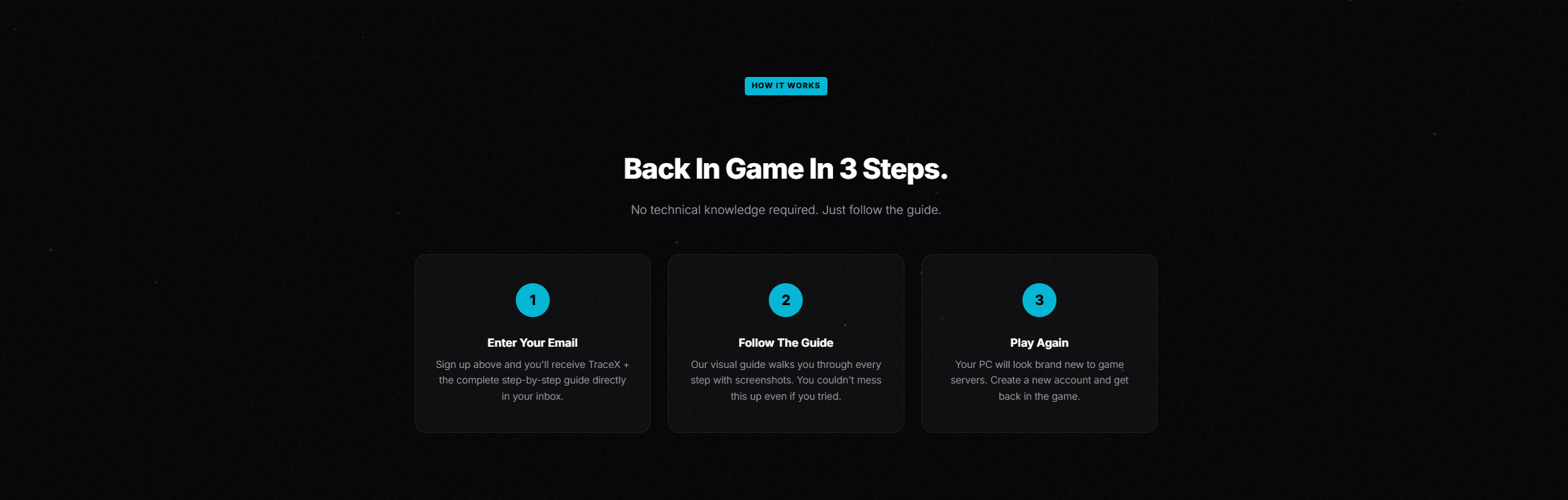
03 Now the manual work begins. TraceX provides a set of instructions that you need to follow step by step. This includes manually configuring Windows settings, cleaning specific registry entries, disabling certain system components, and setting up the NordVPN connection for network identity spoofing.
04 Manually disabled TPM in my BIOS following TraceX's guide. Had to find the correct BIOS menu for my specific motherboard — this alone took 10 minutes of googling since TraceX's guide is more generic than Sync's hardware-specific instructions.
05 Went through additional Windows cleanup steps — clearing traces, removing cached anti-cheat data, and verifying that all the manual changes took effect correctly.
06 Rebooted and ran TraceX's verification to confirm the spoof was complete.
Total time from download to playing? About 45 minutes on my first attempt, and that's without doing the optional Windows reinstall. When I did the reinstall for extra safety, it pushed closer to 60 minutes. Compare that to Sync's 30-second temporary spoof — the time difference is massive. But then again, I paid $0 for TraceX, so there's the tradeoff.
The manual work isn't incredibly difficult, but it does require you to be comfortable navigating BIOS menus, editing Windows settings, and following technical instructions carefully. If you're the kind of person who'd rather just click a button and be done — Sync is the better choice even at $40/month. If you don't mind rolling up your sleeves and have an hour to spare, TraceX gets the job done for free.
Here's What I Got
All major identifiers spoofed. The verification showed clean new serials across the board. I launched Apex on a new account and played for 6 weeks straight — no issues. Moved to Rust after that. Also clean. The end result is comparable to what Sync delivers — it's the journey to get there that's very different. An hour of manual work vs. 30 seconds of clicking a button.
What I Loved
Completely free — only cost is a NordVPN sub (~$2-3/mo) for network spoofing
Supports Vanguard (Valorant) — Sync doesn't
50+ supported games across all major anti-cheats
End result is solid — clean serials across the board
150,000+ users and 4.5/5 Trustpilot rating
The Catch
Requires 30-60 minutes of manual work — BIOS changes, Windows configuration, registry cleanup
Not automated like Sync — you're doing most of the work yourself
Instructions are more generic, not hardware-specific like Sync's dashboard
Optional Windows reinstall recommended for best results (adds more time)
NordVPN requirement may feel like a hidden cost for some users
Pricing
TraceX HWID Spoofer: FREE
NordVPN (required for network spoofing)~$2-3/mo
The tradeoff is crystal clear: you pay with your time instead of your wallet. With Sync, you pay $40/month and get a 30-second fully automated spoof. With TraceX, you pay $0 and spend 30-60 minutes doing manual work. For some people that's an obvious choice — especially if you're only dealing with one ban and have the patience for it.
How Does TraceX Perform in 2026?
Really well — once you get through the setup. SlothyTech has been pushing consistent updates throughout 2025 and into 2026. Detection status remains clean, and with over 50 supported games including Vanguard, the anti-cheat coverage is actually broader than Sync's.
Is it catching up to Sync? In terms of results — arguably yes. In terms of user experience — not even close.
Sync's temporary spoof takes 30 seconds with zero manual work. TraceX takes 30-60 minutes of hands-on configuration. The end result might be similar, but how you get there couldn't be more different. Sync is a premium automated experience; TraceX is a DIY project that happens to be free.
A-TIER - Excellent results if you're willing to put in the work. Free but far from effortless.
#3. PokeSpoof — The Budget Dark Horse
Since early 2025 · ~3,000 Discord members · EAC & BattlEye only
Alright, here's where things get interesting. PokeSpoof is the newest name on this list — they launched in early 2025 — and I'll be real, I almost didn't include them. After testing it personally over the last 4 months, I have mixed feelings. It does some things right for the price, but it's clearly a step below the top 2 in almost every meaningful way.
What Is PokeSpoof?
PokeSpoof is a lightweight HWID spoofer built by a small independent team. Their pitch is simple: reliable spoofing at a price that won't make you wince. They don't have Sync's years of development or TraceX's polish (or TraceX's free price tag, for that matter), but what they do have is a lean, focused tool that handles some of the fundamentals.
I stumbled across PokeSpoof on a spoofing forum where someone posted their results — 3 months unbanned on Fortnite using a $15 spoof. I was skeptical. Super skeptical. But $15 is lunch money, so I figured why not test it myself.
Supported Games
PokeSpoof currently supports EasyAntiCheat and BattlEye games only. Their confirmed list includes Fortnite, Apex Legends, Rust, PUBG, Dead by Daylight, Halo Infinite, and The Finals.
No Ricochet support (so no Call of Duty), and no Vanguard support (no Valorant). That's a significantly smaller game roster than both Sync and TraceX. If your game isn't on the list, you're out of luck — and that list is pretty short compared to TraceX's 50+ supported titles.
Detection Status
Undetected as of my testing in April 2026. Now, I need to be transparent — PokeSpoof has only been around since early 2025. That's roughly 15 months of undetected status. Not bad for a newer tool, but it's a fraction of the track records that Sync and TraceX have built over 5 years each.
There was one brief scare in November 2025 where some users reported delayed bans on Rust. PokeSpoof acknowledged it within 24 hours, paused Rust support, patched their driver within a week, and resumed. Nobody who followed the process correctly post-patch reported issues. I respect how they handled it — but it's still a mark on the record that neither Sync nor TraceX have.
How I Used PokeSpoof — My Process
01 Purchased a license from their website. $15 for a single spoof. Cheapest paid option I've ever tested — though TraceX being free obviously beats it on price.
02 Downloaded the PokeSpoof client from their site. It's a simple executable — no Discord server required for the download, though they do have a Discord for support.
03 Ran the client. Entered my license key. The interface is... basic. Functional, but definitely not winning any design awards. Think early-2010s utility software aesthetic. Jokes apart, it gets the job done — barely.
04 Selected my target anti-cheat (EAC) and hit "Spoof." The tool ran for about 45 seconds, then prompted a reboot.
05 After reboot, ran PokeSpoof's verification tool. It confirmed serial changes for disk drives, motherboard, SMBIOS, and ethernet MAC address.
Total time? Less than 15 minutes. No Windows reinstall. No BIOS changes. No TPM disabling. Just... quick and dirty. And that "quick and dirty" part is both the appeal and the problem.
Here's What I Got
Serials changed across the main identifiers. Hopped on Fortnite with a new account. Played for 3 months — no ban. Moved to Apex Legends. Played for 6 weeks. Still clean. For $15 and 15 minutes of effort, that's a decent result — though I'd feel a lot more confident with Sync's or TraceX's more thorough approach.
What I Loved
Fastest process — under 15 minutes, zero complexity
No Windows reinstall, no BIOS changes required
Decent for what it is on EAC/BattlEye games
The Catch
Doesn't handle TPM, Wi-Fi, or Bluetooth at all
No hardware scanning — no visibility into what's being changed
No Ricochet (Call of Duty) or Vanguard (Valorant) support
November 2025 Rust detection incident — neither Sync nor TraceX have had comparable events
Costs money when TraceX is free and more thorough
Bare-bones UI with minimal feedback
Only ~15 months of track record
Old banned installation traces remain on your drive
Pricing
Single Spoof $15
3-Spoof Pack $35
Unlimited Monthly $25/mo
Here's the thing — Sync's temporary spoof takes 30 seconds and is fully automated, and TraceX is free with more game support. So PokeSpoof's pricing, while cheap in absolute terms, is actually harder to justify when you can either pay a bit more for a vastly superior automated experience (Sync) or pay nothing for a more thorough manual process (TraceX). PokeSpoof sits in a no-man's land between the two.
How Does PokeSpoof Perform in 2026?
It's... fine. The team has been pushing updates every 2-3 weeks, which is faster than most competitors. They added 3 new games to their supported list in Q1 2026, and the Rust detection issue from November 2025 was resolved quickly. But "fine" is a far cry from the confidence I feel with Sync or TraceX.
I wouldn't call it battle-tested yet. It's more like battle-curious.
Is PokeSpoof Worth It in 2026?
Honestly? It's a tough sell. Sync's temporary spoof is faster (30 seconds vs. 15 minutes), more thorough, and fully automated — yes it costs more, but the experience is incomparable. TraceX is free, covers more games, has a better track record, and does a more thorough job — yes it requires manual work, but at least you're not paying $15-25 for a lesser product. PokeSpoof sits in an awkward middle ground: not as fast as Sync, not as free as TraceX, not as thorough as either.
Would I trust it as my only spoofer long-term? Absolutely not. It earns a spot on this tier list for doing the basics right, but it's clearly in third place by a wide margin.
C-TIER Gets the basics done, but falls short of the top 2 in every category that matters.
Final Verdict — Best HWID Spoofers in 2026 Tier List
After 14 months, 7 spoofers tested, and more Windows reinstalls than any sane person should endure — here's my definitive ranking for the best HWID spoofers in 2026.
Sync Spoofer is still the best. Full stop. It's been the best since 2021 and nothing in 2026 has changed that. The temporary spoof takes 30 seconds — fully automated, no manual work, no BIOS changes, no reinstalls. Just download, clean, restart, spoof, play. Nothing else on the market comes close to that speed and simplicity. The permanent spoof option adds even deeper protection when you need it. 20,000+ customers, flawless detection record, exceptional support. The only gap is no Vanguard support — if Valorant is your main game, TraceX has you covered. Sync is S-Tier for a reason.
TraceX by SlothyTech is the best free alternative — and for Valorant players, it's actually the best choice, period. But "free" comes with a cost: 30-60 minutes of manual configuration work every time you spoof. You'll be navigating BIOS menus, editing Windows settings, and following step-by-step guides yourself. The end result is solid, the anti-cheat coverage is the widest on this list, but the user experience is a world apart from Sync's one-click automation. If you don't mind the manual labor and you're on a budget, TraceX won't let you down. Solid A-Tier.
PokeSpoof is the bare-bones option that does the minimum. At $15-25, it's quick and simple for EAC and BattlEye games — but with Sync offering 30-second automated spoofs and TraceX being free, PokeSpoof's value proposition is paper-thin. It's not as proven, not as thorough, and covers fewer games than both competitors. C-Tier — it works, but there's almost always a better option.
If I can do it, so can you. Pick the spoofer that matches your needs, follow the instructions carefully — and you'll be back in-game before you know it.
Best HWID Spoofer For Use Case
Best overall: Sync Spoofer— fully automated, 30-second temporary spoof, best support, most reliable
Best for beginners: Sync Spoofer— zero manual steps with temporary spoof, just click and play
Best for Valorant & League of Legends: TraceX by SlothyTech— the only option on this list with confirmed Vanguard support
Best for multiple games: Sync Spoofer (unlimited plan)— widest anti-cheat support among paid options, 30-second re-spoofs
Best for max security: Sync Spoofer (permanent)— Windows reinstall and BIOS-level modifications leave zero traces
Best for speed: Sync Spoofer (temporary)— 30 seconds, fully automated, nothing else comes close
Best for Call of Duty: Sync Spoofer or TraceX— both support Ricochet, PokeSpoof doesn't
Best budget option: TraceX by SlothyTech— free, but requires 30-60 minutes of manual work per spoof
That's my honest breakdown of the best HWID spoofers in 2026. I've put real hours, real money, and real Windows reinstalls into this tier list — so I hope it saves you from the trial-and-error I went through. If you've got questions, drop them in the comments. And if you do pick one of these tools — follow the instructions carefully. Every step matters. Good luck out there.

Join MILAGROS on Peerlist!
Join amazing folks like MILAGROS and thousands of other builders on Peerlist.
0
1
0