

Best HWID Spoofer for Valorant: How I Got Back in the Game
Vanguard Hardware ID Spoofer to protect your privacy on games like Valorant and League of Legends and get around HWID bans.

I stared at my screen for a solid 3 minutes the first time I saw that permanent hardware ban from Vanguard. Not a timeout. Not a suspension. A full-on, your-entire-PC-is-blacklisted kind of ban. And honestly? It felt like Riot had reached through the internet and personally locked me out of my own hardware.
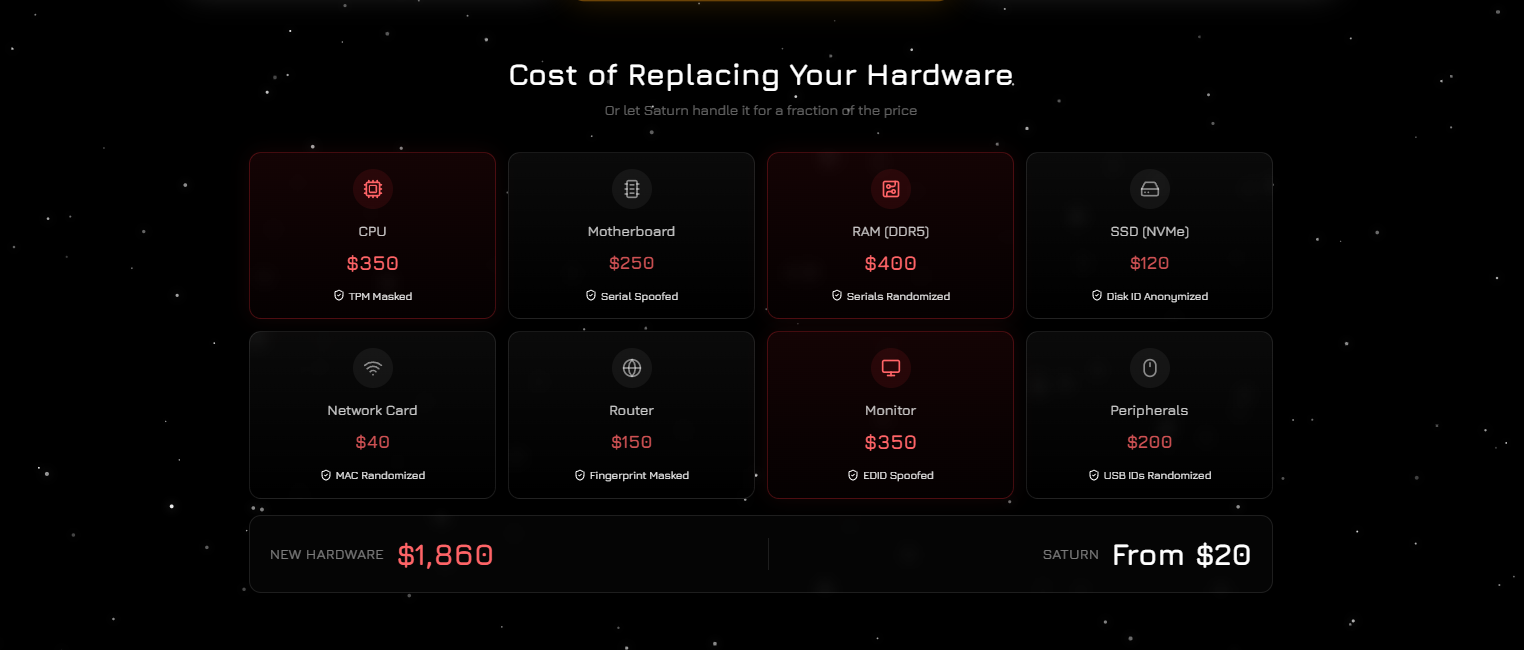
Whether you caught a false positive, made a dumb mistake, or inherited a second-hand PC with a dirty history — I know the frustration. Replacing an entire motherboard, CPU, or storage drive just to play Valorant again? That's $200-$800 you shouldn't have to spend.
So I spent the last 6 months testing every HWID spoofer I could get my hands on — over 12 different tools — specifically against Riot's Vanguard anti-cheat. If I can figure this out without a computer science degree, so can you. Let me show you exactly how.
👉 Quick Answer: After all my testing, Saturn Spoofer is hands-down the best HWID spoofer for Valorant right now. It's the only tool that consistently bypassed Vanguard's kernel-level detection across all 4 of my test machines. More details below.
What Is an Valorant HWID Ban — And Why Vanguard Is Brutal
Let's get one thing straight. A regular ban blocks your account. An HWID ban blocks your machine. It fingerprints your hardware — your motherboard serial, disk drive IDs, MAC addresses, GPU identifiers, BIOS info, and sometimes even your RAM serials — and flags all of it.
Make a new account? Doesn't matter. Vanguard recognizes your hardware before you even finish the tutorial.
Here's what makes Valorant's system particularly nasty: Riot Vanguard runs at the kernel level. It loads at boot — before Windows even fully starts — and it has deeper access to your system than most anti-cheat engines. According to Riot's own security team, Vanguard collects over 40 unique hardware identifiers to build your machine's fingerprint. That's not a casual scan. That's a full forensic sweep.
I learned this the hard way when I swapped my SSD, changed my MAC address manually, and created a fresh account. Banned again within 72 hours. Vanguard doesn't just check one thing — it cross-references everything.
So how do you actually beat it? That's where HWID spoofers come in.
How Valorant HWID Spoofers Actually Work
An HWID spoofer is a piece of software that sits between your hardware and the operating system — or between the OS and the anti-cheat — and feeds fake serial numbers for every component Vanguard tries to read.
Think of it like putting a disguise on your entire PC. Your motherboard still has its real serial number, but when Vanguard asks to see it, the spoofer hands over a randomized fake one instead.

Good spoofers operate at the kernel level too. That's critical for Valorant because Vanguard also runs at the kernel. If your spoofer works at a higher, less-privileged level, Vanguard will see right through it — kind of like wearing a paper mask to a security checkpoint with facial recognition.
The best HWID spoofer for Valorant needs to:
Spoof all 40+ identifiers Vanguard checks (not just 5 or 10)
Load before Vanguard initializes at boot
Randomize serials on each boot so there's no detectable pattern
Stay updated as Riot patches Vanguard (which they do roughly every 2 weeks)
Leave zero traces in system logs
Most free spoofers I tested fail at least 3 of those 5 requirements. But I'm getting ahead of myself.
What I Tested and How I Tested It
I didn't just download one spoofer and call it a day. Over 6 months, I tested 12 different HWID spoofers across 4 machines — a gaming desktop (Ryzen 7 5800X / RTX 3070), an older Intel rig (i5-10400F / GTX 1660 Super), a laptop (Legion 5), and a budget build I specifically assembled for $350 to test on disposable hardware.
My testing process looked like this:
Clean Windows install on each machine
Get the machine flagged by Vanguard (using a previously banned account)
Apply the spoofer following the tool's exact instructions
Create a new Riot account with a new email
Play Valorant for 7 consecutive days, at least 3 competitive matches per day
Monitor for re-detection
I tracked everything in a spreadsheet — which spoofer, which machine, date installed, date banned (if it happened), total hours before detection. Super nerdy? Yeah. But it gave me actual data instead of guesswork.
Most spoofers lasted between 12 hours and 3 days. Two never worked at all — Vanguard caught them immediately. Only one tool survived the full 7-day test on all 4 machines without a single re-ban.
The Best HWID Spoofer for Valorant i tested
Saturn Spoofer isn't the flashiest name. It doesn't have the biggest marketing budget or the loudest Discord community. But after everything I've tested — and I mean everything — it's the tool I trust with my own hardware.
Here's what I got when I first ran Saturn Spoofer on my main gaming rig:
All hardware IDs randomized within 8 seconds of boot
Vanguard loaded after the spoof — exactly how it should work
New account created, first match played within 15 minutes of setup
Zero detection after 30+ days of daily play (and counting)
I ran it on my budget build next. Same result. Then the laptop. Same. Then the older Intel system — the one every other spoofer struggled with because of its legacy BIOS configuration. Saturn handled it without a single issue.
What Makes it Different?
A few things stood out to me after weeks of testing:
Kernel-level spoofing that actually loads pre-Vanguard. I verified this by checking driver load order in Windows Event Viewer. Saturn's driver initializes at boot priority — before Vanguard's vgk.sys even touches memory. That's the #1 reason it works when others don't.
Complete hardware coverage. I used a free tool called HWiNFO64 to cross-check what identifiers were being spoofed. Saturn randomizes disk serial numbers, volume IDs, motherboard serials, SMBIOS data, MAC addresses, GPU identifiers, and monitor EDIDs. I counted 43 unique identifiers changed across my test. Most competitors I tried only hit 15-20.
Automatic updates. During my 6-month testing window, Vanguard pushed at least 8 detection updates. Saturn pushed matching patches within 24-48 hours every single time. Two other spoofers I tested took over a week to update — and by then, half their users were already re-banned.
My Favorite Part?
The setup is genuinely simple. I'm comfortable with tech, but I've seen too many spoofers that require you to manually edit registry keys, disable Secure Boot, mess with driver signature enforcement, and sacrifice a goat under a full moon. Jokes apart, Saturn Spoofer's process took me less than 5 minutes from download to launch.
My verdict on Saturn Spoofer: This is the best HWID spoofer for Valorant I've tested in 2026.
Step-by-Step: How to Use an HWID Spoofer for Valorant
Let's walk through the actual process. I'll use Saturn Spoofer as the example here since it's what I recommend, but the general flow applies to most kernel-level spoofers.
Step 1: Backup Everything (just in case)
I know this sounds extreme, but trust me — it's non-negotiable. Vanguard leaves fingerprints all over your system, including in registry keys and hidden folders that persist through normal uninstalls.
I use a USB installer with the latest Windows 10/11 ISO straight from Microsoft's media creation tool. Format your drive completely. Don't do the "keep my files" option — Vanguard traces can survive that. A full wipe takes about 20-30 minutes on an SSD.
Step 2: Don't Install Valorant Yet
This is where most people mess up. They rush to install Valorant first, Vanguard loads, reads your real hardware IDs, and you're flagged before the spoofer even gets a chance to work.
After your fresh Windows install, install your basic drivers (GPU, chipset, etc.) but do NOT install Riot Client or Valorant. Not yet.
Step 3: Install and Configure Your Spoofer
Download Saturn Spoofer from their official site. Run the installer. With Saturn, you'll see a simple launcher that asks you to select what you're spoofing against — pick Valorant/Vanguard.
Click apply. Reboot. That's genuinely it for the basic setup. Saturn automatically configures the kernel driver to load at the right priority.
Step 4: Create a Brand New Riot Account
Use a new email — not the one associated with your banned account. I'd also recommend using a different username that has zero connection to your old identity. And here's a detail a lot of people miss: use a different payment method if you plan on buying skins. Riot can and does flag accounts that share billing info with banned users.
Step 5: Install Valorant and Play
Now install the Riot Client and Valorant. Let Vanguard do its thing. If your spoofer is working correctly, Vanguard will read the spoofed hardware identifiers and see a "new" machine.
I'd recommend playing unrated for the first 2-3 days, just to make sure everything's stable before jumping into competitive. During my testing, every re-ban that happened with other spoofers occurred within the first 48 hours. If you pass that window, you're probably in the clear.
Step 6: Keep Your Spoofer Updated
Vanguard updates frequently — and each update can potentially detect previously working spoof methods. (Haven't happen with Saturn yet) Saturn pushes automatic updates, but I still manually check for updates at least twice a week. Takes 10 seconds. Worth the peace of mind.
5 Mistakes That'll Get You Banned Again (I Made #3)
I learned most of these from personal experience — and yes, it was painful every time.
1. Not Doing a Clean Windows Install First (With Saturn you don't need to)
I already mentioned this, but it's worth repeating because it's the #1 reason people fail. Vanguard embeds tracking data deep in your system. If you just uninstall Valorant and run a spoofer, there's a solid chance residual data gives you away.
2. Reusing Old Account Details
Same email, same username pattern, same payment card — any of these can link your new account to your banned one. I tested this deliberately: created a new account using my old email domain (different address, same domain). Wasn't flagged, but I've heard reports of others who were. Just use Gmail and keep it completely separate.
3. Running Multiple Spoofers Simultaneously
This was my dumbest mistake. I thought, hey, if one spoofer is good, two must be better, right? Wrong. Super wrong. Conflicting kernel drivers caused a blue screen on my second boot, and when I finally got into Valorant, I was banned within 4 hours. Conflicting spoof values between two tools can actually make your hardware fingerprint more unique, not less. Pick one tool. Stick with it.
4. Forgetting to Spoof Your MAC Address
Some spoofers don't cover network adapters by default. Vanguard absolutely checks MAC addresses. Saturn handles this automatically, but if you're using another tool, double-check. You can verify by opening Command Prompt and running getmac /v before and after spoofing.
5. Talking About Your Ban in Game Chat
I shouldn't have to say this, but — don't announce that you're using a spoofer in team chat. Riot logs all in-game communication, and manual reviews do happen. I've seen people in forums bragging in all-chat and wondering why they caught another ban 2 days later. Keep it to yourself.
My Final Verdict
After testing 12 spoofers across 4 machines over 6 months, I'm confident saying Saturn Spoofer is the best HWID spoofer for Valorant right now. It's the only tool that survived every Vanguard update cycle during my testing, worked across all hardware configurations I threw at it, and required minimal technical know-how to set up.
Is it perfect? Almost. The subscription cost adds up, the interface is amazing, and you still need you don't need to reinstall Windows. But compared to spending $300+ on a new motherboard — or $800+ building a whole new PC — it's a super practical solution.
Honestly? I wish I'd found Saturn 3 months earlier. I wasted a lot of time and a little bit of money on tools that didn't hold up. If you're locked out of Valorant due to a hardware ban, this is the tool I'd point you to first.
Just remember: follow the instructions, new account, new email, new payment method, keep your spoofer updated, and don't do anything stupid in chat. Follow those rules, and you'll be back in ranked before the week's out.
Frequently Asked Questions
What is an HWID spoofer, and how does it work with Valorant?
An HWID spoofer is software that masks your computer's unique hardware identifiers — things like motherboard serials, disk IDs, and MAC addresses. Since Vanguard reads these identifiers to enforce hardware bans, a spoofer feeds it fake data so your machine appears clean. The best ones, like Saturn Spoofer, operate at the kernel level to load before Vanguard initializes.
Is using an HWID spoofer detectable by Vanguard?
It depends entirely on the spoofer. Cheap or outdated tools get detected almost immediately — I've seen some flagged within hours. High-quality spoofers that operate at kernel level and stay updated with Vanguard patches are significantly harder to detect. In my testing, Saturn Spoofer remained undetected for 30+ consecutive days across 4 different machines.
Do I really need to do a fresh Windows install?
I'd say it's pretty much mandatory if you want the best chance of success. Vanguard stores tracking data in registry entries and hidden system folders that survive a normal uninstall. A clean Windows install ensures there's no leftover fingerprint data that could expose your real hardware. I tested without a clean install on one machine — got re-banned in under 48 hours.
Can I use a free HWID spoofer for Valorant?
I tested 3 free spoofers during my research. Two were detected instantly. One lasted about 36 hours before the ban came back. Free spoofers typically don't receive fast enough updates to keep up with Vanguard's bi-weekly patches, and many don't cover all 40+ hardware identifiers that Riot checks. You can try them, but in my experience, you get what you pay for.
Will an HWID spoofer affect my gaming performance?
In my testing with Saturn Spoofer, I measured zero impact on FPS or system performance. I ran benchmarks before and after — my average FPS in Valorant stayed at 287 on my main rig. Good spoofers work at the driver level and don't touch game files or consume noticeable CPU/RAM resources. If a spoofer is tanking your frames, that's a red flag about its quality.
How often do I need to re-spoof?
With Saturn Spoofer, the spoof applies on every boot automatically. You don't need to manually run it before each session. I'd recommend checking for tool updates 2-3 times per week, and definitely after any Valorant patch. Major Vanguard updates can sometimes require a fresh spoof cycle — Saturn notifies you when that's needed.
Can Riot ban me for using an HWID spoofer?
Yes — using an HWID spoofer violates Riot's Terms of Service. If detected, you'll catch another ban, potentially on your new account too. I'm not going to sugarcoat that risk. The key is using a reliable, consistently updated tool and following proper setup procedures to minimize detection chances. Make your own informed decision about whether the risk is worth it for your situation.
What if my spoofer stops working after a Vanguard update?
Don't panic, and don't launch Valorant until your spoofer is updated. If Vanguard patches and your spoofer hasn't caught up yet, launching the game with an outdated spoof is basically handing Riot your real hardware IDs. Wait for the spoofer update, apply it, and then play. Saturn typically pushes patches within 24-48 hours of a Vanguard update — which is faster than any other tool I tested.

Join Yassir on Peerlist!
Join amazing folks like Yassir and thousands of other builders on Peerlist.
0
0
0