

12 Resume Rules Every Developer Should Know
75% of resumes get filtered out before a human ever reads them. Here are the rules that actually matter.
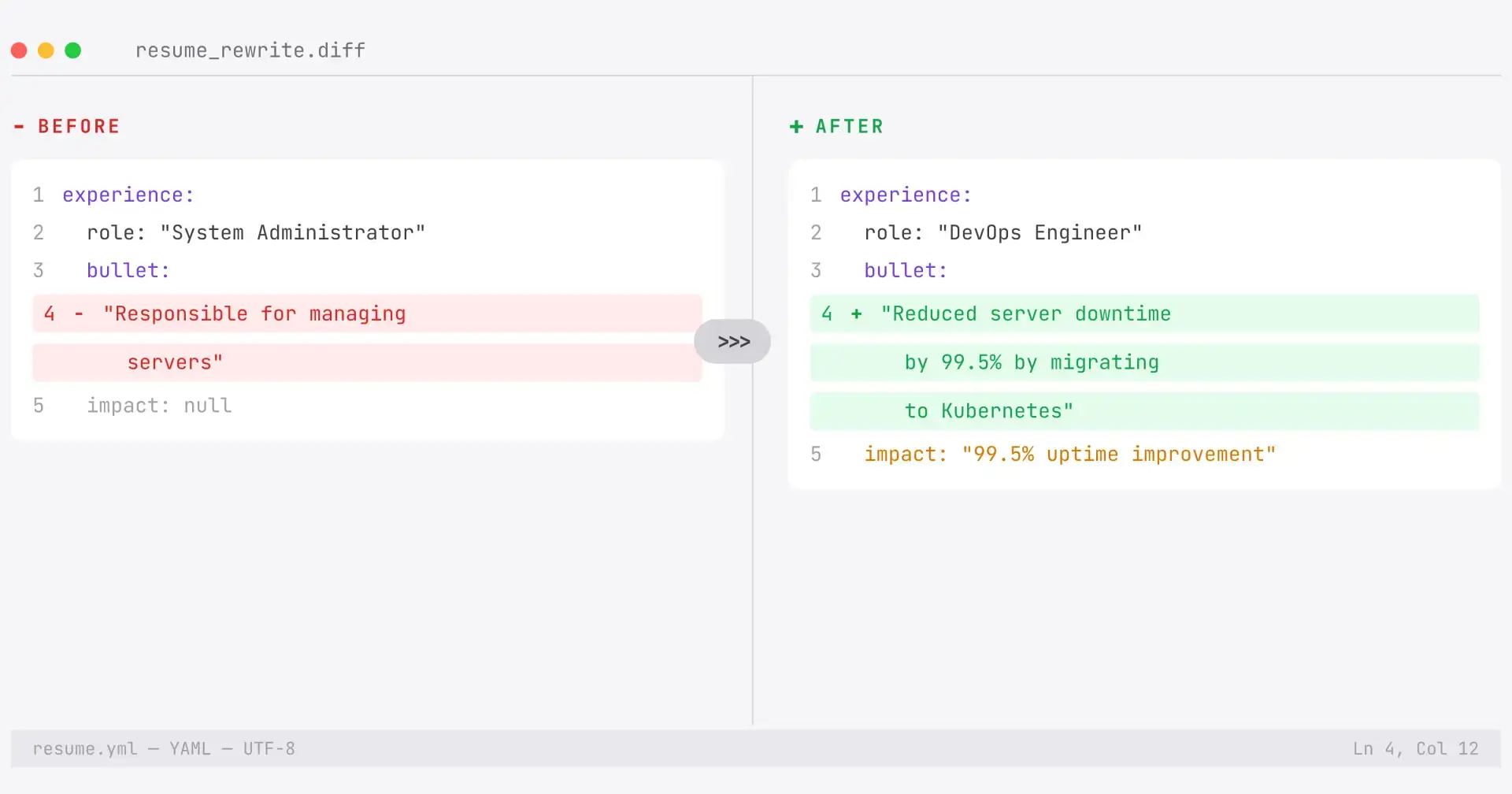
75% of resumes get filtered out before a human ever reads them (Resume Genius, 2026). Not because the candidate wasn't qualified — because the resume was poorly structured.
I've reviewed a lot of developer resumes over the past couple of years — for hiring, for friends, for people who asked on Twitter. The same mistakes keep showing up. Here are the 12 rules that matter most.
Content: What to Write
1. Don't list skills that are the minimum expectation
Git. VS Code. Terminal. Jira. Every developer knows these. Listing them is like a chef putting "knows how to use a knife" on their resume. If every junior dev uses it on day one, leave it off.
2. Don't quantify your skill level
Those "JavaScript: 4/5" or "React: ████░" progress bars? They mean nothing. What does a 3/5 even mean? You know the syntax but can't debug? There's no standard. Drop the bars.
3. Only list skills you want to be asked about
Everything on your resume is fair game in an interview. Listed Docker? You might get asked about multi-stage builds and compose orchestration. If you can't hold a 5-minute conversation about it, don't put it there.
4. Quantify the impact of your work
75% of hiring managers look for quantifiable achievements (Resume Genius, 2026). Yet 36% of resumes contain zero measurable metrics (Cultivated Culture, 2025).
Before: "Used esbuild to reduce build times."
After: "Saved 40 hours per engineer per month by migrating from Webpack to esbuild, reducing CI build times from 12 minutes to 90 seconds."
Don't have exact numbers? Estimate. "Approximately 40%" is infinitely better than nothing.
5. Use strong action verbs
Recruiters spend 6-8 seconds on an initial scan. The first word of each bullet is the only word guaranteed to be read.
Before: "Made the endpoint faster using caching."
After: "Decreased API response time by 70% by implementing Redis caching on high-traffic endpoints."
"Made" describes an activity. "Decreased" describes impact. Use: Architected, Automated, Debugged, Deployed, Eliminated, Engineered, Launched, Migrated, Optimized, Refactored, Scaled, Spearheaded.
6. Use the XYZ formula
Google's hiring team created this: "Accomplished X, as measured by Y, by doing Z."
Before: "Worked on the authentication system."
After: "Reduced authentication failures by 35% (from 12K to 7.8K monthly) by migrating from session-based auth to JWT with refresh token rotation."
More examples:
• "Reduced infrastructure costs by $4K/month by containerizing 8 microservices and migrating from EC2 to ECS Fargate."
• "Improved test coverage from 45% to 92% across 3 services by implementing integration tests with Testcontainers."
7. Weave keywords into bullet points
Don't dump your tech stack in a separate "Skills" block. When you list "React, Node.js, PostgreSQL" separately, recruiters don't know how you used them.
Before: Skills: React, TypeScript, GraphQL, AWS
After: "Migrated legacy REST API to GraphQL, reducing frontend data-fetching by 60% and eliminating 12 redundant endpoints across React and React Native clients."
The keyword is contextualized. ATS catches it. Humans understand it. Both win.
Format: How It Should Look
8. Keep it to one page
One page forces you to prioritize your strongest work. The ideal resume is 475-600 words — 77% fall outside that range (Cultivated Culture, 2025). For 95% of developers, one page is the rule.
9. No personal photo or avatar
In the US, UK, and Canada — leave it off. It introduces unconscious bias before the recruiter reads a single bullet. Your work samples say more than a headshot.
10. Always submit as PDF
A .docx might render differently on the recruiter's machine — fonts shift, margins break, columns collapse. PDF locks your layout. Every time.
11. Reverse chronological order
Most recent job first. 72% of recruiters say inconsistent formatting weakens an application (StandOut CV, 2026). Functional resumes often read like you're hiding gaps.
12. Don't list non-higher education
Nobody cares about your high school. If you're self-taught with bootcamp experience, list the bootcamp. Same goes for irrelevant certifications — keep education to 2-4 lines.
These 12 rules are inspired by The Engineer's Resume Checklist — a community-curated Notion doc with 24 rules total. These are the ones developers mess up most.
If you want a resume builder that enforces clean formatting, consistent spacing, and PDF export by default — try ResumeFreePro. Free, no watermarks.
Your code is clean. Your resume should be too.

Join Abhay on Peerlist!
Join amazing folks like Abhay and thousands of other builders on Peerlist.
0
5
0