

How to Detect an AI Attractiveness Test Using AI? (Complete Guide for 2026)
Discover How Attractive You Are With AI
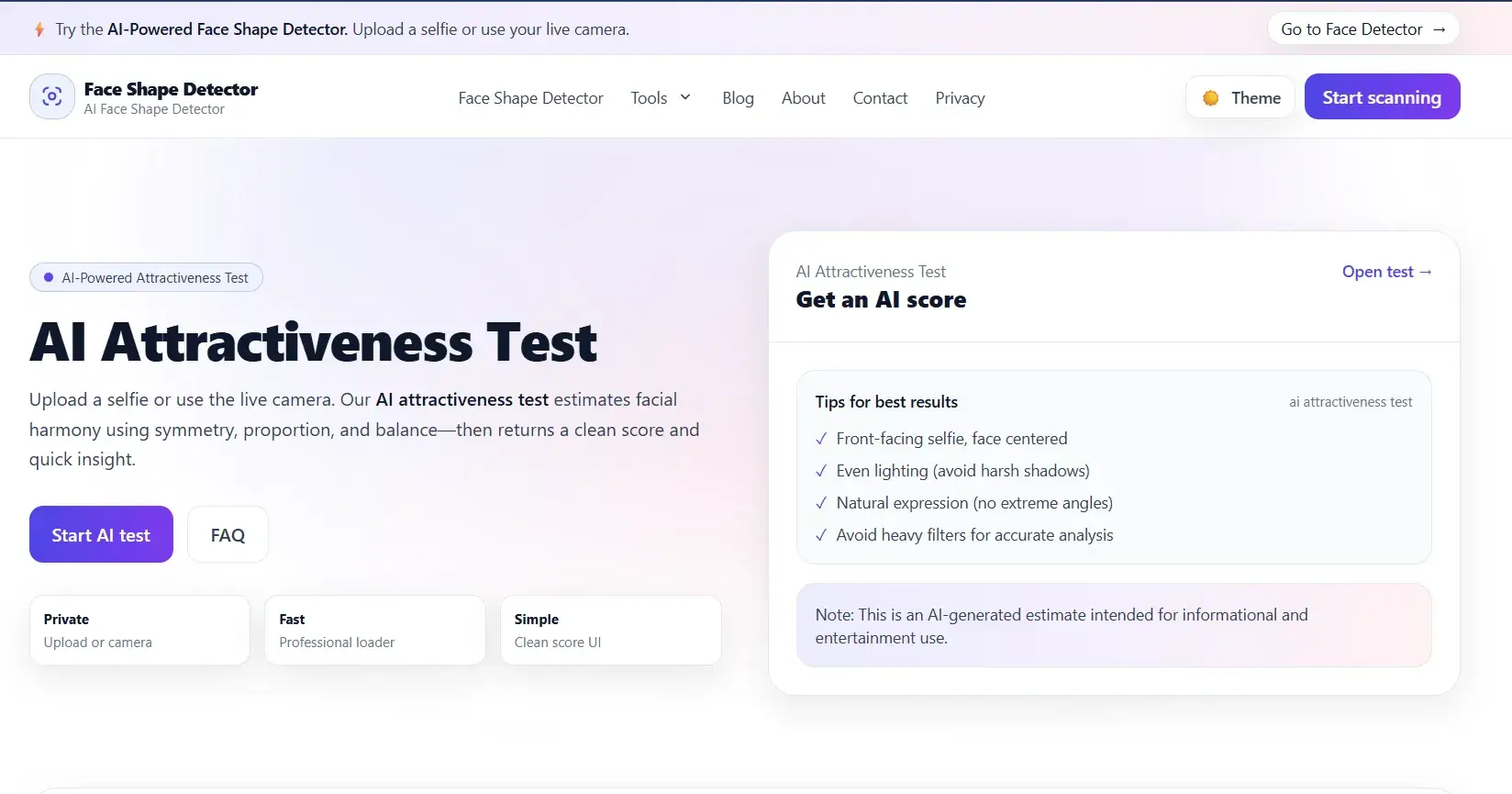
Artificial Intelligence is transforming facial analysis, and one of the most searched topics today is “how to detect AI attractiveness test using AI?” From beauty score calculators to facial symmetry analyzers, AI-powered attractiveness tests use advanced algorithms to evaluate facial harmony, proportions, and balance.
In this in-depth SEO-optimized guide, you’ll learn:
What an AI attractiveness test is
How AI calculates beauty scores
The technology behind facial attractiveness analysis
Step-by-step process of AI beauty detection
Accuracy, limitations, and ethical considerations
Real-world applications of AI attractiveness tools
What Is an AI Attractiveness Test?
An AI attractiveness test is a computer vision system that analyzes facial features and calculates a beauty score based on:
Facial symmetry
Proportional balance
Golden ratio alignment
Feature spacing
Skin clarity (optional in some tools)
Jawline and cheekbone definition
The system uses machine learning models and facial landmark detection algorithms to compare your facial structure against large datasets.
It’s important to understand: AI attractiveness analysis measures mathematical harmony — not personal worth or human value.
How Does AI Measure Attractiveness?
AI beauty analyzers rely on:
Facial landmark detection
Deep learning classification
Geometric ratio analysis
Symmetry detection
Statistical modeling
Let’s break down the process.
Step-by-Step: How AI Attractiveness Test Works
1️⃣ Face Detection
The AI first identifies the face in an image using computer vision libraries such as:
OpenCV
Google MediaPipe
Dlib
These frameworks detect facial boundaries and prepare the image for detailed analysis.
2️⃣ Facial Landmark Mapping
AI maps key facial landmarks such as:
Eye corners
Nose bridge
Lip edges
Jawline
Cheekbones
Chin
Forehead edges
For example:
Dlib’s 68-point landmark model
MediaPipe’s 468-point face mesh
These points allow precise measurement of facial geometry.
3️⃣ Facial Symmetry Analysis
One major factor in AI beauty scoring is symmetry detection.
The system:
Splits the face vertically
Compares left and right side alignment
Calculates deviation percentages
Higher symmetry often results in a higher attractiveness score.
4️⃣ Golden Ratio Calculation
Many AI attractiveness tools reference the Golden Ratio (1.618), historically associated with aesthetic harmony.
Golden Ratio
AI measures ratios like:
Face length ÷ face width
Eye spacing ÷ face width
Nose width ÷ lip width
Chin length ÷ lower face length
The closer these proportions are to the Golden Ratio, the higher the harmony score.
5️⃣ Deep Learning Beauty Classification
A Convolutional Neural Network (CNN) trained on thousands (or millions) of faces predicts an attractiveness score.
The model evaluates:
Feature alignment
Proportion consistency
Skin texture (in some advanced models)
Overall facial harmony
It then generates:
Beauty score (e.g., 1–10 or 1–100)
Confidence level
Symmetry percentage
Technologies Behind AI Attractiveness Detection
Modern AI beauty analyzers use:
Deep learning frameworks like TensorFlow & PyTorch
Neural networks
Real-time face mesh tracking
2D & 3D facial modeling
Cloud platforms such as:
Microsoft Azure
Amazon Web Services
These technologies allow scalable and near-instant analysis.
Factors That Influence AI Beauty Score
AI attractiveness tests typically consider:
Facial symmetry
Balanced proportions
Jawline sharpness
Eye spacing
Lip-to-nose ratio
Skin smoothness (optional)
Lighting conditions
For best results:
Use natural lighting
Keep a neutral expression
Avoid heavy filters
Use a straight, front-facing photo
Is AI Attractiveness Test Accurate?
AI beauty scoring systems are:
Data-driven
Statistically modeled
Based on pattern recognition
However:
Beauty standards vary culturally
Training datasets may introduce bias
Attractiveness is subjective
AI cannot measure personality or charisma
An AI attractiveness score is an algorithmic estimate — not an absolute judgment.
Use Cases of AI Attractiveness Tests
AI beauty analyzers are commonly used for:
Cosmetic surgery planning
Facial harmony consultations
Dating app filters
Social media face analysis
Virtual makeover tools
Personal curiosity
Ethical Considerations of AI Beauty Analysis
While AI attractiveness detection is innovative, ethical concerns include:
Reinforcing narrow beauty standards
Dataset bias
Psychological impact
Over-reliance on algorithmic scoring
Responsible platforms emphasize that beauty is multidimensional and not defined by a number.
Future of AI Beauty & Facial Analysis
With advancements in:
3D facial scanning
Augmented Reality (AR)
Real-time biometric modeling
Generative AI face simulation
AI attractiveness tests will become more personalized and context-aware.
Future systems may analyze:
Facial expressions
Emotional warmth
Cultural preferences
Dynamic attractiveness (video-based scoring)
Final Thoughts
Detecting an AI attractiveness test using AI involves facial landmark detection, symmetry analysis, golden ratio measurement, and deep learning classification. By analyzing facial proportions and geometric harmony, AI generates a beauty score based on mathematical models.
However, remember: AI measures structure — not confidence, kindness, personality, or uniqueness.
Beauty is far more than data.
Free AI Attractiveness Test Website:

Join Adil on Peerlist!
Join amazing folks like Adil and thousands of other builders on Peerlist.
0
12
0