

Face Symmetry Checkers Ultimate Guide: Tools, Science, and Tips [2026 Update]
What is Facial Symmetry?
In an era where AI-driven beauty tools are at our fingertips, face symmetry checkers have surged in popularity.
These innovative applications and online platforms allow users to upload a selfie and receive an instant analysis of their facial balance, often scoring symmetry on a scale from 0 to 100%.
Whether you're curious about your "golden ratio" alignment or seeking insights for cosmetic enhancements, understanding face symmetry checkers can empower you to explore aesthetics in a data-driven way. This comprehensive guide dives into the science, mechanics, top tools, benefits, limitations, and practical tips for 2026.
What is Facial Symmetry?
Facial symmetry refers to the degree to which the left and right sides of your face mirror each other in terms of feature placement, size, and shape.
Key elements include the alignment of eyes, eyebrows, nose, cheeks, lips, and jawline. Perfect symmetry is rare; most people have subtle asymmetries due to genetics, lifestyle, or environmental factors.
However, higher symmetry is often linked to perceptions of beauty and health.
The Science Behind Facial Symmetry and Attractiveness
Research consistently shows that symmetrical faces are rated as more attractive across cultures and demographics.
This preference may stem from evolutionary biology: symmetry signals genetic fitness, developmental stability, and resistance to environmental stresses like illness or poor nutrition.
For instance, studies indicate that faces with higher symmetry correlate with better health perceptions, though subtle asymmetries don't necessarily indicate poor health.
The "Evolutionary Advantage Theory" posits that our brains are wired to favor symmetry as a marker of robust genes. Additionally, the golden ratio (approximately 1:1.618) plays a role, where facial proportions closer to this mathematical ideal enhance attractiveness.
However, the normality of how "average" a face appears often mediates symmetry's impact on appeal, with extreme symmetry sometimes perceived as unnatural.
Individual differences, such as hormone levels or cultural influences, also affect preferences. While perfect symmetry isn't essential for attractiveness, deviations beyond certain thresholds (e.g., asymmetry indices of 3.1) can noticeably reduce perceived beauty.
How Face Symmetry Checkers Work with AI
Modern face symmetry checkers leverage artificial intelligence, particularly computer vision and machine learning, to analyze photos. The process typically involves:
Facial Landmark Detection: AI identifies key points (e.g., 68-468 landmarks) on features like eyes, nose, and mouth using models like MediaPipe or dlib.
Midline Alignment: The face is divided along a vertical axis, often based on the centers of the eyes or nose.
Symmetry Calculation: Distances and angles between corresponding points on each side are compared. Algorithms compute deviations using metrics like Euclidean distance or Siamese Neural Networks for similarity scoring. Proportions are evaluated against the golden ratio.
Scoring and Insights: A symmetry percentage or score is generated, often incorporating attractiveness ratings trained on datasets of rated faces. Advanced tools assess dynamic symmetry (e.g., during smiles) or integrate with PROMs for clinical use.
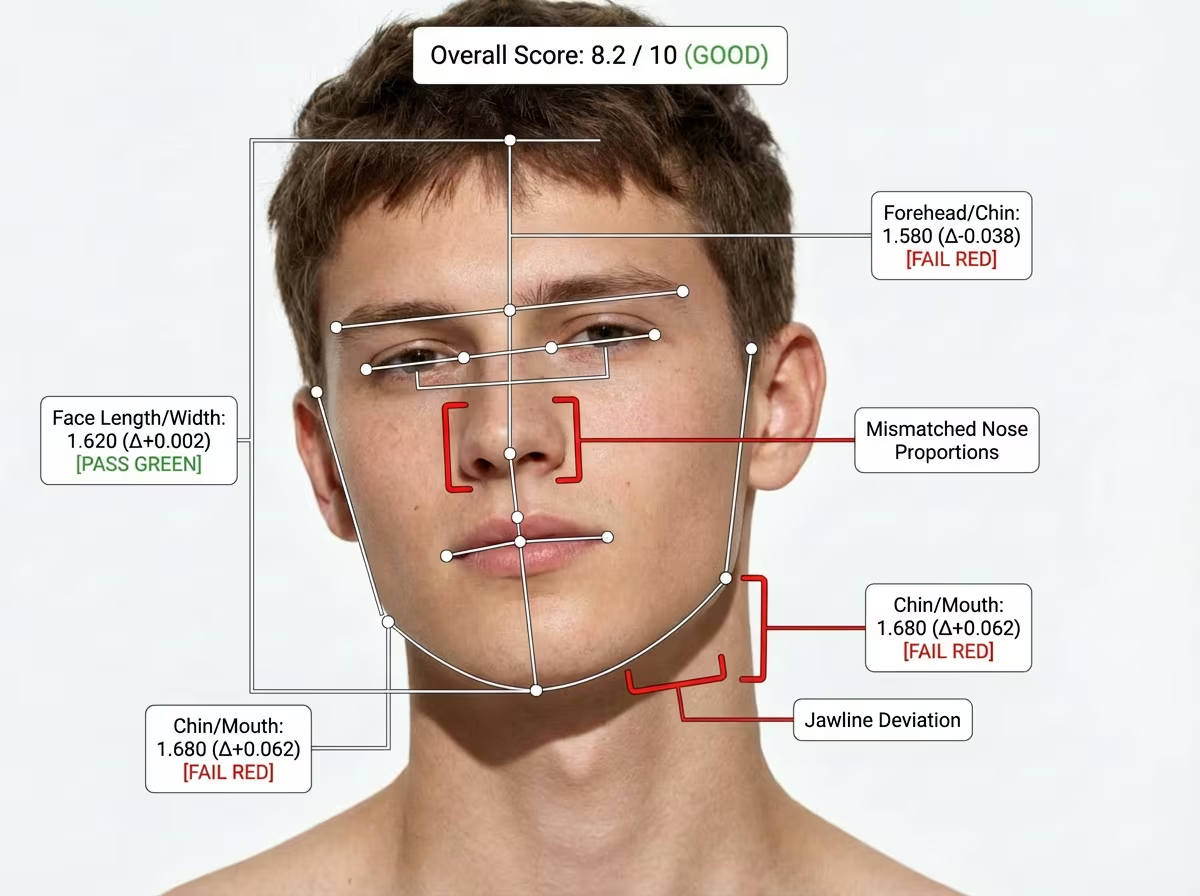
The diagram illustrates how AI overlays measurements to evaluate ratios and deviations, providing a detailed breakdown.

Join Adil on Peerlist!
Join amazing folks like Adil and thousands of other builders on Peerlist.
0
5
0