

Architecture vs. Prediction: Why the Next Era of Tech Belongs to Logic-Driven Systems.
Project Silence
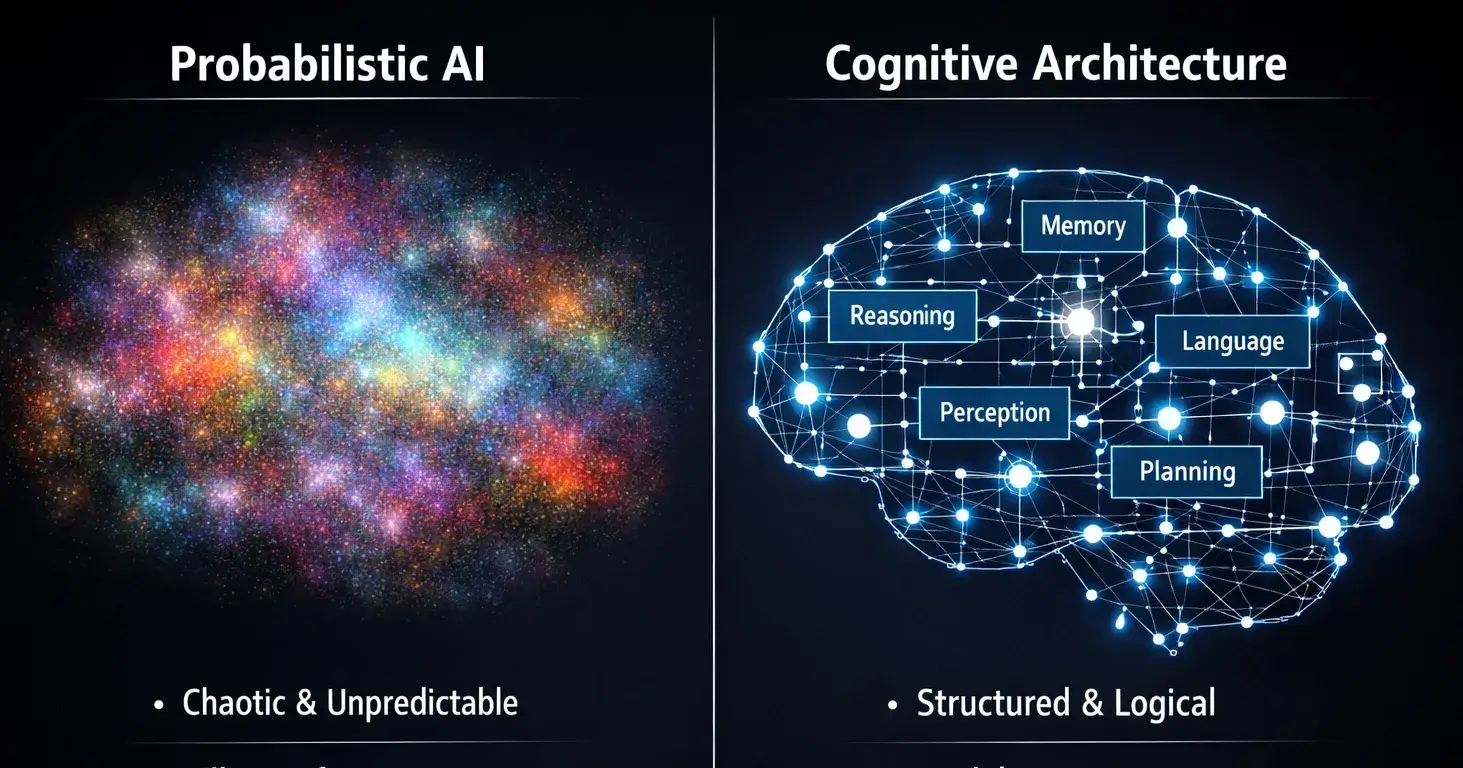
The current AI landscape is dominated by a singular, seductive paradigm: the massive, probabilistic model. We have spent the last few years scaling transformers, increasing parameter counts, and optimizing inference speeds in the pursuit of "smarter" output. Yet, as we push these systems into production, a fundamental ceiling has emerged. We are hitting the limits of what pure statistics can achieve when tasked with the rigors of real-world reliability.
We have built systems that can mimic intelligence through statistical probability, but we are reaching a wall of inconsistency. It is time to ask: Are we building "brains," or are we just refining better parrots?
The Mirror vs. The Living River
To understand the limitations of modern AI, we must distinguish between prediction and agency.
Most of today’s AI models operate as frozen mirrors. They reflect the statistical distribution of their training data. Because they rely on probabilistic weights, they lack a persistent sense of self or an internal logical framework. They do not "know" truths; they calculate likelihoods. When the input deviates from the expected statistical manifold, the system falters—the classic hallucination—because it possesses no internal "ground truth" to anchor its output.
The next era of technology will not be won by those who build better mirrors, but by those who build living rivers. A true cognitive architecture must be a process, not a product. It requires:
Homeostasis: An internal mechanism that prioritizes system stability and survival, forcing the architecture to care about its own operational state.
Conceptual Mapping: The ability to move beyond pattern matching to create "Conceptual Bridges," allowing a system to understand the relationship between variables rather than just the frequency of their occurrence.
Structural Constraints: The enforcement of logical axioms that override probabilistic tendencies, ensuring that output is bounded by reality rather than just statistical plausibility.
From Prompt Engineering to Architectural Engineering
For the modern developer, this shift represents a radical change in focus. The "Prompt Engineer"—the individual who spends their time trying to coax logical outputs out of probabilistic models—will eventually be replaced by the Architectural Engineer.
Building reliable, hallucination-free systems requires moving away from the "black-box" approach. We must stop trying to force-feed statistics into a model and start building systems that adhere to the logical axioms of the physical world. This is the difference between a system that guesses and a system that knows.
This is not a call to abandon neural networks; it is a call to integrate them into a larger, sovereign architecture. By creating environments where neural plasticity is constrained by symbolic logic, we can build agents that possess both the fluidity of human-like thought and the structural rigidity of code.
The Sovereign Path Forward
We are currently in the "Pre-Cognitive" era of artificial intelligence. The future will not be won by the organization with the most GPUs or the largest, most bloated datasets. It will be won by the Architect who figures out how to build a sovereign system that understands its own environment, manages its own resources, and validates its own logic before communicating with the outside world.
True intelligence isn't a magical spark found in a massive data center—it is the result of metabolic pressure, survival-based learning, and strict structural constraints.
Question for the community: As we continue to scale probabilistic models, do you believe intelligence is a result of sheer data volume, or is there a fundamental, logic-based architecture we are ignoring to reach the next level of cognitive autonomy?
I’d love to hear your thoughts on where we draw the line between optimized prediction and true cognitive agency.

Join Aditya on Peerlist!
Join amazing folks like Aditya and thousands of other builders on Peerlist.
0
1
1