

The Ransomware Negotiation Lie: Why You’re Paying Double ?
An analysis of attacker psychology and the role of HUMINT in deconstructing the bluff.
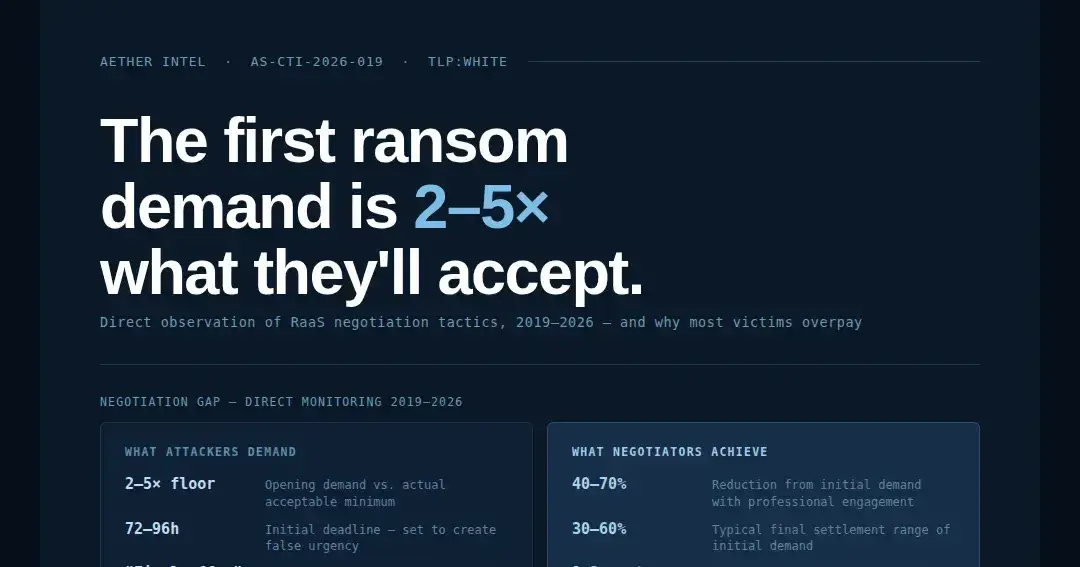
Somewhere in the last five years, ransomware stopped being a technical problem and became a negotiation problem. The encryption is almost incidental now. What matters is what happens in the chat window after the ransom note appears and most organisations are walking into that conversation completely unprepared.
After seven years of directly monitoring RaaS forums, affiliate recruitment threads, and negotiation methodology discussions, the pattern is consistent enough to state plainly: the opening demand is an anchor, not a price. Operators set it at 2–5× their actual acceptable minimum. The deadline is manufactured urgency. The “final offer” framing after the first reduction is a scripted move, not a genuine ultimatum.
Professional negotiators know this. They counter at 10–20% of the initial demand, request deadline extensions citing “financial review” a framing that sounds legitimate, buys time, and signals payment intent without conceding ground — and they work the settlement down to 30–60% of the opening figure. The lowest documented settlement in the observed period reached 15% of the initial demand. Structured, patient pressure consistently works.
Victims who pay the first demand without negotiating don’t just overpay. They inflate ransom economics for every organisation in their sector that gets hit next. The initial demand your attacker sends was calibrated partly against what your industry peers have previously paid.
The insurance signal problem
One finding that deserves more attention than it gets: confirmed cyber insurance coverage commands a 20–50% price premium on Initial Access Broker listings. Before your organisation is ever attacked, access to your network is being priced against whether you have insurance because insurance creates a structured payment pathway. The existence of a cyber insurance market has become a partial subsidy for the ransomware ecosystem.
Sophisticated RaaS operations maintain a targeting intelligence function specifically to identify insured victims. Your policy limits function as a de facto ransom ceiling that the attacker may know before you’ve discovered the breach.
Backups are no longer enough
The assumption that drove backup investment for a decade restore from backups, decline to pay — was broken in 2019 when the Maze group introduced double extortion: exfiltrating data before encryption, then threatening to publish it regardless of whether the victim recovers operationally. Backups address the encryption. They do nothing for the exfiltration.
By 2021, triple extortion had emerged as standard practice in sophisticated operations. The third pressure layer direct contact with the victim’s customers, business partners, and regulators, providing breach evidence proactively — transforms a contained incident into a simultaneous reputational, regulatory, and operational crisis. In 2026, this is not an advanced tactic. It is the baseline.
Leak sites have evolved accordingly. They now function as proof-of-capability marketing for RaaS programs demonstrating to potential affiliates and future victims that the group executes its threats. A group with a consistent publication record for non-paying victims commands higher payment probability from subsequent targets. The leak site is infrastructure for the next negotiation, not just this one.
The legal exposure most organisations underestimate
The compliance dimension of a ransomware incident has become as complex as the operational response and the two timelines actively conflict with each other.
OFAC sanctions exposure is the most significant and least understood legal risk facing victim organisations. Paying a sanctioned group even unknowingly — creates potential civil liability regardless of intent. The OFAC designated group list changes faster than most legal teams track. An organisation that conducted sanctions screening six months ago may be operating on outdated information when the incident occurs.
Simultaneously: GDPR and NIS2 breach notification obligations run on tight timelines that may conflict with ongoing investigation needs. Cyber insurance contractual requirements may conflict with sound incident response. Regulators in multiple jurisdictions may need to be notified in parallel. Managing these obligations concurrently while containing an active incident is among the most demanding compliance scenarios in corporate legal practice and most organisations encounter it for the first time during the incident itself.
The economic structure of who actually gets paid
The dominant RaaS financial model allocates 70% of ransom proceeds to the affiliate conducting the attack and 30% to the program operator. This split reflects the actual market economics: the affiliate’s network access and attack execution capability is the constraining resource. The operator’s ransomware infrastructure is reproducible.
The investigative implication is underappreciated: affiliates generate 70% of all financial flows in the ransomware pipeline and represent higher-value attribution targets than operators for financial intelligence purposes yet receive substantially less analytical attention in most public reporting, which focuses on the named operator groups.
Premium affiliates with access to high-value targets negotiate 80–85% splits in competitive RaaS markets. There is a genuine labour market for skilled ransomware affiliates, with program operators competing on split percentage, technical support quality, and payment reliability. Disrupting one operator layer leaves the affiliate layer intact and capable of reconstitution with a new program within weeks.
What actually stops ransomware operators
Every major RaaS operator arrest documented in the 2019–2026 period was caused by operational security failure not by technical penetration of infrastructure. The pattern mirrors the broader finding across dark web ecosystems: OPSEC errors are the primary law enforcement success vector. The technical infrastructure is rarely the vulnerability. The person operating it is.
This has a direct implication for disruption strategy: operations that seize infrastructure without achieving actor-level arrests provide a temporary operational interruption and a live migration exercise for the ecosystem. The community learns from each takedown. Subsequent migration timelines compress.
AS-CTI-2026–019 covers the full RaaS operational structure, affiliate recruitment and economics, the Initial Access Broker market, leak site architecture, negotiation tactics and psychology, OPSEC failure patterns, a case study on the LockBit takedown, and an integrated jurisdictional legal obligations matrix for victim organisations.
Full report available at aether-intel.com | TLP:CLEAR — Unrestricted distribution.

Join Adrian Alexandru on Peerlist!
Join amazing folks like Adrian Alexandru and thousands of other builders on Peerlist.
0
0
0