

If AI Can Design Your UI, It Was Never UX to Begin With
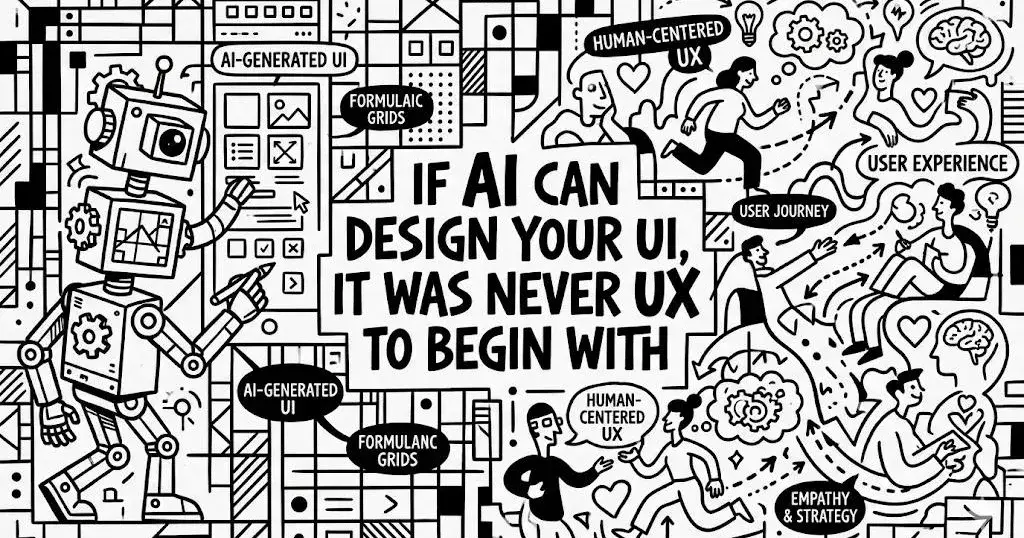
There’s a quiet anxiety in the design world right now.
Tools like Claude, Figma AI, and a growing stack of generative design systems are producing layouts, flows, and even full interfaces in minutes. The fear is understandable: if AI can design the UI, what happens to UI/UX designers?
But that question rests on a flawed premise.
UX was never just UI to begin with.
The Real Shift Isn’t About Replacement
What AI is actually doing is exposing a truth the industry has quietly avoided for years:
A large portion of what we labeled as “UX/UI work” was execution not experience design.
When UI becomes faster, cheaper, and increasingly automated, the differentiator is no longer how well you can design a screen.
It’s how well you can define:
What problem is worth solving
Who you are solving it for
Why it matters in a real-world context
How the experience holds up beyond the interface
That’s not new. That’s foundational UX.
We just blurred that line over time.
As someone who has worked across product, business, and operations, especially in immersive tech for non-tech-savvy users. I rarely had the luxury of focusing only on screens.
Because the real challenges weren’t UI problems.
They were human problems:
Users hesitant to adopt unfamiliar technology
Teams resistant to change despite clear efficiency gains
Stakeholders optimizing for metrics that didn’t reflect real behavior
In those situations, no amount of “better UI” fixes the problem.
What matters is:
How you introduce the product
How you reduce friction before interaction begins
How you align incentives across users and buyers
How you design trust, not just usability
That’s UX.
And none of it can be automated by generating a prettier interface.
AI Is Not Competing With UX
AI is exceptional at patterns, speed, and iteration.
It can:
Generate UI variations
Suggest layouts
Accelerate design systems
And that’s a good thing.
Because it removes the bottleneck of execution and frees designers to operate where they create the most value at the level of thinking, not just making.
Instead of asking “Will AI replace designers?”, a more useful question is:
“What parts of design were never truly defensible to begin with?”
What This Means for Designers Right Now
For product and UX designers, this moment isn’t a threat but rather an opportunity to evolve.
It separates:
Interface builders from experience strategists
Tool operators from problem framers
Use AI to:
Rapidly prototype and test multiple directions
Offload repetitive UI tasks
Explore edge cases faster than before
And invest your energy in:
Understanding human behavior deeply
Connecting business strategy with user needs
Designing systems, not just screens
Making decisions in ambiguity
Because that’s where design becomes irreplaceable.
The Reframing We Need
The narrative shouldn’t be that UX is expanding beyond screens because of AI.
The reality is simpler and more uncomfortable:
UX was never limited to screens. We just made it smaller to fit the tools we had.
Now that the tools are evolving, the definition is correcting itself.
Final Thought
AI won’t replace UX designers.
But it will replace the version of design work that was never truly UX to begin with.
And for those willing to step into the broader, more complex, more human side of design.
This is not a disruption.
It’s an upgrade.

Join Aishwarya on Peerlist!
Join amazing folks like Aishwarya and thousands of other builders on Peerlist.
0
2
0