

Why User-Centric Products Are the Missing Link in Workforce Skilling
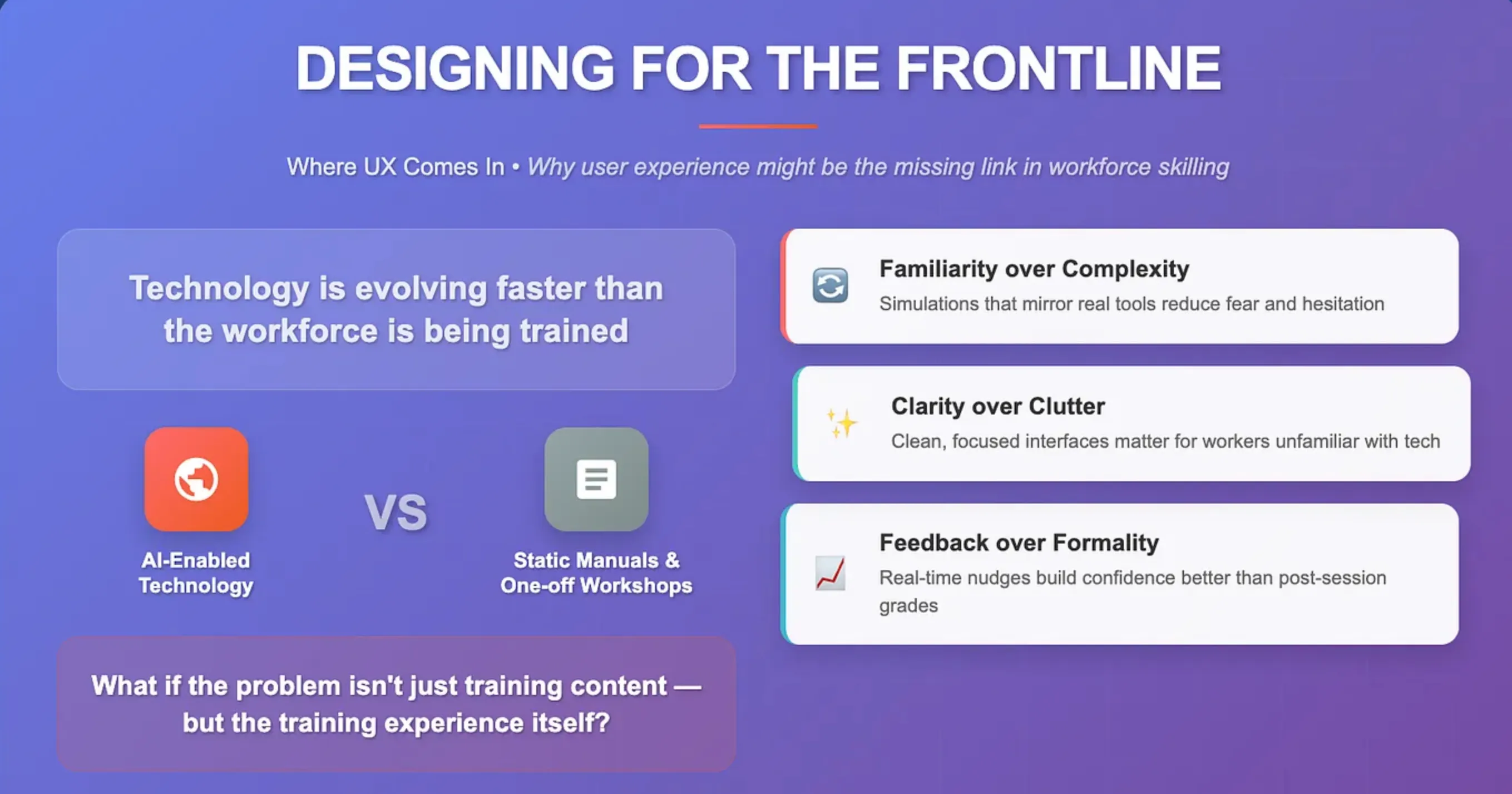
Over the past five years, my work at the intersection of product design, immersive technology, and workforce transformation — particularly at Cusmat — has centered on one mission: building solutions that truly serve the end user. I’ve worked closely with industries like manufacturing, logistics, and EV systems, where expectations from frontline teams are rising fast — but the tools built to train them often lag behind.
Time and again, I saw the same pattern:
Enterprises invest in advanced technology, but overlook the experience required to adopt it.
Frontline workers are now expected to interact with AI-powered diagnostics, automated systems, and complex machinery. Yet, their training often relies on passive formats like PDFs, outdated workshops, or generic e-learning modules. The result? Frustration, inefficiency, and unnecessary errors — not because people can’t learn, but because the products designed to help them do so weren’t made with them in mind.
Where User-Centric Product Thinking Changes the Game. Gamified Learning = Real Engagement
One of the most overlooked aspects of workforce skilling today is engagement. Skilling is often treated as a checkbox — a mandatory requirement for compliance — without truly absorbing its purpose: building capability.
That’s where gamified 3D simulations play a transformative role.
For blue-collar workers, they offer a safe, repeatable, and interactive way to build confidence. Instead of sitting through lectures or reading manuals, learners can perform tasks in simulated environments that replicate real-world conditions — without the real-world consequences of failure. It fosters curiosity, reduces fear, and makes skilling feel empowering, not intimidating.
For enterprises, gamified simulations offer a more measurable, scalable, and standardized approach to workforce development. They move skilling from a fragmented, ad hoc process to a product-led system with performance data, completion insights, and clear ROI.
This shift helps organizations take skilling seriously — not just as a mandate, but as a critical part of productivity, compliance, and culture.
Skilling Isn’t a Mandate. It’s a Product Challenge.
Too often, skilling is treated like a regulation to meet or a checkbox to tick. But in practice, it is one of the most important levers for operational success — and it deserves the same product thinking we apply to customer-facing platforms.
The true ROI of innovation lies not in adoption — but in usable, repeatable, and scalable adaptation.
The most valuable training products aren’t the ones that simply digitize content. They’re the ones that empower the workforce, evolve with operational complexity, and speak the user’s language — whether that user is on a factory floor or in a field workshop.
That’s what I’ve come to believe — and what I continue to build toward.
💬 Curious how product-led skilling could work in your industry? I’d love to hear your thoughts. Let’s talk about how design, behavior, and product execution can redefine how we train and retain our workforce.

Join Aishwarya on Peerlist!
Join amazing folks like Aishwarya and thousands of other builders on Peerlist.
0
12
0