

How to Build a Community-Driven Dating App Without Starting From Scratch
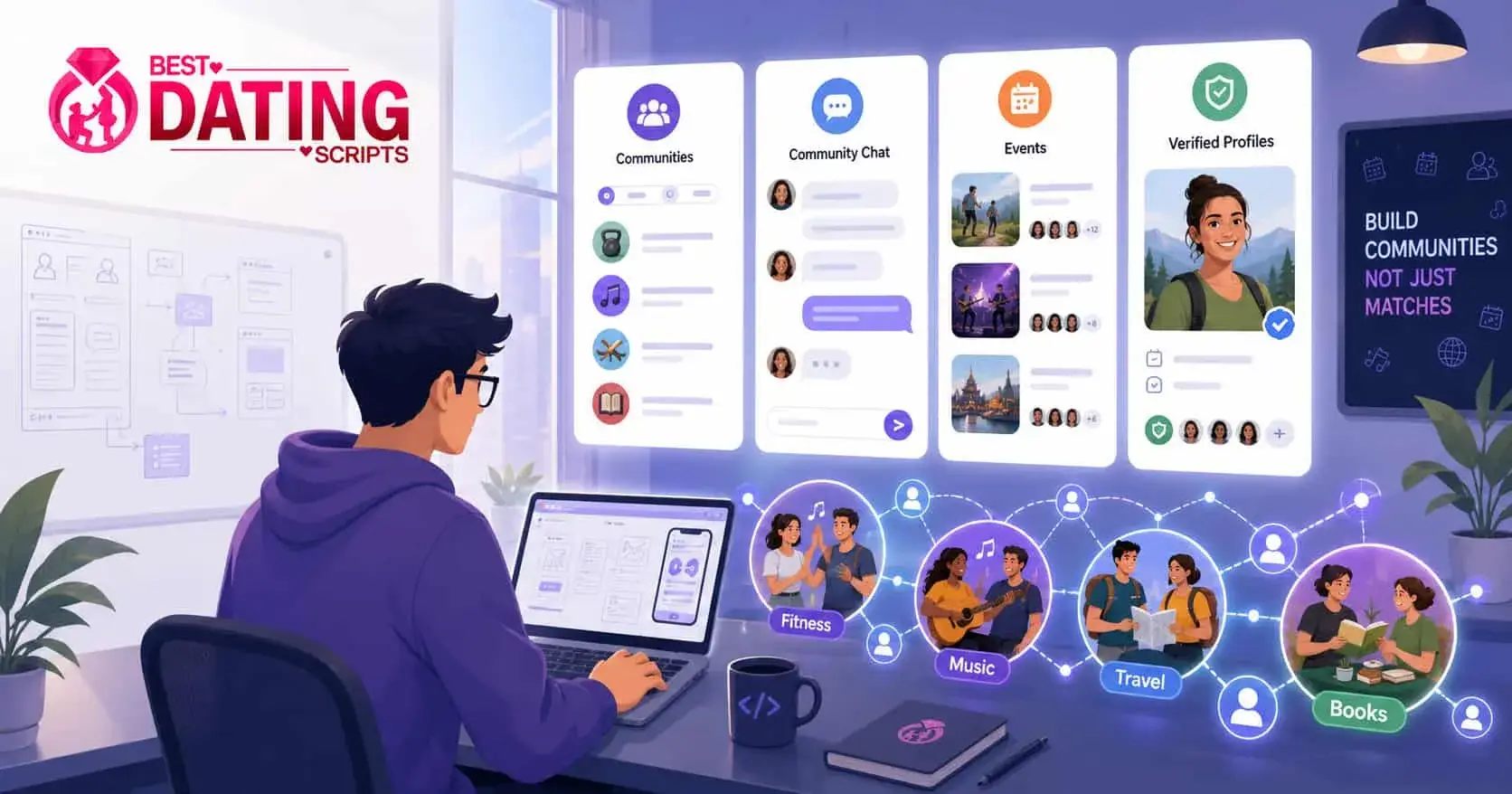
Dating app installs dropped 13% year-over-year between 2023 and 2024. That's not a blip — it's a market telling you something. Swiping through hundreds of strangers has lost its novelty, and users are moving toward platforms that feel like communities rather than catalogues. The apps gaining traction now aren't the biggest. They're the most specific.
If you're a founder thinking about launching a dating platform, that shift matters. Building yet another general-purpose app and competing with Tinder and Bumble on their own terms isn't a plan — it's a budget problem. What's working better is the community-first model: platforms built around a shared identity, interest, or lifestyle where matching is almost a side effect of belonging.
The practical challenge, though, is how you actually build one of these. Custom development takes months and burns cash before you've validated anything. That's why more founders are starting with white label dating software — not as a shortcut, but as a smarter first move.
Why Community-Focused Dating Apps Are Pulling Ahead
The global online dating market hit $10.28 billion in 2024 and is projected to reach nearly $19.33 billion by 2033. But the headline number masks a more interesting story: the growth is increasingly coming from niche platforms, not the giants. Research suggests niche community apps could hold 45% of market share by 2028 — a significant slice for a segment that barely registered a few years ago.
The reason is simple. When a platform is built around a specific identity — faith, profession, lifestyle, culture, shared hobby — users don't have to do as much filtering. The community does it for them. That means faster matches, less frustration, and better retention.
What 'Community-Driven' Actually Means in Product Terms
It's not just adding a few interest tags to a profile. A genuinely community-driven dating experience involves social feeds, group events, interest-based discussions, and moderation tools that enforce community norms. Consider what BLK, the largest dating app for the Black community, found: over 30% of its users in 2024 used the app primarily to build social circles, not pursue romance. The platform had evolved into a social discovery tool — and that made it stickier, not less valuable.
The takeaway for builders: community features aren't optional extras to bolt on later. They're the product. If you plan to add them after launch, you've already made a structural mistake.
What a Community Dating App Needs Beyond the Basics
Most early-stage founders focus too much on the matching engine and not enough on the infrastructure that keeps people coming back. Here's what actually matters:
Trust Mechanisms
Verified profiles, identity checks, and clear moderation policies aren't differentiators — they're table stakes for any community app. Without trust, your retention numbers will tell a bleak story within the first 30 days. Users who don't feel safe don't come back, and they don't refer friends.
Engagement Loops Beyond Swiping
Research from dating app engagement studies in 2025 consistently shows that gamification and community features boost session time by around 20%. Weekly challenges, interest-based groups, virtual events, and offline meetup tools all give users a reason to open the app when they're not actively looking for a match. That matters enormously for retention.
The Adjust engagement research specifically recommends building interest-based social clubs into your product — spaces where users can join discussions, participate in challenges, and plan meetups — as one of the most effective strategies for reducing churn in a saturated market.
Retention Over Acquisition
The apps that burn out fast are the ones that spend everything on user acquisition and nothing on making the experience worth staying for. For a community-focused platform, word-of-mouth from tight-knit users is far more cost-efficient than paid acquisition at scale. Build the community first; growth follows.
Build From Scratch vs. Use a White Label Dating Script — An Honest Comparison
This is the decision most founders delay too long, and it costs them. Let's be direct about what each path actually looks like.
Custom Development
A custom-built dating platform typically takes four to nine months to reach a stable, launchable version. You're looking at hiring a backend engineer, a mobile developer (or two, for iOS and Android), a designer, and a QA person at minimum. Factor in the time to build user onboarding, profile flows, matching logic, real-time chat, notifications, admin controls, payment integration, and app store compliance — and you'll understand why the real cost of dating app development routinely catches founders off guard. Custom makes sense when you're inventing an entirely new interaction model. For community-focused dating, you're not reinventing the wheel — you're customizing it.
White Label Dating Software
A quality white label dating script gives you tested core infrastructure — matching logic, profile systems, real-time messaging, admin dashboards, payment gateways — in days or weeks, not months. You skip the early build phase and move straight to the part that actually differentiates your platform: the community design, the branding, and the specific features your target audience cares about.
The tradeoffs are real, though. Not every white label solution offers genuine flexibility. Some constrain your customization options or take a revenue share. If you're going this route, the key evaluation criteria are: Can you fully brand the platform? Can you add custom features later? Do you own the codebase? Does it scale without re-engineering?
Who Should Use Which
If your goal is to validate demand and get real users before a major investment, white label is almost always the smarter starting point. If your goal is to build a genuinely novel interaction paradigm from day one, custom development may be unavoidable. Most community dating apps fall squarely into the first category — the differentiation comes from community design, not technology invention.
One thing worth reading if you're still on the fence: common mistakes founders make when building dating platforms. Overbuilding too early and underestimating the maintenance burden of custom code are two of the most expensive.
How Long Does It Actually Take to Launch a Community Dating App?
This depends almost entirely on your starting point.
Custom development: four to nine months for a stable MVP, assuming a competent team and clear specs. Add another month or two for app store review cycles, and that's before you've acquired a single user.
White label: a solid white label dating app solution can be live in two to four weeks. The variable is customization depth. Basic branding and configuration is fast. Adding community-specific features — event tools, forums, niche matching criteria — takes longer, but you're still working within a tested framework rather than building from scratch.
For the MVP, resist the urge to add every feature you've imagined. The things that matter most in a community dating app's first 90 days are: trust (verification and moderation), relevance (do users find people they'd actually want to meet?), and engagement (is there a reason to open the app twice a day?). Everything else can come after you've validated those three.
Practical Steps to Build Your Community Platform
Define the Community Before You Define the Features
Start with the people, not the product. Who exactly are you building for? What do they have in common beyond looking for a relationship? What would make them trust a new platform enough to create a profile? The answers shape everything — your matching criteria, your moderation rules, your community event formats, your onboarding copy.
Founders who skip this step end up with a generic dating app wearing a niche costume. That's a fast path to churn.
Choose a White Label Dating App Solution That Allows Real Customization
Not all white label platforms are built the same. The evaluation questions that matter: Can you add custom matching criteria beyond age and location? Can you build community features — group spaces, event tools, interest channels — into the core experience? Do you retain control of the codebase and data? Can it handle real-time messaging at scale?
Some founders building community-first platforms have used providers like Best Dating Scripts to bypass the infrastructure phase and move straight to community customization — which is where their real differentiation lives. The underlying technology is handled; the team focuses on the experience.
Build Community Infrastructure Into V1 — Not V2
Here's where most community dating apps go wrong: they launch with a standard dating UX and plan to add the community features "later." But retention data is unforgiving. If users don't experience the community element in the first week, they're likely gone before V2 ships.
Community features need to be discoverable from day one: interest groups, community events, shared activity feeds, moderation that actually works. That's also true for your matching algorithm — why entrepreneurs trust ready-made dating scripts in 2025 increasingly comes down to the ability to customize matching logic around community-specific criteria, not just demographics.
What Features Separate a Community Dating App From a Generic One?
This is worth spelling out, because the difference is often misunderstood.
A generic dating app has profiles, a matching algorithm, and a messaging system. A community dating app has all of that plus: interest-based groups where members interact before matching, event tools for virtual or in-person meetups, shared activity feeds or discussion spaces, verified profiles with community-specific trust signals, and moderation built around community norms rather than just spam prevention.
The distinction is whether users feel like they've joined a community or just signed up for a service. That feeling — or its absence — determines whether they come back after the first week.
Practically, this also means your admin panel matters more than most founders expect. Moderation, event management, community health metrics — these are operational tools you'll use constantly. A platform that requires developer intervention for every admin task doesn't scale. Make sure your chosen white label dating app solution provider includes a genuinely usable backend, not just a polished front end.
Closing Thoughts
The opportunity in community-driven dating is real. The market is large, users are burned out on generic alternatives, and the barriers to entry have dropped significantly with quality white label infrastructure now available.
The founders who get this right will be the ones who design the community first and use technology to serve it — not the other way around. Whether you start with a white label dating script or build custom from day one, the core question is the same: does your platform give a specific group of people a reason to feel like they belong somewhere? If the answer isn't clear, no matching algorithm will save you.
The next generation of dating platforms won't win on features. They'll win on belonging.

Join Alan on Peerlist!
Join amazing folks like Alan and thousands of other builders on Peerlist.