

OpenTelemetry sampling in production: how to balance cost, coverage, and debuggability
A practical guide to choosing between head and tail sampling without losing the traces engineers need during real production incidents.
Keeping every trace sounds like the safe choice.
It usually is, at first.
When a team starts using distributed tracing, the goal is simple: get visibility, understand requests across services, and make debugging less painful.
Nobody wants to be the person who dropped the exact trace that could have explained a production issue. So the early instinct is understandable. Keep everything. Store everything. Figure out the rest later.
That approach works for a while.
Then the system grows. Traffic increases. More services get added. More dependencies appear. One user request no longer stays inside one application. It moves through an API gateway, several internal services, a queue, a database, maybe a cache, and one or two external systems. The number of spans grows quietly in the background until tracing becomes expensive enough to notice.
And when teams finally start reducing volume, they often discover the harder problem: it is easy to lower trace volume, but much harder to keep the traces that actually matter.
That is what makes sampling a production concern.
Not cost or storage alone.
The real question is: will your team still have the evidence it needs when something breaks in production?
That is what a sampling strategy decides.
Why sampling becomes a problem faster than teams expect

Most teams hit sampling limits during production, not during setup.
The first pressure usually comes from volume.
Distributed systems generate far more telemetry than people expect, especially once traffic, retries, fan-out calls, and asynchronous flows start stacking up. Every additional service makes the tracing picture richer, but it also makes the data footprint larger.
The second pressure comes during incidents.
This is usually where the discussion changes. A team opens tracing during a customer-facing issue and finds that the most useful request paths are missing. Maybe the failure was rare. Maybe the slow requests were sampled out. Maybe the policy treated a critical checkout path the same way it treated routine internal traffic.
At this point, teams realize sampling is about protecting debugging quality while controlling volume.
What sampling actually does
At the simplest level, sampling decides which traces are kept and which are dropped.
That sounds straightforward, but in production, the decision is more important than it looks. The point is to keep enough of the right data so that engineers can still explain failures, latency spikes, and broken user journeys when they happen.
Most teams end up comparing two broad approaches: head sampling and tail sampling.
Head sampling: makes the decision near the start of the trace. It is fast, simple, and easy to roll out. The trade-off is that the system has to decide before it knows how the request will end. At that point, the request might look normal even if it later turns into an error, a timeout, or a very slow trace.
Tail sampling: makes the decision later, after more of the trace is visible. That gives teams a chance to retain traces because they actually ended in error, crossed a latency threshold, or matched a condition that only became clear after execution.
That difference matters a lot in production.
One approach decides early for simplicity. The other decides later for better signal quality.
When head sampling works well
Head sampling is often the right place to begin.
That may not sound exciting, but good production decisions are not always exciting. They are often the ones that are easiest to operate, easiest to explain, and easiest to trust.
If a team needs quick cost control, a simple rollout path, and a lower operational burden, head sampling does that well. It helps reduce trace volume fast. It is usually easier to reason about. And for many systems, especially those still early in their tracing maturity, it preserves enough signal to understand broad performance patterns and overall service behavior.
This works best in environments where traffic is fairly stable, where tracing is mainly used for visibility rather than deep incident forensics, and where the team values simplicity over precision.
Where head sampling breaks down
The weakness of head sampling is timing.
It forces the system to make a keep-or-drop decision before the interesting part of the request has happened.
That is fine when you care mostly about averages. It becomes much less fine when you care about the exceptions. And production issues are usually made of exceptions.
Rare errors, sudden latency spikes, partial timeouts, bad downstream dependencies, and unusual customer journeys often reveal themselves late. A request can look ordinary when it begins and still become the exact trace your team will want an hour later during an incident review.
If that trace was dropped early, the damage is already done.
This is why some teams feel like they have tracing and still struggle to debug real issues. They are not blind. They just do not have the right evidence when they need it most.
That is the main risk of using head sampling too aggressively, especially across customer-facing systems, revenue-critical paths, or workflows where rare failures matter far more than normal traffic.
When tail sampling is worth the extra effort
Tail sampling starts to make sense when the cost of losing the right trace is higher than the cost of running a more advanced pipeline.
This is common in production systems where a small number of traces carry most of the investigation value. Error traces matter. Slow traces matter. Broken user journeys matter. In those environments, random or early decisions are often not enough.
Tail sampling helps because it allows teams to keep traces based on what actually happened, not what seemed likely at the start. That makes it much better for preserving the traces engineers usually care about during real incidents.
But tail sampling is not free. It is harder to operate. The collector needs to hold more state. Routing matters more. Memory usage matters more. The design is simply more demanding.
That does not mean it should be avoided. It just means teams should choose it for a clear reason. Tail sampling is most valuable when better debugging quality is the goal, not when teams are only chasing lower ingest volume.
Head sampling vs tail sampling: how to choose in real systems
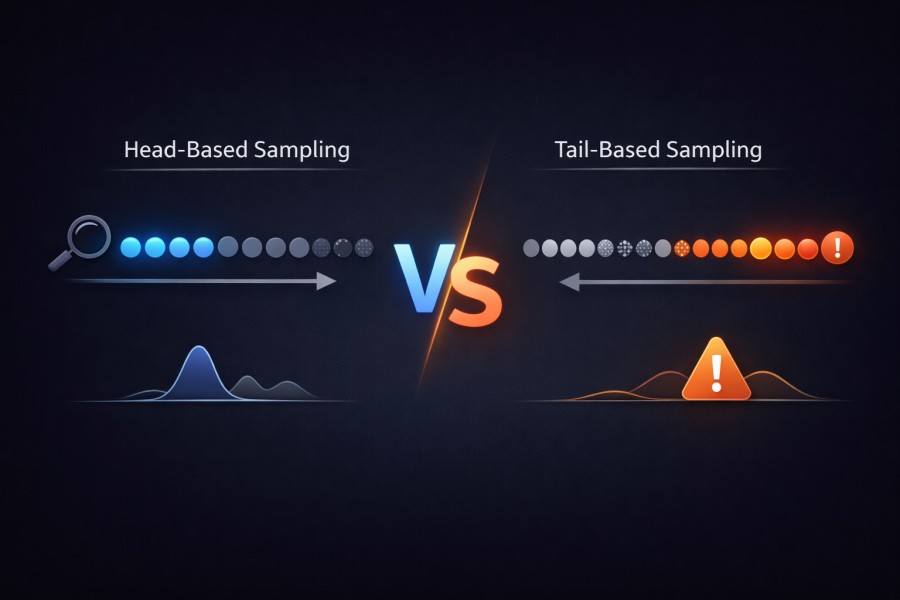
In the battle of head vs tail sampling, the best way to choose is not to start with architecture preference.
Start with the actual problem.
If your main issue is cost and your team wants a lower-effort solution, head sampling is usually the better first move.
If your main issue is missing important traces during production incidents, tail sampling deserves serious consideration.
If both are true, the answer is often not one universal policy. It is usually a more selective approach where different services or traffic classes get different treatment.
Critical paths need more protection than low-risk background work. Healthy high-volume traffic can usually be sampled more aggressively than error-prone or customer-facing flows. Services do not all carry the same business importance, so they should not all inherit the same trace policy.
Once teams start thinking this way, sampling becomes part of production system design.
How to reduce telemetry cost without losing important incident data
The strongest sampling strategies do not begin with “how do we cut more?”
They begin with “what would hurt the most to lose?”
That question changes the quality of the decision.
Good sampling strategies usually keep more of what engineers rely on during incidents and much less of what provides little investigation value.
Error traces are kept at a higher rate.
Slow traces are retained more often.
Routine healthy traffic is sampled more aggressively.
Critical services are treated differently from low-risk ones.
This is how teams reduce trace volume without quietly reducing debugging quality.
It also helps to review sampling through the lens of incident usefulness, not just storage savings. A policy may look efficient on paper and still be a bad production policy if it removes the evidence people actually need when systems fail.
Common mistakes teams make
Treating sampling as only a finance decision: Cost absolutely matters. But cheap observability that hides the reason behind a production issue is not efficient. It is just a cheaper form of confusion.
Using the same rule for every service: That usually sounds cleaner than it actually is. Systems do not have equal risk, equal traffic patterns, or equal business value. A one-size-fits-all policy often preserves too much of the wrong data and too little of the data that matters most.
Setting a policy once and leaving it unchanged: Traffic changes. Architecture changes. Incident patterns change. What was a sensible policy a few months ago can become weak or even harmful later. Teams should revisit sampling after incidents, not just after budget reviews.
What good looks like in practice
Good sampling in production is usually balanced. It is not full retention. It is not extreme reduction. It is not a single global percentage applied to everything.
Routine healthy traffic is reduced more aggressively.
Error traces are preserved.
Slow traces are retained.
Critical user-facing services get stronger protection than low-priority internal jobs.
Policies are reviewed after production issues and refined over time.
The goal to collect and retain useful data.
When teams get this right, they control telemetry cost without making incidents harder to investigate. They stop paying to keep huge volumes of low-value traces, while still preserving the requests that explain real production pain.
Final takeaway
Sampling is about deciding what your team will still be able to see when production stops behaving the way it should.
Head sampling is often the right starting point because it is simple, predictable, and operationally light.
Tail sampling becomes worth the extra effort when rare failures, slow requests, and critical user paths matter more than broad averages.
Most teams do not need to treat these as ideological choices. They need to choose based on what helps them operate their systems better.
In mature environments, sampling becomes a way to protect signal quality. And that is the mindset that actually works in production.

Join Amrita on Peerlist!
Join amazing folks like Amrita and thousands of other builders on Peerlist.
0
0
0