

React Reconciliation Explained: The Secret Behind React’s Efficient UI Updates

When working with React, you might wonder: How does React update the UI so fast without reloading everything? The answer lies in a powerful process called Reconciliation.
In this article, we’ll explore what reconciliation is, why it’s important, and how React uses it to make applications both performant and scalable.
🚀 What is Reconciliation?
Reconciliation is the process React uses to update the DOM efficiently when your application’s state or props change.
Instead of rebuilding the entire page, React:
Creates a new Virtual DOM tree.
Compares it with the previous Virtual DOM using the Diff Algorithm.
Applies only the necessary changes to the real DOM.
This ensures the UI always stays in sync with your data while avoiding costly full-page re-renders.
🎯 Why is Reconciliation Important?
Performance → The real DOM is slow to update. Reconciliation minimizes DOM operations, keeping apps fast.
Declarative UI → You only describe what the UI should look like. React decides how to update it efficiently.
Consistency → Guarantees that the UI reflects the latest state and props.
Scalability → Makes it possible to manage large, complex UIs without performance bottlenecks.
Without reconciliation, React apps would feel sluggish, especially as they grow.
🌳 DOM vs Virtual DOM
DOM (Document Object Model): The browser’s tree structure of your UI. Updating it directly is slow because each change may trigger reflows, repaints, and style recalculations.
Virtual DOM: React’s in-memory lightweight copy of the DOM.
When state/props change, React updates the Virtual DOM first (cheap and fast).
Then React compares the new Virtual DOM with the previous one to determine the minimal real DOM updates.
This two-step process dramatically improves rendering speed.
🔍 The Diff Algorithm
The Diff Algorithm is the heart of reconciliation. Its job is to detect differences between the old and new Virtual DOM trees.
React uses several optimizations:
Tree Diff → If node types differ, React destroys the old node and creates a new one.
Component Diff → If component types are the same, React reuses the instance and just updates props. Otherwise, it remounts the component.
Element Diff → If element type is the same but props differ, only the changed props are updated.
Key-based List Diff → Keys help React efficiently track list items. With proper keys, React only updates changed items instead of re-rendering the entire list.
⚡ The Reconciliation Process
Here’s how reconciliation flows internally:
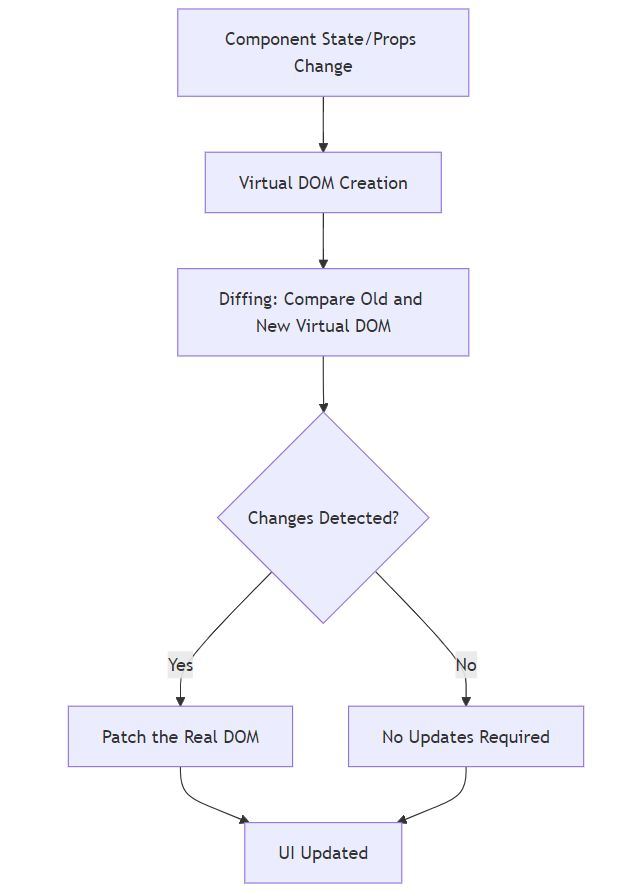
Reconciliation occurs whenever:
A component’s state changes.
A component’s props change.
A parent re-renders, triggering child updates.
🧠 React Fiber: Smarter Reconciliation
Before React 16, reconciliation was synchronous. Once React started rendering, it couldn’t pause until it was finished. Large updates could block the main thread, causing visible lags.
React Fiber (introduced in React 16) changed this:
Breaks rendering work into small units (fibers).
Can pause and resume work.
Introduces priorities:
High → user interactions, animations.
Low → background updates.
Enables incremental rendering, ensuring the UI remains responsive even during heavy computations.
Fiber is essentially the new engine that powers reconciliation, making React much more efficient for modern applications.
📝 Wrapping Up
Let’s recap:
Reconciliation is React’s process of updating the DOM efficiently.
It works by using the Virtual DOM, Diff Algorithm, and the Fiber engine.
The goal is to apply the minimal set of changes to the real DOM while keeping the UI in sync with state and props.
This makes React applications fast, consistent, and scalable.
Simple Analogy
DOM = Actual city
Virtual DOM = Map of the city
Diff Algorithm = Finds which streets changed
Reconciliation = Builds/repairs only those streets
Fiber = Traffic control that decides which streets to fix first
Next time you see a React component re-render, remember: React isn’t rebuilding everything — it’s performing a surgical update through reconciliation.

Join Ankit on Peerlist!
Join amazing folks like Ankit and thousands of other builders on Peerlist.
0
7
0