

A Guide to Medical Image Bounding Box Datasets
Bounding box annotation is where clinical experts meet the requirements of localizing human anatomy by drawing boundaries around abnormalities, so models can learn to find them on their own.
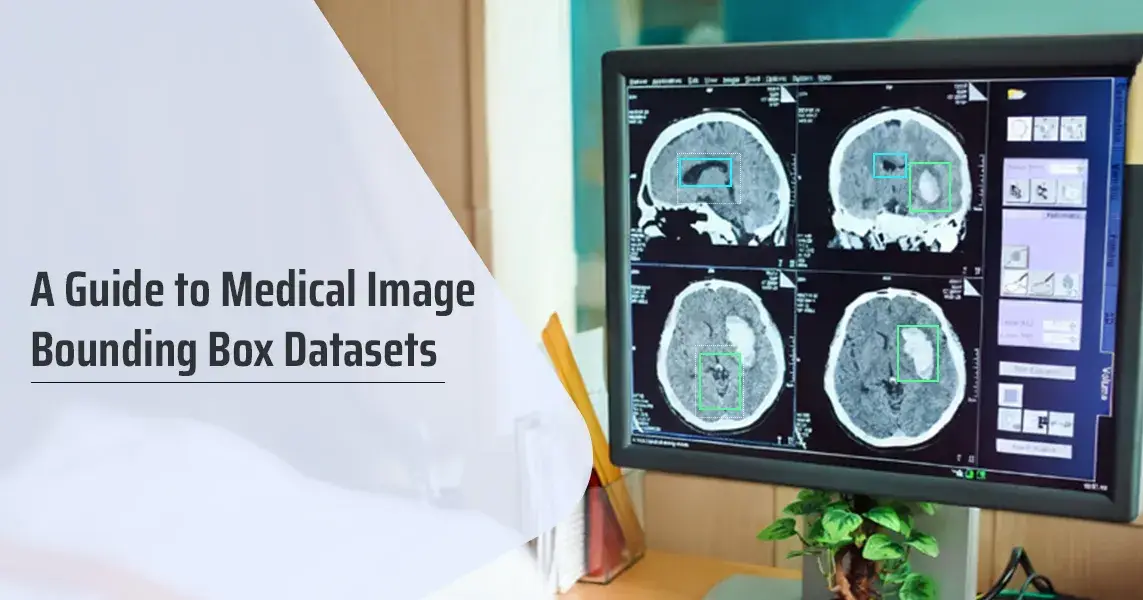
Artificial Intelligence (AI) in healthcare is no longer theoretical. In the case of chest radiograph analysis, AI enhances diagnostic performance for detecting lung cancer, pneumonia, and tuberculosis at earlier stages. This capability in an AI model stems from precise data preparation methods, such as bounding-box annotation, that enable models to accurately localize pathologic findings in medical images.
In one example of a clinical finding, a team of 14 radiologists discarded studies with poor image quality or issues with the report or findings list, and then manually annotated the findings using bounding boxes to identify or highlight regions of interest in each image. This kind of clarity is what AI developers need to develop radiology detection models: high-quality bounding-box training data for DICOM-formatted CT, MRI, or X-ray images, which may contain hundreds of image slices per study.
In this article, we will delve into bounding box annotation as the core learning approach for image recognition models, its applications in medical science, its benefits and challenges, and how to find your go-to partner for these services.
What Is a Bounding Box?
A bounding box is a computer vision annotation method that defines four coordinates to enclose an object of interest in an image, appearing as a rectangle in 2D images or a cuboid in 3D environments. In the context of detecting medical imagery (e.g., X-rays, MRIs, CT scans, ultrasounds) stored in Electronic Health Records (EHR), a bounding-box labeling conveys to the model: "This region, right here, is what matters."
Among the various annotation techniques, bounding-box annotation is a fundamental method for object detection. It sounds simple. And in a way, it is. But in the case of annotating medical images, skilled professionals are needed to convert complex raw data into machine-readable formats, because without specialized knowledge of what to include within four coordinates and what not to, it makes a real difference in building dependable medical training datasets.
The need to understand clinical sensitivity in medical images necessitates our reliance on expert-led annotation, as they bring precision to their work. It is why drawing a box may sound technically simple, but across varied clinical documents, expertise becomes essential.
The Bounding Box Advantage
Bounding-box annotation provides the model with a clear distinction between what it should identify and what it should ignore, enabling it to later efficiently handle the enormous diversity and complexity of noisy documents that happen in the real world, such as finding the presence of radiographic abnormalities in a single projection, which is difficult because all organs—ribs, clavicles, vessels, and soft tissue—appear in the same plane.
It is very important to account for the lack of labels for objects that do not matter in an image. This refers to the fact that failing to label relevant objects in the scene can significantly impact the model's final result. An area without a bounding box is itself a signal that denotes: "This chart, this logo, this decorative figure—these are not what we care about. Don't flag them. Don't learn from them as positives."
Suppose a human annotator draws a bounding box around a region of interest in an MRI scan and indicates whether the region corresponds to a clinically significant object. The act of annotating conveys expertise in a format that can be read by a supervised object detection machine learning algorithm.
This kind of best practice helps the overall medical AI community for secure model development, where false negatives and false positives could be clinically significant. Bad annotations lead to bad models. Good models give accurate and reliable object localization.
The Challenges That Demand Attention
Despite its foundational role, bounding box annotation poses its own set of challenges, making it essential for organizations to prepare in advance to tackle them as they build object detection systems at scale.
The foremost obstacle is annotator subjectivity. It refers to how different annotators may label or interpret the same data differently. This difference in interpretation is annotator subjectivity. It implies that without clear, consistent guidelines, the “quality” factor in training data will decline. When datasets are inconsistent, training data may cause the classifier to behave unpredictably during testing.
Class imbalance is another data annotation bias. Some datasets have unequal numbers of examples per class. For instance, training deep learning models for anomaly detection might involve thousands of well-labeled images of uninjured areas or healthy tissue. As a result, the model learns from this imbalance. When the model is used in practice, it learns to predict "normal" most of the time because the inherent data distributions were flawed.
3D annotation complexity introduces an additional layer of difficulty in domains such as medical imaging, where organs, vessels, and tissues overlap spatially, and in the understanding of sensor noise & motion for autonomous vehicles. Drawing a precise cuboid around a structure that evolves across dozens of volumetric slices demands both domain expertise and significant annotator time.
Lastly, annotation fatigue in high-volume pipelines is a real operational concern. This challenge can be understood with the fact that an MRI scan of a single patient generates multiple sequences (e.g., T1, T2, FLAIR), each producing its own set of images. It may happen that repetitive work may bore human annotators, leading to fatigue or burnout; therefore, maintaining consistent annotation quality requires regular quality audits.
The above challenges also begot the idea that building an in-house workforce of annotators is often unaffordable and unsustainable. This leads us to the next section on finding a partner to help with bounding box annotation services.
Finding the Right Annotation Partner
Outsourcing the workforce is easy, but choosing the right annotation partner is the hard part. Let us look at how to figure out the right partner.
Outsourcing data annotation without losing clinical control: A reliable partner offers domain knowledge experts relevant to the task at hand. In cases where the stakes are high, the vendor’s quality control procedure should involve or at least be able to access domain experts: for medical images, these might be radiologists.
To make it happen, the AI data provider or vendor can collaborate with the client organization’s medical specialists to focus on validation and review rather than day-to-day annotation. Notably, some data annotation companies have networks of medical professionals working for them on high-end tasks. Thus, define your project needs clearly and address them early.
Understand data quality standards: When selecting a partner, it is critical to understand their quality assurance processes. Many vendors support inter-annotator agreement (IAA) measures, such as Kappa scores, and undergo a multi-stage review process to ensure that annotations are compliant with required standards.
Requesting a sample audit from a vendor before sourcing a full project can be a good idea, because a vendor may be able to manage your pilot project of 5000 images, but will they be able to handle the influx of images that arise when you scale up? It is essential to ask in advance about their QC procedures and how they operate when the need for datasets to train a model increases.
Data security and compliance are important in many ways: For example, if you are annotating patient images, you must ensure these images comply with HIPAA standards that dictate how the data can be stored and that you have sufficient controls over where the data is physically stored to prevent it from falling into the wrong hands. The same HIPAA considerations also apply to PCI compliance, but it is more focused on transactional data, as the name implies.
The first requirement of PCI compliance is that all sensitive data must be encrypted in motion and at rest. Another requirement is that any company handling sensitive transactional data must follow specific audit and access-control procedures to prevent such information from falling into the wrong hands. And several other controls need to be put in place as well. These controls ensure that no sensitive information is written to disk, which can then be recovered. That sensitive information is not cached in memory; it is written to disk, where it remains a permanent copy.
Conclusion
Bounding box annotation is where clinical experts meet the requirements of localizing human anatomy by drawing boundaries around abnormalities, so models can learn to find them on their own. Getting these annotations right matters enormously: the diversity of imaging types, disease presentations, and patient anatomy means there's little room for inconsistency. It means recognizing visible pathological deviations or disease progression patterns, which AI systems can efficiently identify when trained on the right data.
The quality of datasets marked in rectangular boxes to identify masses, lesions, and foreign bodies—then converted into structured localization labels—is non-negotiable. Done right, the utility of these labels is contingent on annotation consistency, modality-specific expertise, and systematic quality assurance, as they become the backbone of AI systems that can be trusted in real clinical settings.

Join Rayan on Peerlist!
Join amazing folks like Rayan and thousands of other builders on Peerlist.
0
0
0