

Role of Privacy-first Approaches to Medical Image Annotation
Medical Image Annotation Services
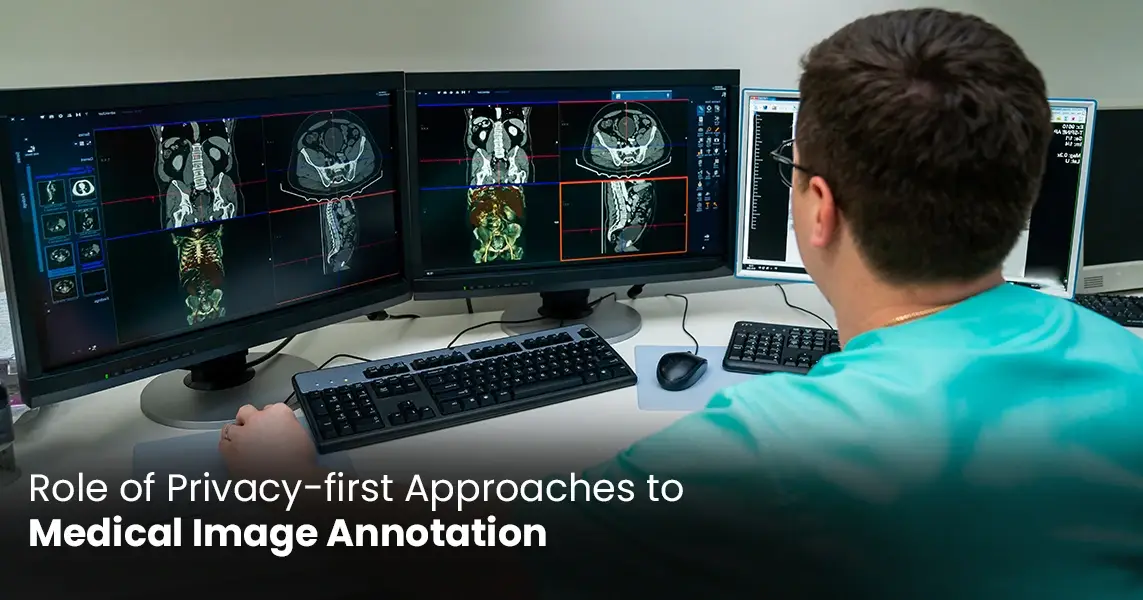
The healthcare industry has seen tremendous transformation thanks to artificial intelligence (AI)-aided medical diagnosis. With AI in healthcare, there are widespread concerns about protecting patient privacy when using patient image-based data. Access to open-source healthcare datasets has also increased the need for a privacy-first approach to healthcare data to reduce data deterioration and maximize research benefits. Globally, various legal rules and regulations have been adopted to enforce stringent data privacy measures.
Data annotation companies are a significant contributor to healthcare AI innovation. The increased worldwide interest in AI applications for medical imaging datasets has necessitated that AI data providers ensure patient de-identification before data sharing. They prepare the training datasets using anonymization methods to secure patient privacy, hire skilled individuals to classify the data, and utilize tools that automate privacy controls.
Many researchers have focused on designing advanced image annotation tools to overcome the need to curate large datasets (big data) that are also compliant. This approach ensures that training data is safe and affordable while maintaining patient confidentiality.
This blog aims to describe different aspects of medical data annotation and explain why outsourcing medical image annotation ensures the highest standard of patient privacy.
Preparing Medical Image Datasets
Medical image annotation—labeling X-rays, CT scans, MRIs, and other imaging data—is essential for building accurate AI models. Yet, alongside accuracy, patient privacy remains a top priority.
When labeling images for model training, AI data providers must maintain the confidentiality of all identifiable information. They also have to ensure the training data is "qualitative." “Garbage in, garbage out” is a universally recognized principle of machine learning (ML) and computing in general. Achieving this balance between structuring raw data and compliance-driven data requires a combination of manual oversight and advanced annotation tools.
Anonymization can be done manually, but some medical image annotation tools have built-in features to automate compliance and speed up the labeling process. These tools have also been embedded in web applications, making it intuitive and straightforward for annotators to capture the required information, even without a technical background.
Third-party providers utilize human-in-the-loop and AI tools to create medical imaging databases where skilled annotators manually verify that every image is de-identified correctly. At the same time, sophisticated platforms enforce HIPAA and GDPR safeguards at every stage.
Why Privacy Matters in Medical Image Annotation?
Medical images often contain sensitive details beyond the visible anatomy. Since doctors consider visible anatomy first to detect disease/injuries, correctly annotating these features is essential for training AI systems to assist in diagnosis, treatment planning, and surgical guidance. Many medical images, especially those stored in formats like DICOM, contain essential text elements that must be annotated carefully.
Medical text annotation for DICOM has metadata embedded in file formats that may include patient names, birth dates, or hospital IDs. In some cases, even the images can reveal personal information, such as facial features in cranial scans or identifying tattoos. Regulations such as HIPAA in the United States and GDPR in Europe require that all personal health information (PHI) be removed or protected before data can be used.
Non-compliance with these global regulations can result in heavy penalties and hinder model deployment. Specialized annotation platforms often include OCR integration and privacy-compliant workflows. They also guide annotators to use bounding boxes, polygons, or segmentation tools to mark text regions before extraction or anonymization.
Role of Manual Processes that Protect Privacy
Automation will be used more often, but it doesn't imply that human oversight isn't still needed to keep privacy protected. A typical manual process involves several careful steps:
Data Intake and Verification – Before annotation begins, trained staff check incoming images for proper consent and review metadata for any personal identifiers.
Manual De-identification – Annotators examine DICOM headers and other data fields to remove patient names, IDs, or hidden notes that might reveal identity.
Visual Anonymization – In this step, data annotators manually blur or crop identifiable regions such as facial features, tattoos, or surgical markings that automated systems might miss.
Secure Annotation Environment – Human annotators work on encrypted platforms with role-based access, ensuring only authorized personnel can view or edit data.
Quality Checks – Quality auditors review anonymized images and maintain logs of all actions to prove compliance during audits.
Importance of Tools with Built-in Compliance Features
Alongside manual efforts, specialized annotation tools provide automated safeguards that help meet privacy regulations, such as Encord, Flywheel, Medannot, etc., with features that support HIPAA and GDPR compliance. Typical features include the following:
Automatic Metadata Scrubbing – Tools can strip patient information from image headers before annotation begins.
Encryption and Secure Storage – Data is protected during transfer and at rest, preventing unauthorized access.
Access Controls—The annotator can label images, but is restricted from downloading the original files. This implies role-based permission to access the files.
Audit Logs – Every action is recorded, providing proof of compliance for regulators and clients.
These built-in safeguards reduce the risk of human error and streamline large-scale annotation projects without compromising privacy.
Why is Outsourcing to a Top Medical Image Annotation Company a Trusted Option?
High-quality datasets are paramount in artificial intelligence. Creating these datasets often faces a significant challenge: the time-intensive image annotation process. Although hospitals and healthcare institutions generate vast amounts of medical images daily, much of this data cannot be used to train supervised learning models because it lacks proper annotations. The focus is on the need to standardize image curation and annotation.
Top data annotation companies use careful human supervision and automation to ensure every image is labeled correctly and personal information is removed. This approach safeguards patient privacy and delivers quality data to train AI models. Hospitals and research centers prioritize this, leading to outsourcing medical image annotation to specialized AI training data providers.
Even though you’ve sourced free healthcare datasets, the images and videos within must be cleaned and prepared for annotation. If your AI model is being trained as part of a commercial project aiming for FDA approval, patient identifiers must be removed from tags and metadata. You need a reliable partner who can do this work for your benefit, as they have an ideal infrastructure, resources, and updated tools to ensure top-notch medical training data.
Conclusion
Keeping patient information private is an ongoing practice. Manual de-identification removes subtle identifiers, while automated tools ensure compliance. Both strategies offer a solid privacy framework that protects patient privacy while encouraging new ideas in medical AI.
The value of these datasets can’t be understated, especially if you’re training a model for medical image analysis. Depending on the goals, you might be able to use one of the open-source or public datasets, or you might need access to proprietary medical imaging datasets. In both cases, an annotation process is necessary to ensure data is cleaned, labeled, and compliance-driven to a reasonable level of accuracy.

Join Rayan on Peerlist!
Join amazing folks like Rayan and thousands of other builders on Peerlist.
0
0
0