

Meaning of GTM for Early Stage B2B SaaS Startups in 2025
There’s plenty of advice out there, but most of it assumes that what worked for one company will work for another. That’s rarely the case.
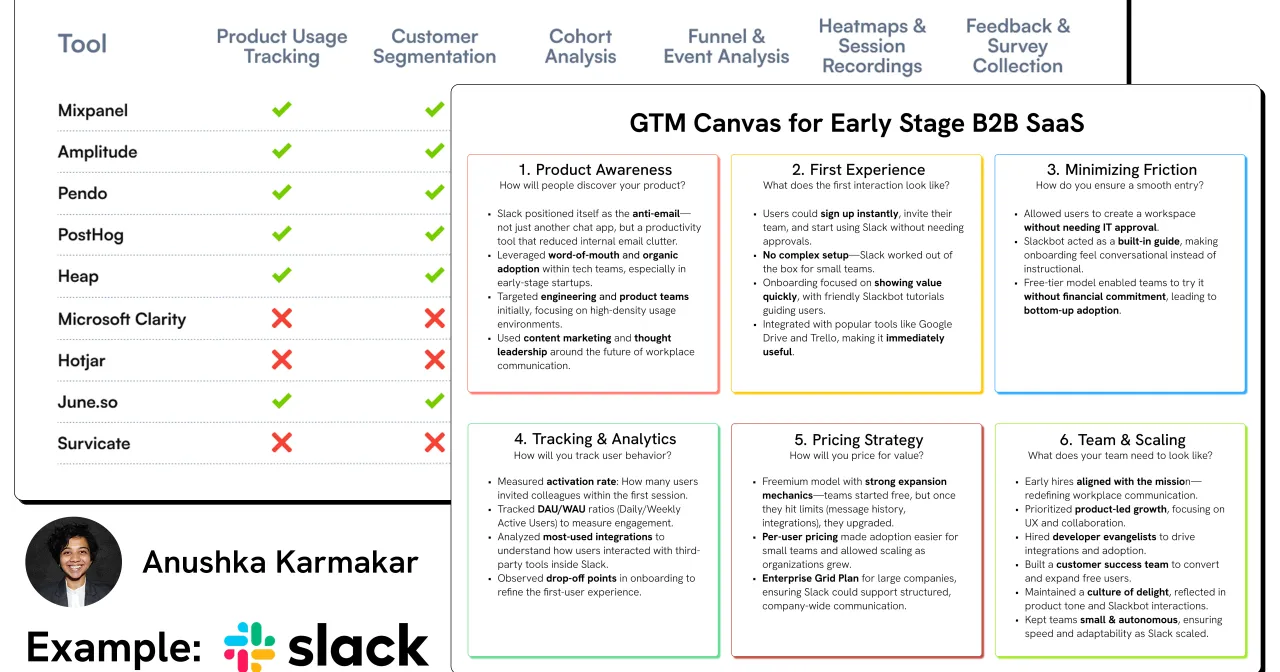
Building a go-to-market (GTM) strategy for an early-stage B2B SaaS startup can be overwhelming. There’s plenty of advice out there, but most of it assumes that what worked for one company will work for another. That’s rarely the case. Every product, team, and market is different, and so are the challenges they face.
The GTM Canvas offers a different approach. Instead of handing you a rigid playbook, it gives you a framework to start with a way to think clearly about your strategy and adapt it to your unique situation. It’s about asking the right questions and finding answers that make sense for you.
This paper will take you through the core sections of the GTM Canvas, with practical ideas and insights to help you create a strategy that feels intentional and effective. Whether you’re a founder, marketer, or simply curious about GTM, the goal is to give you a starting point.

The GTM Canvas
The GTM Canvas is built on the idea that every SaaS company faces unique challenges. Instead of prescribing a specific formula, it provides a structured framework that helps you think critically and adapt to your circumstances.
This paper intentionally avoids jargon. The goal is to ensure that no one gets lost in technical terms or buzzwords.
First-principle thinking, the foundation of this approach, focuses on breaking problems into their most basic elements and reasoning upward from there. It’s a way to uncover core truths and build solutions tailored to them. If you’re curious to learn more, this article from Farnam Street provides an excellent introduction.
The GTM Canvas itself is divided into key sections that reflect the fundamental components of a successful go-to-market strategy. Each section represents an area where you’ll need clarity to make informed decisions:
How do you create awareness for your product?
What does your first customer interaction look like?
How do you ensure people experience the value of your product?
What systems will you use to track behaviour and improve outcomes?
How will you price your product fairly and effectively?
What does your team need to look like as you grow?
By addressing these questions, the GTM Canvas encourages you to think holistically, aligning your product, team, and market in a way that feels intentional.
Click here to download the Figma Template or PNG file.

Asking the Right Questions
The GTM Canvas is a way of thinking.

To fill in the sections effectively, you need tools that help you ask better questions. Mental models provide structure and help approach challenges with precision.
Throughout this paper, you will see these models referenced in different contexts, guiding how you approach key parts of the GTM Canvas. Below is an introduction to three mental models that are particularly helpful when building your strategy.
a. Jobs to Be Done (JTBD)
This model helps you understand the purpose your product serves for customers. It shifts the focus from features to outcomes.
Example: If your product is an analytics tool, the question is not, “What dashboards do users want?” The better question is, “What decisions do users need to make, and how can we help them make those decisions faster?”
Identify the customer’s core challenge.
Ask, “What are they trying to achieve in their work or daily life?”
Frame your product as the enabler of that outcome.
Relevant to:
How will people discover your product? (GTM Canvas Question 1) If customers are already searching for ways to complete a task, positioning the product around their needs makes it easier for them to find and understand its value.
What does the first experience look like? (GTM Canvas Question 2) Onboarding designed around helping users complete their intended job quickly increases engagement.
b. Inversion Thinking
Thinking about success is important, but sometimes starting with failure reveals blind spots. Inversion thinking asks, “What could go wrong?” and helps build strategies to prevent it.
Example: Instead of asking, “How do we retain users?” ask, “What would make users leave?” This can help focus on onboarding issues, hidden frustrations, or unmet expectations.
List everything that could go wrong.
Think about ways to prevent or mitigate those risks.
Use these insights to refine your GTM approach.
Relevant to:
How will you minimize friction? (GTM Canvas Question 3) Instead of just improving onboarding, identifying why users might drop off makes it easier to design an intuitive experience.
How will you price for value? (GTM Canvas Question 5) Instead of only asking what the best pricing strategy is, considering what would make customers reject the pricing helps avoid common pitfalls.
c. First-Principles Thinking
This model challenges you to break ideas down to their simplest truths instead of relying on assumptions.
Example: Instead of assuming, “Freemium is essential for product adoption,” ask, “What makes customers see the value of our product? Is freemium the best way to achieve that?”
Identify the assumptions you are working with.
Ask, “Why do I believe this? Is this based on evidence or habit?”
Build strategy based on insights, not convention.
Relevant to:
How will you track and analyze user behavior? (GTM Canvas Question 4) Instead of defaulting to standard analytics, determining what truly signals success for the product ensures the right data is collected.
What does your team need to look like as you grow? (GTM Canvas Question 6) Conventional hiring strategies may not fit every startup. Identifying what is actually needed leads to better decisions about team growth.
Mental models do not provide answers, but they refine how questions are asked. Applying them at the right stages ensures decisions are intentional rather than reactive.
Before focusing on awareness, it's crucial to understand who you're trying to reach. Without this clarity, marketing efforts can become scattered and ineffective. If you haven't yet defined your Ideal Customer Profile (ICP), start there. This guide from Salesforce, published in December 2024, offers a comprehensive approach to identifying your ideal customers.
1. Letting Your Product Be Known
(GTM Canvas Question 1: How will people discover your product?)
Before users can experience a product, they need to know it exists. The challenge is ensuring the right people see, understand, and care enough to explore further.
Positioning comes first. Without a clear positioning strategy, marketing efforts become scattered. Every touchpoint, from the website to outbound messaging, should reinforce what the product does, who it’s for, and why it matters.
a. Defining Positioning Before Driving Awareness
Positioning is the foundation of awareness. If a product isn’t positioned well, no amount of marketing will make it stick.
What helps:
Clarity on the core value proposition. What specific problem does the product solve? Who experiences this problem most intensely?
Competitive differentiation. How is this product different from existing solutions? Is it faster, cheaper, more efficient, or solving a problem in a new way?
Messaging that resonates. Does the way the product is described align with how the target audience talks about their pain points?
The best positioning makes marketing easier by ensuring that every interaction reinforces a single, compelling narrative.
b. Building Awareness Based on Budget
Once positioning is clear, the focus shifts to where and how to create awareness. The right approach depends on budget and available resources.
Budget allocation depends on a startup’s stage and priorities. Some early-stage B2B SaaS startups allocate around 15-20% of their annual revenue to marketing, while growth-stage companies may invest 30-50% of their revenue to drive rapid customer acquisition. In some high-growth cases, SaaS companies spend as much as 40% of their revenue on marketing.
A "small budget" typically means relying on founder-led content, community engagement, and organic channels, while a "big budget" allows for paid campaigns, media partnerships, and a dedicated content team. Understanding these benchmarks can help startups make informed marketing investments.
If there’s no budget:
Be present where the target audience already spends time—LinkedIn, industry-specific forums, Slack communities, or Reddit.
Share insights, perspectives, or expertise related to the problem the product solves.
Build relationships with early adopters who have influence within their networks (some of these references are likely to come from investors, if there are any).
If there’s a small budget:
Work with freelancers or agencies to create blog posts, videos, or targeted campaigns.
Run low-cost experiments to test different content formats and distribution channels.
Focus on platforms that maximize organic reach rather than relying heavily on paid ads.
If there’s a big budget:
Build a media presence—through original research, video series, podcasts, or in-depth industry reports.
Invest in paid distribution to amplify organic efforts.
Create collaborations with industry experts, influencers, or companies that share the same audience.

c. Creating Alongside the Product
The best awareness strategies evolve with the product. Instead of waiting until everything is perfect, building in public helps establish credibility early.
What helps:
Writing about learnings and insights. Whether on LinkedIn, a company blog, or Twitter, sharing knowledge builds trust.
Testing messaging live. Positioning doesn’t have to be fixed. Engaging in discussions helps refine the way the product is framed.
Letting early adopters shape the narrative. The way users describe the product is often the best way to position it for future marketing efforts.
Letting a product be known is about making sure the right people see it, understand it, and feel compelled to explore it further. Strong positioning makes that easier, and a thoughtful awareness strategy ensures that when people find the product, they already feel like it’s meant for them.
2. Creating a Memorable First Experience
(GTM Canvas Question 2: What does the first experience with your product look like?)
A user’s first experience with a product does not start at sign-up. It starts the moment they land on the website. If the website does not clearly communicate what the product does, who it is for, and why it matters, users will not move forward. A strong first experience builds confidence, making users feel like they are in the right place before they even try the product.
a. Optimizing the First Touchpoint: The Website
Before users explore the product, they evaluate its promise. The website should make that decision easy. Instead of listing features, it should focus on what users can achieve with the product.
What helps:
Clarity on value. Users should instantly understand how the product helps them reach their goals.
Realistic expectations. If setup is required before the product becomes useful, say so upfront.
A natural next step. Whether it is signing up, booking a demo, or trying a sandbox environment, users should not have to think about what to do next.
b. Setting the Right Expectations
Not every product delivers instant value. Some require initial setup, such as importing data, integrating systems, or configuring preferences, before users see results. When this is the case, setting clear expectations upfront helps users commit to the process.
What helps:
A transparent onboarding path. Let users know what steps are involved and what they will get in return.
Previews of success. Show examples, templates, or case studies to help users visualize the impact of using the product.
A mix of self-serve and guided options. Some users prefer to explore on their own, while others benefit from structured guidance.
c. Helping Users Reach Their First Win
A memorable first experience delivers early value. The sooner users see a tangible outcome, such as an insight, an automated process, or a completed task, the more likely they are to stay engaged.
What helps:
Simplifying the path to value. The product should guide users toward a meaningful outcome without overwhelming them with choices.
Preloaded data or sandbox environments. Letting users explore before committing reduces hesitation.
Human assistance when needed. Some products benefit from hands-on guidance, whether through live chat, onboarding calls, or interactive walkthroughs.

Users stick around when they see value quickly. A strong first experience gives them a reason to continue.
3. Minimizing Friction to Ensure Adoption
(GTM Canvas Question 3: How will you minimize friction and make it easier for people to get started?)
Getting started with a product should feel effortless, but the right approach depends on how complex the product is. Some products are simple enough to explore without guidance, while others require structured onboarding. A product that involves integrations, compliance steps, or technical configurations will naturally have more steps before users see value. In these cases, removing friction entirely is not the goal. The goal is to make necessary steps as seamless as possible while ensuring users know what to do next.
a. Understanding Product Complexity & Friction
Not all products can be fully self-serve, and that is not a flaw. Some products require setup before they can deliver value, and onboarding decisions should be based on this complexity.
Self-serve products (such as note-taking apps or collaboration tools) benefit from minimizing steps and letting users explore independently.
Complex products (such as infrastructure tools, AI automation, or fintech solutions) need a structured path to onboarding. In these cases, friction is not a problem—it ensures users configure the product correctly. When setup is complex, human assistance can be a better option than forcing users through an automated flow.
b. What Causes Friction?
Friction appears when users struggle to move forward, whether due to a complicated sign-up process, unclear next steps, or excessive requirements before they can start using the product. Some of the most common causes include:

Requiring too much upfront information. Long sign-up forms asking for unnecessary details create hesitation.
Lack of immediate value. If users do not experience something useful early on, they are likely to disengage.
Forcing every user down the same path. Some users prefer guided onboarding, while others want to explore on their own.
Reducing friction does not mean removing structure. The goal is to eliminate unnecessary obstacles while keeping the essential steps that help users succeed.
c. How to Minimize Unnecessary Friction
Friction cannot always be eliminated, but it can be simplified. A well-designed onboarding flow ensures users can move forward with minimal effort while still completing necessary setup. What helps:
Single Sign-On (SSO) and passwordless login. Reducing authentication friction makes sign-up faster.
Preloaded default settings. If users need to configure the product, providing recommended defaults reduces decision fatigue.
Letting users skip non-critical steps. If an action is not essential for immediate value, users should be able to return to it later.
When necessary steps are streamlined, users move forward with less hesitation.

Source: Onboarding Done Right: A Masterclass with Ramli John, Author of Product-Led Onboarding
d. Balancing Automation with Human Guidance
Some onboarding steps require human support, and that is completely fine. The more complex the setup, the more valuable human assistance becomes. While automation improves scalability, the right level of human guidance can reduce drop-off in products that require configuration.
What helps:
Live chat or onboarding calls. These can be offered selectively for high-intent users or when setup involves technical decisions.
Interactive walkthroughs. For products that are mostly self-serve, in-app guides help users navigate key workflows.
Pre-recorded onboarding videos. When real-time guidance is not feasible, structured walkthroughs can provide clarity without requiring a live call.
The key is to provide guidance where it matters while keeping the process intuitive for those who prefer to figure things out on their own.
4. Tracking and Analyzing the Journey
(GTM Canvas Question 4: How will you track and analyze their journey?)
Every business needs analytics, but tracking what happens inside the product is not enough. Understanding how users navigate the product is useful, but without customer intelligence, it is impossible to know which types of customers take which actions and why.
To make analytics actionable, product data must be paired with customer insights. The real value comes from knowing:
Who is using the product? (Customer intelligence)
What are they doing inside the product? (Product analytics)
What patterns emerge across different customer segments? (Segmentation)

a. Combining Product Analytics with Customer Intelligence
Product analytics tracks events that occur within the product, such as feature usage, time spent in-app, and drop-off points. Customer intelligence data adds context by showing who the users are, what their needs are, and how different segments behave differently.
When combined, these insights help answer deeper questions:
Are power users concentrated in a specific industry or company size?
Do churned users share common behaviors before leaving?
Which customer segment reaches the activation milestone the fastest?
b. Modern Analytics Tools Blend These Insights
Most analytics platforms today do not separate these concepts, they allow businesses to track user behavior while also identifying trends across customer segments. Tools like Mixpanel, Amplitude, and Pendo let teams analyze product usage while grouping users into cohorts based on company size, industry, or user role.
Instead of looking at analytics as separate categories, the focus should be on building a feedback loop where product data informs customer strategy, and customer insights refine product decisions.
For further reading on the integration of product analytics and customer intelligence, consider these recent articles:
How AI-enhanced product analytics drives dynamic decision-making – This article discusses how AI-driven product analytics improves decision-making by rapidly processing data and predicting trends.
What is Customer Intelligence (CI)? Examples & Insights – This piece delves into the process of gathering and analyzing consumer data to understand customers on a deeper level.
How B2B SaaS Analytics Drive Growth – This article highlights the importance of high-quality consumer data in understanding customer journeys and driving business success.

5. Pricing Your Product
(GTM Canvas Question 5: How will you price your product fairly and effectively?)
Pricing shapes how customers perceive the product and determines how revenue scales over time. While pricing changes are inevitable, it is always harder to raise prices later than it is to adjust early on. A thoughtful pricing strategy ensures customers see the value and are willing to pay for it.
a. Common Pricing Mistakes and How to Avoid Them
Many early-stage SaaS startups struggle with pricing because they either underprice too early, overprice without proof, or structure pricing tiers poorly.
Underpricing Too Early
A lower price can attract users quickly, but once customers associate a product with a low price, increasing it becomes difficult. When prices go up, many leave because they never valued it at a higher price in the first place.
What helps: If pricing has to be low in the beginning, make it clear that it is temporary. Label it as early adopter pricing or pre-launch pricing. Another way to offset this risk is by structuring pricing so that revenue scales with customer usage.Overpricing Before You Have Proof
Pricing signals value, but without supporting proof such as case studies, testimonials, or clear differentiation, it can feel arbitrary and slow adoption.
What helps: Pre-revenue pricing can help. Offering early access pricing in exchange for testimonials or case studies builds validation while ensuring early users have skin in the game.Misaligned Pricing Tiers
If pricing tiers do not align with customer needs, some customers feel they are overpaying while others feel blocked from real value.
What helps: Run willingness-to-pay tests before setting tiers. Pricing should scale with perceived value, and upgrades should feel natural rather than being driven by artificial restrictions.
b. Should You Offer a Free Trial or Freemium Model?
Free pricing models work well for certain SaaS products, but not all products benefit from free trials or a freemium plan.
When free trials work well:
If users can reach value quickly, a free trial makes sense (e.g., project management tools, email automation).
If the onboarding is self-serve, users can explore independently.
When freemium works well:
If the product delivers ongoing value at scale, freemium can drive adoption (e.g., Slack, Notion).
If network effects improve retention, free users can convert over time.
When free models fail:
If it takes too long to reach value, a free trial can lead to unqualified sign-ups.
If the product requires deep integrations or human onboarding, free users may never convert.
For high-touch B2B SaaS products, free trials should be short and designed to get users to their "aha moment" as fast as possible.
c. Validating Pricing Before Launch
Instead of guessing, startups should test pricing with real customers before committing to a model.
What helps:
Talking to potential customers and asking:
"At what price does this feel too expensive?"
"At what price is this expensive, but still worth considering?"
"At what price does this feel like a bargain?"
Benchmarking against competitors to understand pricing models, not just numbers.
Using the Van Westendorp model to measure pricing sensitivity across different customer segments.
d. Aligning Pricing Tiers with Customer Segments
Pricing tiers should match how different customer groups perceive value.
SMBs prefer predictable pricing. They often choose lower tiers and expect simple, transparent pricing.
Enterprises expect customization. They are willing to pay for higher-tier plans if they include compliance, security, and scalability features.
If a product has both SMB and enterprise customers, the pricing model should account for the different ways they justify cost.
e. Psychological Anchoring in Pricing
Pricing influences perception. A well-structured pricing page can drive conversions by using strategic price positioning.
A $99/month plan looks affordable next to a $299/month plan. The contrast makes the lower price feel reasonable.
A high-priced premium tier increases conversions on mid-tier plans, even if very few customers choose it.
Bundling features into higher tiers ensures that each pricing level offers a meaningful step up in value.
However, psychological pricing only works if it aligns with customer expectations. If the baseline price feels too high, anchoring will not work—customers will walk away instead.
For a pricing strategy to be effective, it needs to balance perceived value, willingness to pay, and long-term revenue scalability.
6. Building a Scalable Team
(GTM Canvas Question 6: What does your team need to look like as you grow?)
A product does not grow on its own. The people behind it determine how well it scales. A strong team understands the mission, adapts to rapid changes, and feels personally invested in the product’s success. But as a company grows, so do the challenges of keeping the team aligned and moving in the same direction.
a. A Team That Believes in the Product
Before customers advocate for the product, the team needs to believe in it. When team members feel their work contributes to solving a real problem, they naturally become advocates. They share their experiences, take pride in what they are building, and bring credibility that no marketing budget can buy.
What helps:
Ensuring alignment from day one. People do their best work when they understand the vision and how their role contributes to it.
Involving the team in decisions. When people feel heard, they are more likely to take ownership of outcomes.
Recognizing meaningful contributions. A simple acknowledgment of good work reinforces engagement and motivation.
Word-of-mouth starts internally. A team that believes in the product will organically drive interest outside the company.
b. Internal Alignment Prevents Silos
As teams grow, misalignment increases. Product, sales, marketing, and customer success teams often operate with different goals, which leads to confusion and inefficiencies. A common problem in scaling teams is that the product team is building one thing while sales is selling another.
What helps:
Shared customer insights. Every team should have access to the same customer data, whether through shared dashboards or regular cross-functional meetings.
Defined ownership of key growth metrics. If marketing measures success by leads, sales by revenue, and product by adoption, they may work in different directions. A single shared growth framework ensures everyone stays aligned.
Early involvement across teams. Bringing sales, marketing, and customer success into product discussions early prevents misalignment between what is promised and what is delivered.
Scaling means ensuring teams work together toward a common goal.
c. Structuring the Team for Growth
Startups often hire reactively, bringing people on when pain points arise. But a scalable team structure requires thinking ahead.
Early-stage startups need generalists. When speed matters, hiring people who can adapt and take on multiple roles is critical.
As the product matures, specialists become more valuable. Growth marketing, sales enablement, and product operations become necessary functions.
Hiring should align with product maturity. Bringing in specialists too early slows momentum, while waiting too long can lead to inefficiencies.
The best hiring decisions consider both immediate needs and future scalability.
d. Scaling Without Losing Culture
Culture does not scale automatically. Early teams work closely, but as the company grows, communication becomes harder. The biggest challenge is not just hiring the right people, it is ensuring they share information, make aligned decisions, and feel connected to the mission.
What helps:
Transparency about challenges. People stay engaged when they feel part of the journey, not just when things are going well.
Clear communication of decisions. As teams scale, assumptions become dangerous. Regular updates on priorities, product changes, and company goals prevent misalignment.
Investing in personal growth. Whether through mentorship, training, or encouraging team members to explore new skills, growth-driven teams stay motivated.

A strong team does not just build a great product. it makes the journey meaningful. Regardless of the outcome, the time spent building should feel like it was worth it.
Fin.
That’s it. I hope this article helps you ask better questions, adapt as you grow, and make decisions with clarity.
This paper would not be what it is without David Yockelson, who took the time to review it and provide thoughtful feedback. His insights have shaped many of the ideas here, and I am grateful for his generosity in sharing his expertise.
If you have any questions or suggestions, feel free to reach out on LinkedIn or drop me an email at [email protected].
Thank You
David Yockelson – Two and a half years ago, I barely knew anything about GTM. Yet, you always took the time to answer my questions, no matter how naive they were. You teach me humility.
Wes Bush – For me, PLG is synonymous with Wes. I first discovered the book, then the concept. Four years later, I feel fortunate to be one of the early readers of your latest book before it launched.

Join Anushka on Peerlist!
Join amazing folks like Anushka and thousands of other builders on Peerlist.
0
6
0