

The Placenta Study I Can’t Stop Thinking About
Microplastics are everywhere from our oceans and food to our blood and urine
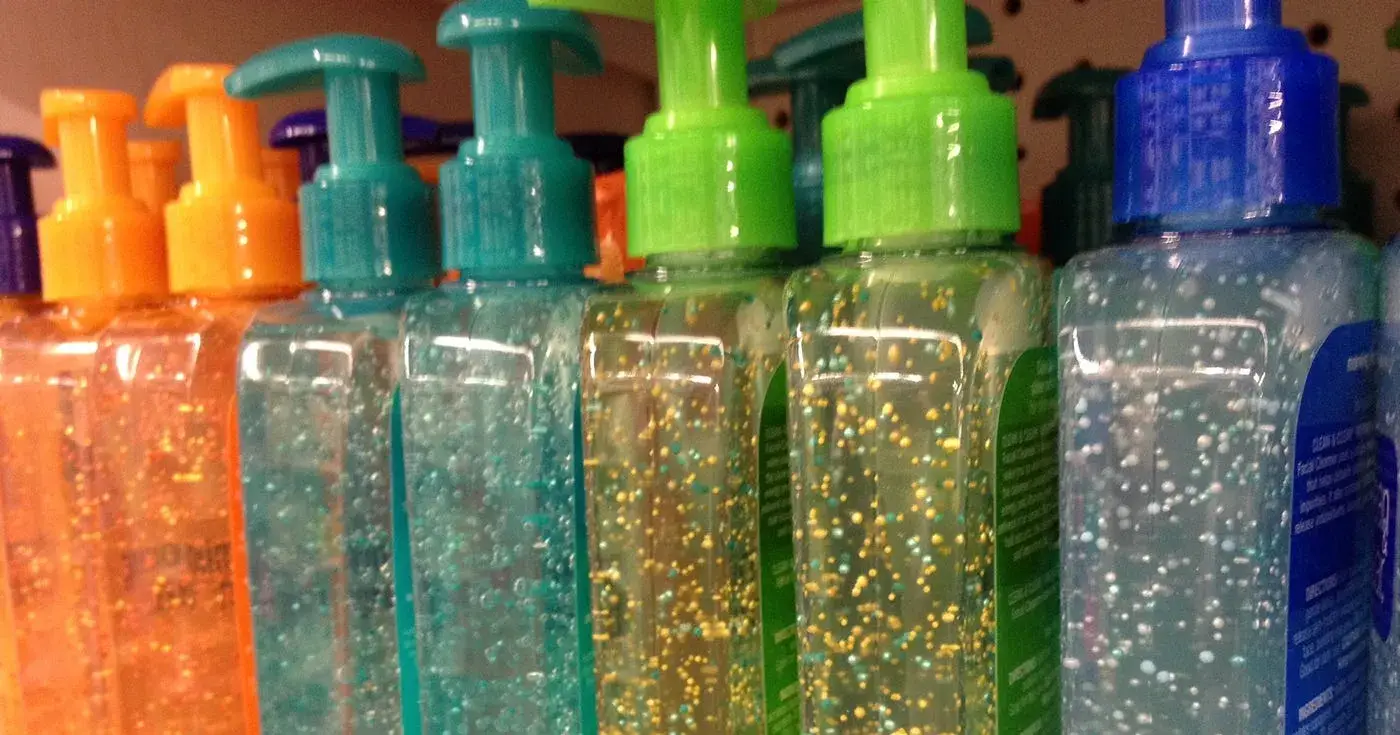
You should not need a chemistry degree to know what you are putting on your body.
In 2015, the US government banned plastic microbeads from rinse-off personal care products, such as toothpastes, exfoliating face scrubs, and cleansing washes.
The law was straightforward: the tiny plastic particles were going down drains, passing through water treatment systems, and accumulating in lakes and oceans where fish were ingesting them. Congress called it the Microbead-Free Waters Act. Most people considered it just another “environmental problem” and moved on.
Because, I was lucky to be raised on a Greek island with pristine waters, I paid attention. I switched toothpaste brands.
My consumer choice changed. Naturally, I felt accomplished.
Then I read a research study.
In 2021, a team of Italian researchers published a paper in Environment International under a title I have not forgotten: “Plasticenta: First Evidence of Microplastics in Human Placenta.” They analyzed six placentas from women with healthy, uncomplicated pregnancies. They found microplastic fragments — consistent with polypropylene and with pigments used in cosmetics and polymers — on both the fetal and maternal sides, and in the chorioamniotic membranes.
The placenta is the tissue that forms during pregnancy with the specific biological function of filtering what reaches a developing child.
Then in 2024, University of New Mexico corroborated these findings with their study of 62 placentas as well.
Molecules, toxic or not, interact with one another to create our living world. This is one of the reasons, I studied Chemical Engineering.
I understand how compounds move through biological systems. As a result, medical phenomena are of high interest to me.
If it is in the placenta and in our waterways, aren’t environmental contamination and personal health two sides of the same coin?
What else is in these products that was not designed with our long-term health in mind?
This pattern has precedent
Before BPA became a household word, it was an industry standard (plastic bottles, food can linings), even though internal research had already flagged its endocrine-disrupting properties. The compound spent decades accumulating in the bloodstream of most of the developed world before “BPA-free” became a label. This 2011 study by researchers in Edmonton, Alberta, supports the claims of BPA’s persistence in our bodies by studying the blood, sweat, and urine of people.
The European Union has restricted or banned 2574 substances in cosmetics under its regulatory framework. The US FDA is more loose. The difference between these regulatory bodies is philosophical. The EU bans what might be harmful. The US requires proof of harm first. No pre-market safety testing is legally required for cosmetics sold in the American market.
In the following table we can see a more practical reference of ingredients that are banned in the EU but sometimes legally used in formulations in the US.
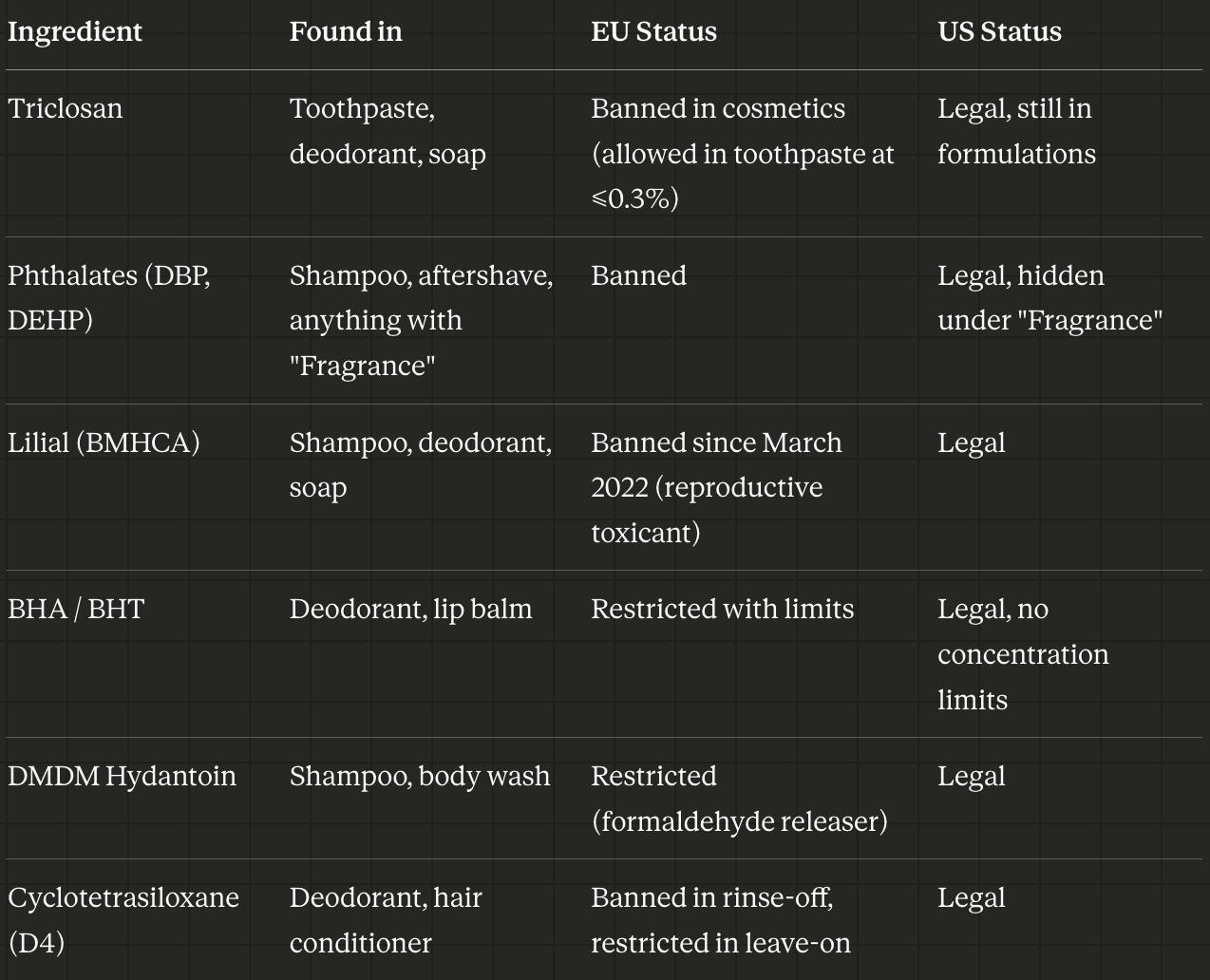
That gap is not theoretical. Triclosan — an antimicrobial linked to thyroid disruption — is banned in EU cosmetics and still present in some US deodorants and soaps. Phthalates, with documented anti-androgen activity, are banned in EU formulations and still appear in US products listed under the single word: Fragrance. The list goes on; this is just a sample.
I do not have a chronic illness. But I have a family history that functions like a quiet warning. My grandmother died of heart disease at fifty. My aunt, cancer, at sixty-four. Neither of them was reckless with their health. They were living with the products and the information available to them — which is to say, very little of the latter.
What I found on my own bathroom shelf confirmed that these chemicals are prevalent everywhere. Ingredient after ingredient with documented endocrine-disrupting profiles that even I as a trained chemical engineer would be unaware of. Not because the information doesn’t exist, but because it is trapped in a language most people were never taught, in a list designed to be skipped.
Nobody had built a tool that made this legible for men — in the time it takes to actually stand in a pharmacy aisle, with a product in your hand, running late.
So I built one that makes finding information about a product, as easy as scanning it.
What is more, healthy product alternatives are the core offering that addresses the need that I and many other males have.
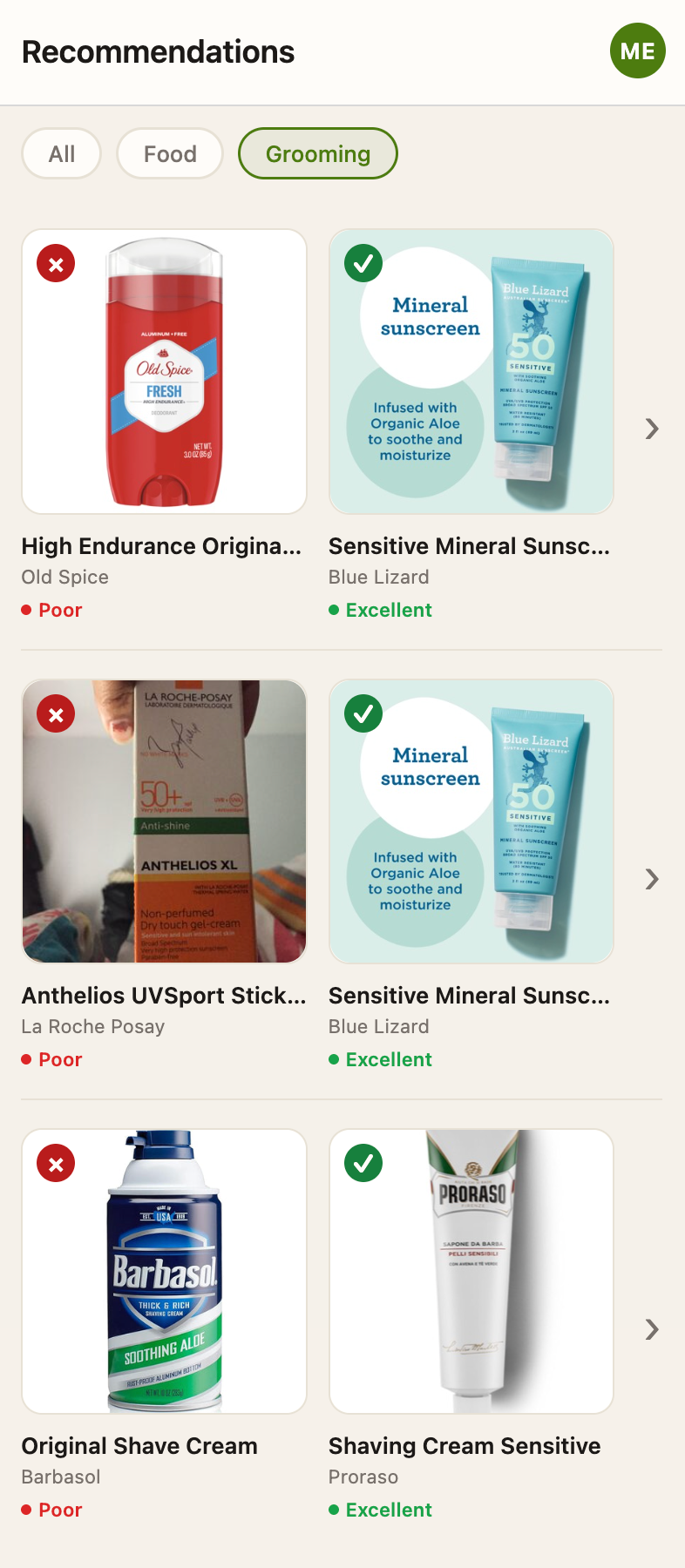
Mangood scans grooming, supplement, and some food product labels and scores them against the best available evidence — weighted for male-specific health: testosterone, fertility, and endocrine function. Because the research exists. It just was never made accessible at the moment it matters.

Join Ari on Peerlist!
Join amazing folks like Ari and thousands of other builders on Peerlist.
0
6
0