

Reliance against Telegram , the technical element .
What is BGP hijacking and what is reliance doing against telegram to reduce competition .
Before understanding the whole story , let's go through the boring part first , How does internet even work ? .
How does Internet work ?
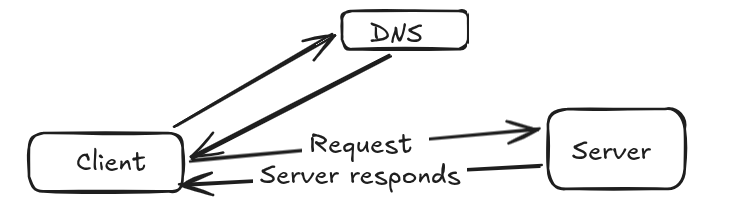
You must be familiar with this whole setup above , where your client requests for a url and the request is then checked in DNS server also called as DNS Lookup , then IP is found and request is sent to the server and then it (server) responds back .
But who carries this whole request ? Your ISP , right ?
How does the ISP carry these requests , because there is very less chance that your ISP covers the whole world with their fibre optic cables .
Border Gatway Protocol
When your request reaches the ISP , ISP doesnot know the route to that IP . It doesnot know where does it belong to and where to send that request next .
That is where BGP is introduced , this protocol basically is the postmaster (mentioned in mang blogs) of the Internet .
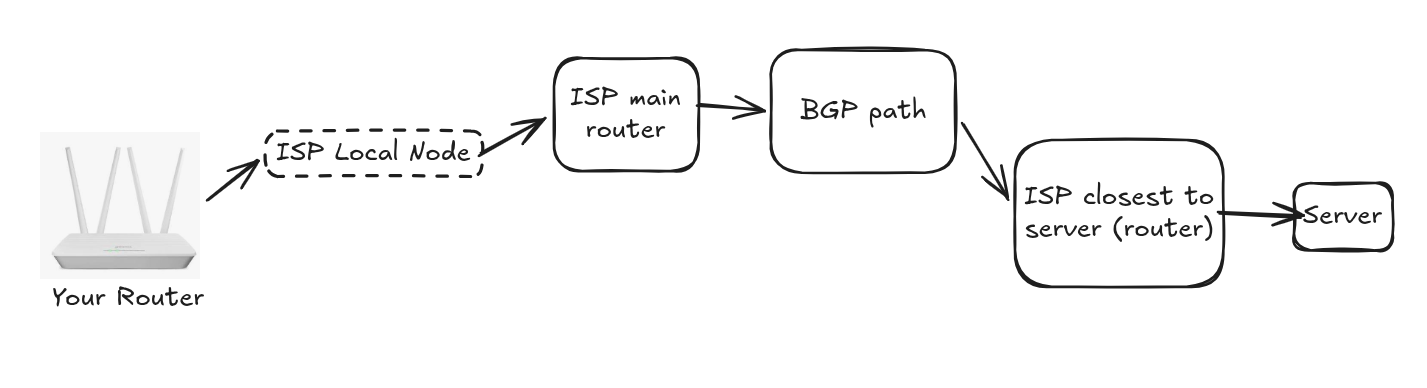
And this happens for all requests , be it your DNS lookup request , direct connection to server , or anything . This same thing happens each and every time (there is router level caching as well to remeber this path ) .
How does BGP decide where to route the request
There are several factors , but it majorly depends on how are the connections between these several ISPs .Here is the list below :
Weight: A Cisco-proprietary attribute, this tells a router which local paths are preferred.
Local preference: This tells a router which outbound path to select.
Originate: This tells a router to choose routes it added to BGP itself.
AS path length: Similar to the example diagram above, this attribute tells a router to prefer shorter paths.
Hop count : after how many hops is the request going to reach the destination
Business conditions (some companies may not like some other companies and this their request is not allowed to pass).
Cost : How much cost is associated if some x path is taken .
Look at request again
Now that we understand the BGP , let's look at our previous request again , but how it interacts physically.
DNS lookup
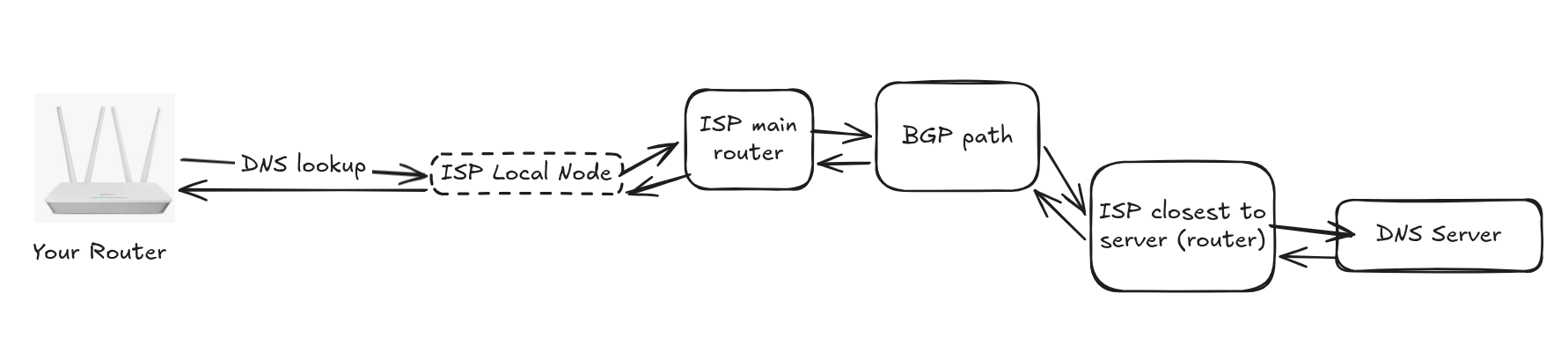
This is what the request looks like for DNS lookup , which goes before reaching the server .
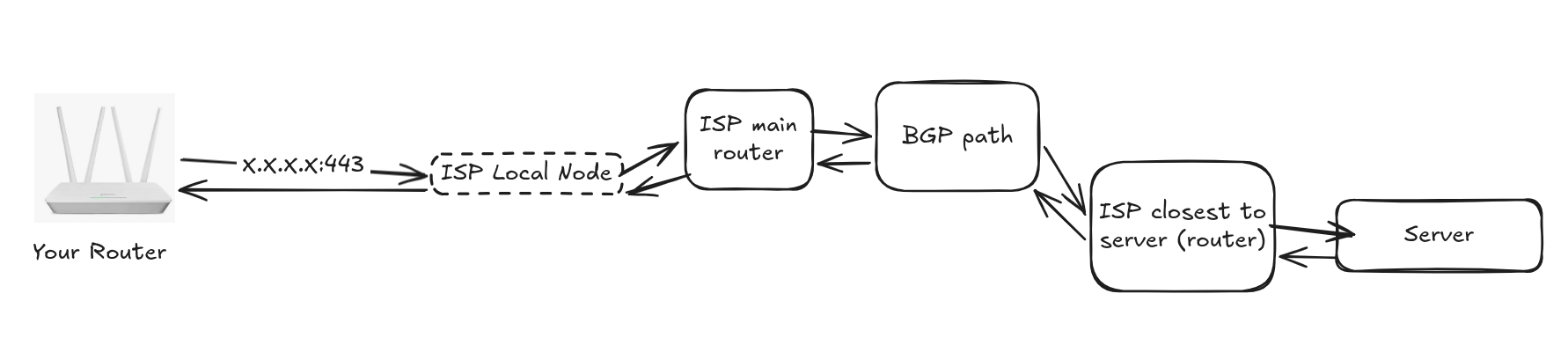
After getting the IP address of the destination server , then the server takes this whole setup again , like this .
Internet , a definition
Internet is a collection of many subnetworks , that are not owned by anyone , and these are called as Autonomous Systems (ASs) .These subnetworks are hundreds or even thousands in number . These network pools are owned, run and maintained by ISPs / organizations .
If BGP is postmaster , then these network pools are post offices , here you as a user (or your router) sends your message . Which is then sent to the postmaster to get the correct location , as well as the route of this destination .
The internet is a very dynamic place , many servers are created and destroyed everyday , so how do these AS ( autonmous systems ) know which one is obsolete or running , or newly created ? They talk to each other over TCP/IP and share routing information , this is called as peering .
What happened between Reliance and Telegaram
Now that the boring part is over , lets get back to the story , what exactly happened ?
The GOI recently blocked Telegram's usage in the country from 16th june, because of NEET paper leaks till 22nd june .
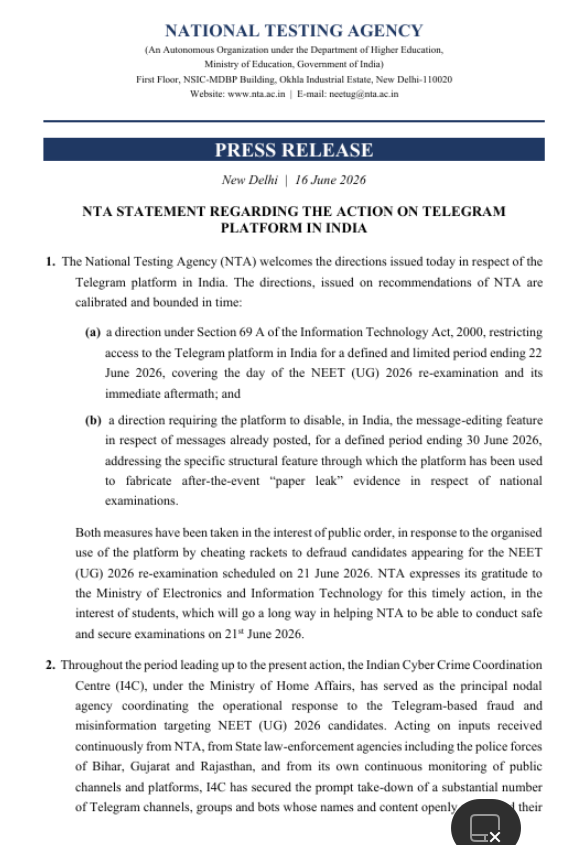
Now , against this , pavel durov (founder of telegram ) responed with this .
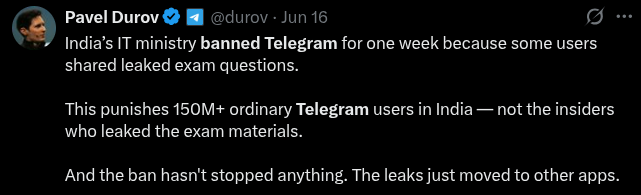
Now even though the ban is limited to India , still many people in dubai and other places are not able to access telegram .
Why ?
because , reliance's (jio) BGP is IP blocking , telegram's IP group , this is also known as BGP hijacking. Where you don't allow certain IPs to pass through your BGP.
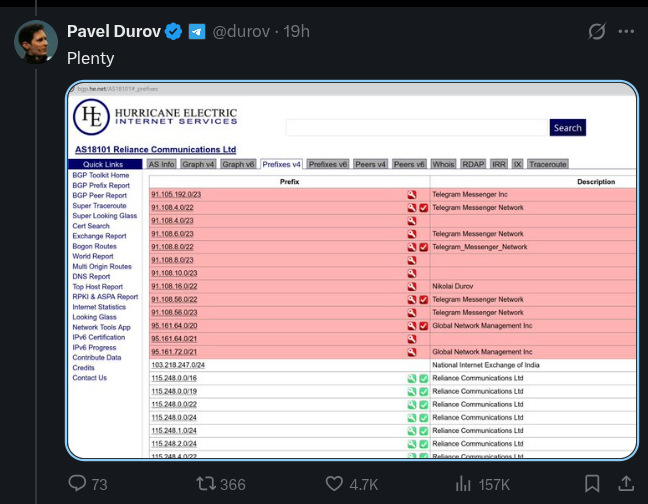
and the above results are from reqests of UAE .
Another allegation that durov has made against Reliance telecom and jio is :
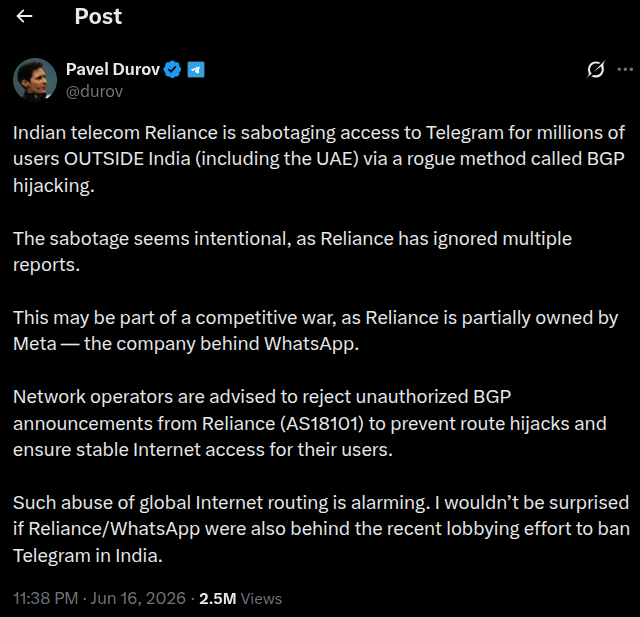
Reliance has not released any statements regarding this so far , but it is unsure why this is happening .
Get around
How to get around this ? Use any VPN or proxy server of your choice , be it public or private , the get around is pretty straightforward , and there is not much that they have achieved with this .
Credits / Sources / References

Join Ashish on Peerlist!
Join amazing folks like Ashish and thousands of other builders on Peerlist.
0
1
0