

Claude API vs ChatGPT API – Pricing, Features & Use Case Comparison
Compare Claude API vs ChatGPT API pricing, features, and real use cases. Find which AI API fits your product, cost, and scalability needs.
Over the last few months, I’ve worked closely with both Anthropic Claude API and OpenAI ChatGPT API while building real AI systems — not just demos, but actual products like chatbots, automation tools, and data-driven applications.
And one thing I’ve noticed is that most comparisons available online are either too surface-level or completely biased towards one side. They talk about features, list pricing, and end there. But in reality, choosing between these APIs is not that simple.
Because when you actually start building — cost behaves differently, performance changes based on use case, and small technical differences can completely impact your product.
For example, in one project where I had to process large datasets and long documents, Claude performed better in terms of structure and context handling. But in another project where speed and integrations mattered more, ChatGPT felt more practical.
So instead of giving you a generic comparison, in this article, I’ll break everything down based on how these APIs behave in real-world scenarios — including pricing, features, limitations, and where each one actually makes sense.
If you’re building something using Claude API or planning to, feel free to follow me on Linkedin for any queries related to Claude API or AI development.
Now let’s start with the most important part — pricing — because that’s where most decisions begin.
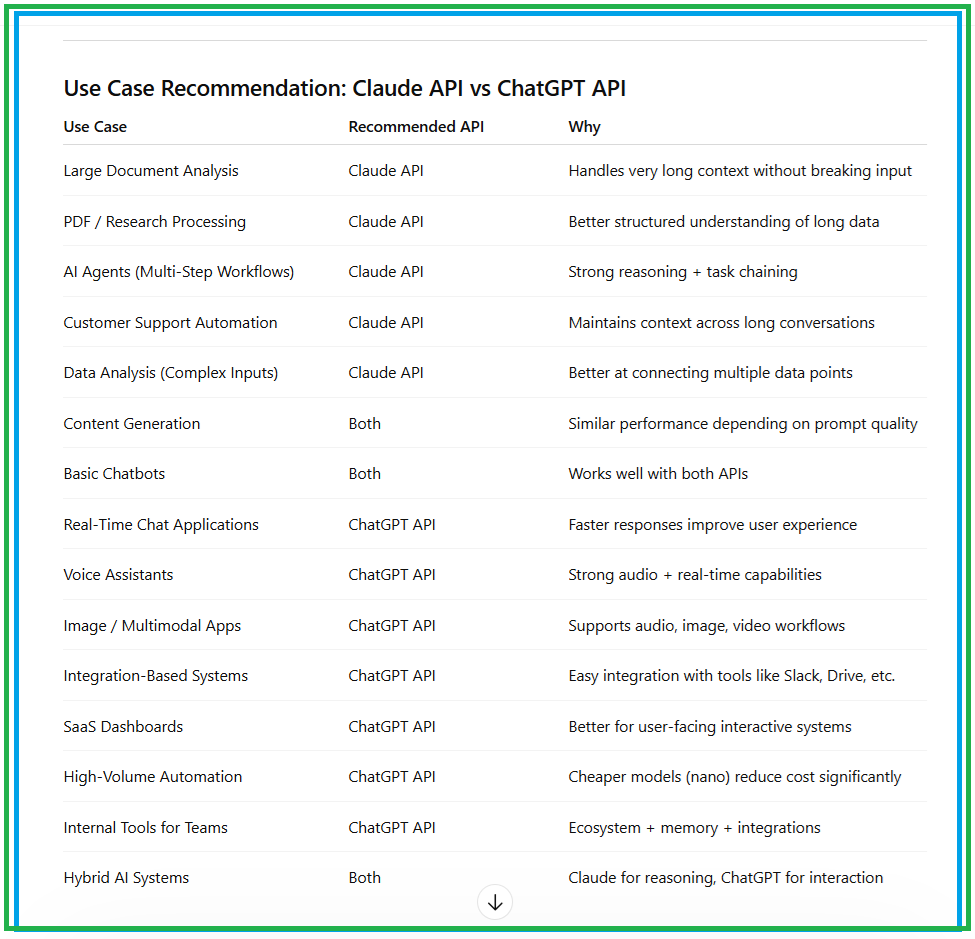
Use Case Recommendation: Claude API vs ChatGPT API
From my experience, the choice between Anthropic Claude API and OpenAI ChatGPT API is less about which one is better and more about what kind of problem you’re solving.
If your use case involves long documents, deep reasoning, or multi-step workflows, Claude usually performs more reliably because it handles context and structured thinking better. On the other hand, if your product is user-facing, requires fast responses, or depends on integrations and multimodal features, ChatGPT feels more practical and scalable.
In many real-world applications, I’ve found that the best approach is not choosing one over the other, but combining both — using Claude for heavy processing and ChatGPT for interaction and delivery.
Pricing Comparison: Claude API vs ChatGPT API
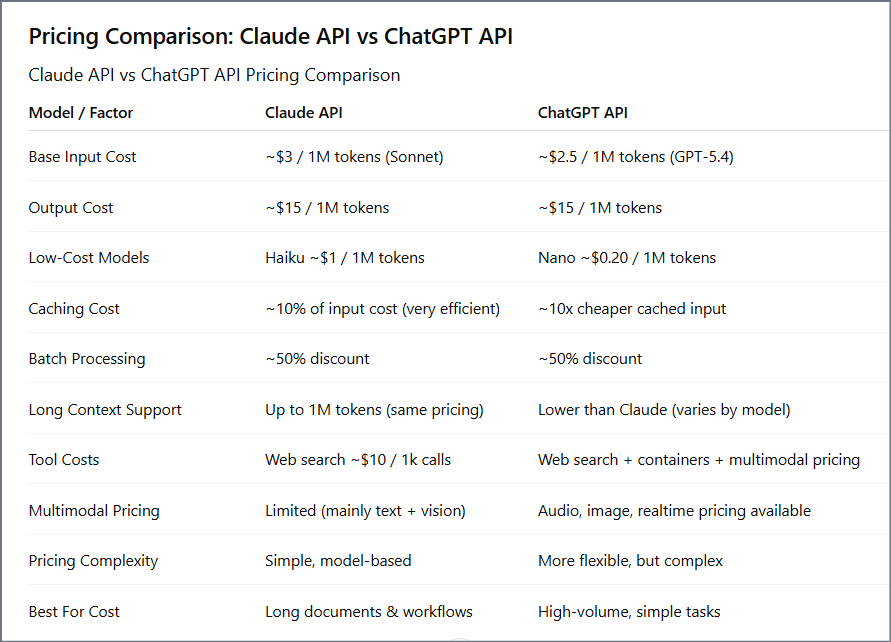
Whenever I start working on any AI product, pricing is not just a “number comparison” for me. It’s more about how the cost behaves when the system scales — because that’s where most people get surprised.
Let me break this down based on what I’ve actually seen while working with both APIs.
Input Cost (What You Pay to Send Data)
When you send data to the model, you pay for input tokens.
With Claude API (Sonnet level), input cost is around $3 per million tokens.
With ChatGPT API (latest GPT-5.4), input cost is around $2.5 per million tokens.
At first glance, ChatGPT looks slightly cheaper here. And honestly, if your use case is simple — like short prompts or basic automation — you will feel that difference.
But in real-world systems, input cost alone doesn’t decide anything.
Output Cost (What You Pay for Responses)
Now comes output tokens — which usually matter more.
Claude API charges around $15 per million tokens (Sonnet level).
ChatGPT API is also around $15 per million tokens for comparable models.
So here, both are almost at the same level.
In most applications I’ve built, output cost ends up being the bigger chunk of billing, especially in chat-based systems or content-heavy workflows.
Cheap Models (Where Cost Really Drops)
This is where things get interesting.
Claude offers Haiku models starting around $1 per million tokens.
ChatGPT offers nano models going as low as $0.20 per million tokens.
So if your system is handling:
high-volume requests
simple automation
background processing
ChatGPT becomes significantly cheaper.
But the trade-off is performance — and that matters more than people expect.
Caching (Where Real Cost Optimization Happens)
Now this is something most people ignore, but I’ve seen it save a lot of money.
Claude API allows you to cache prompts, and when reused, it costs only about 10% of the original input price.
That means if your system uses:
repeated instructions
same system prompts
long conversation memory
you can reduce costs drastically.
ChatGPT also provides cached input pricing, which is cheaper, but Claude feels more optimized for repeated workflows and agent systems.
Batch Processing (For Scale Systems)
Both APIs provide batch processing with around 50% cost reduction.
But from my observation, Claude’s documentation and structure make it more aligned for:
async workflows
background jobs
agent pipelines
While ChatGPT also supports this, it feels more like an additional feature rather than a core workflow.
Long Context Cost (This Changes Everything)
This is one of the biggest differences I’ve personally experienced.
Claude supports up to 1 million tokens context, and the pricing remains consistent even at large inputs.
That means you can:
upload full PDFs
process long reports
analyze entire datasets
without worrying about exponential cost jumps.
ChatGPT supports large context too, but comparatively lower.
So if your product deals with:
legal documents
research papers
large structured data
Claude becomes much more practical and sometimes even cheaper.
Hidden Costs (Where Most People Get Confused)
Now this is where things get real.
Claude API:
charges for web search (~$10 per 1,000 searches)
tool usage adds token overhead
ChatGPT API:
charges for web search
charges for containers (compute usage)
charges differently for audio, images, and real-time models
👉 This means:
Claude = simpler pricing structure
ChatGPT = more flexible, but more complex pricing
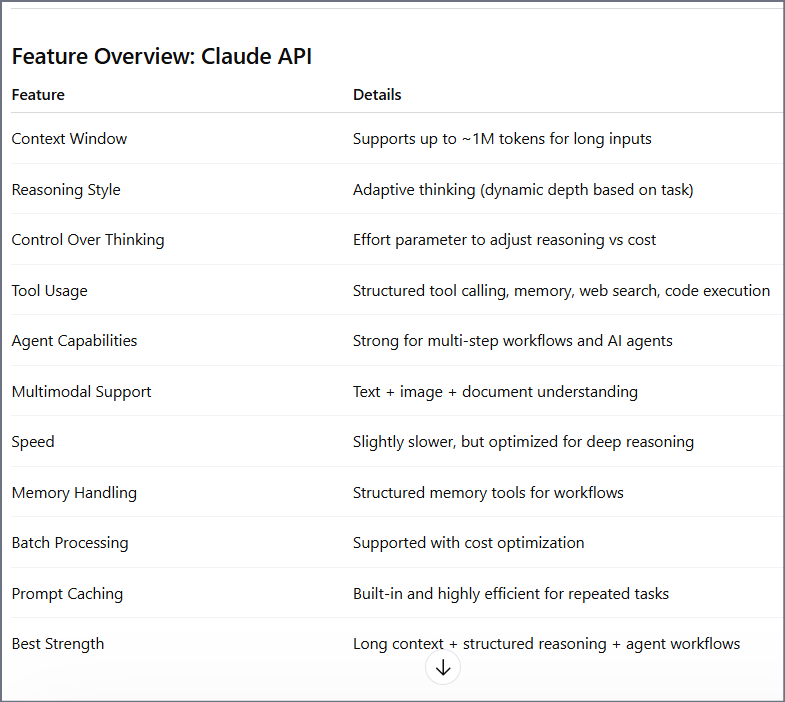
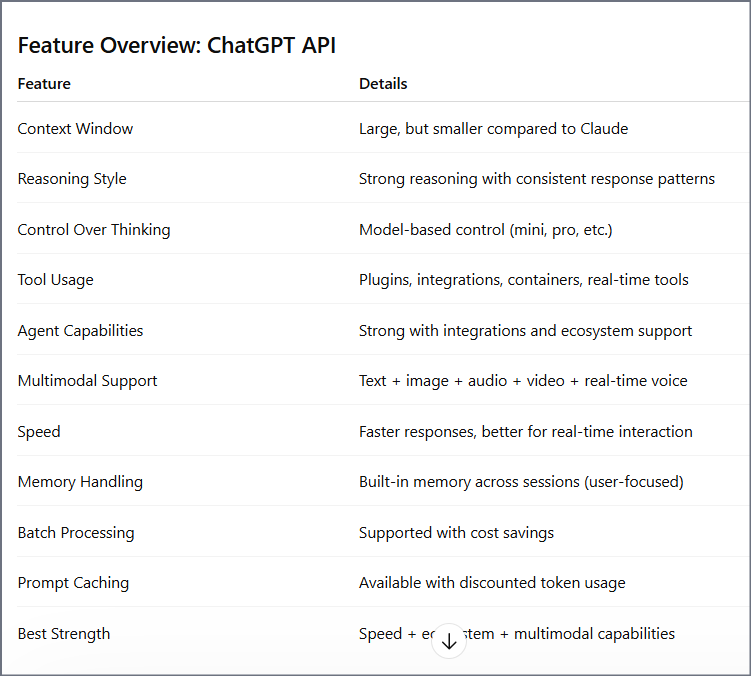
Feature Comparison: Claude API vs ChatGPT API
After pricing, the next thing I always evaluate is not just “what features exist,” but how those features actually behave when you build something real.
Because on paper, both Anthropic Claude API and OpenAI ChatGPT API look very similar.
But when you start building systems, the difference becomes very clear.
Context Handling (Where I Saw the First Major Difference)
One of the earliest differences I noticed was how both models handle large inputs.
With Claude, I was able to pass extremely long documents — full PDFs, reports, even combined datasets — and it handled them without breaking context. The support goes up to around 1 million tokens, which is honestly massive.
With ChatGPT, context is strong too, but comparatively smaller. For most applications it works perfectly fine, but once you start pushing large documents or multi-layered inputs, you begin to feel the limitation.
So if your system involves:
document analysis
long conversations
multi-step workflows
Claude feels more natural.
Reasoning Behavior (Not Just Output, but Thinking Style)
This is where things get interesting.
Claude introduces something called adaptive thinking, where it decides how much reasoning is needed depending on the task.
What I’ve noticed in practice is:
Simple questions → fast answers
Complex problems → deeper, structured responses
ChatGPT is also strong in reasoning, especially with newer models, but the behavior feels more consistent rather than adaptive.
So the difference is subtle but important:
Claude feels like it adjusts its thinking
ChatGPT feels like it applies a consistent reasoning pattern
Control Over Intelligence (Developer Perspective)
Claude gives you more direct control using something like an “effort” parameter.
In simple terms, you can decide:
keep it fast and cheap
or let it think deeper and spend more tokens
This becomes very useful when you’re optimizing cost vs performance.
With ChatGPT, control exists through model selection (mini, pro, etc.), but not as explicitly adjustable inside a single request.
So from a developer point of view:
Claude = more controllable
ChatGPT = more predefined
Tool Usage & Agent Capabilities
Both APIs support tool usage, but they approach it differently.
Claude provides:
structured tool calling
memory tools
code execution
web search
tool chaining
And recently, I’ve seen it becoming very agent-focused, where it’s easier to build multi-step workflows.
ChatGPT, on the other hand, goes much broader.
It supports:
plugins and integrations
external apps (Slack, Google Drive, etc.)
container-based execution
real-time tools
So the difference is:
Claude is better for structured agent workflows
ChatGPT is better for connected ecosystems
Multimodal Capabilities (Where ChatGPT Pulls Ahead)
If your use case involves more than text, the gap becomes clearer.
Claude supports:
text
images
document understanding
ChatGPT supports:
text
images
audio
video
real-time voice interaction
So if you’re building something like:
voice assistants
AI video tools
real-time interaction systems
ChatGPT is simply more capable here.
Speed & Latency (What You Feel Immediately)
In real-world usage, speed matters a lot more than people think.
Claude is slightly slower in general responses, though it does offer a fast mode at higher cost.
ChatGPT feels faster by default, especially in interactive applications.
So if your product depends on:
instant responses
live interaction
real-time UX
ChatGPT has an edge.
Memory & Persistence
Claude provides memory tools that can be structured into workflows.
ChatGPT goes a step further by offering built-in memory across conversations, especially in product environments.
So if you're building:
user-facing apps
personalized AI experiences
ChatGPT feels more ready out of the box.
Ecosystem & Integrations (Big Strategic Difference)
This is probably the biggest philosophical difference I’ve seen.
Claude is focused on:
API
developer workflows
controlled environments
ChatGPT is building:
a full ecosystem
integrations
apps
enterprise tools
From what I’ve seen, ChatGPT is not just an API anymore — it’s becoming a complete AI platform.
My Real Feature Insight
If I simplify everything based on actual usage:
Claude works better when:
your system is complex
reasoning matters
context is large
workflows are structured
ChatGPT works better when:
speed matters
integrations are needed
multimodal features are required
you’re building user-facing products
And this is where the real decision starts forming — not from pricing or features alone, but from use cases.
Use Case Comparison: Claude API vs ChatGPT API
In my experience, this is where most confusion gets solved.
Because honestly, both APIs are powerful.
But they are not built for the same type of problems.
Let me walk you through real scenarios where I’ve seen each one perform better.
When I Prefer Using Claude API
Whenever I’m working on something that involves deep thinking, long data, or structured workflows, I naturally lean towards Anthropic Claude API.
1. Large Document Processing
In one project, I had to analyze long reports and extract structured insights.
Claude handled:
full-length PDFs
multi-section documents
context-heavy analysis
without losing flow.
Because of its large context window, I didn’t have to break the data into chunks again and again.
👉 This saves both time and cost.
2. AI Agents & Multi-Step Workflows
If you’re building something like:
customer support automation
internal workflow agents
research assistants
Claude feels very stable.
It can:
plan steps
maintain context
execute structured reasoning
👉 This is where its adaptive thinking really shows value.
3. Data Analysis & Long Context Reasoning
Whenever I’ve had to process:
structured datasets
logs
combined data + instructions
Claude performs better in keeping everything connected.
It doesn’t “forget” earlier parts easily.
4. Cost-Sensitive Long Conversations
If your system has:
repeated prompts
long sessions
memory-heavy interactions
Claude’s caching and long context make it more efficient over time.
When I Prefer Using ChatGPT API
Now on the other side, there are many cases where I directly go with OpenAI ChatGPT API without even thinking twice.
1. Real-Time Applications
If I’m building:
chat interfaces
live assistants
interactive tools
ChatGPT feels faster and smoother.
That small latency difference actually matters a lot in user experience.
2. Multimodal Applications
For anything involving:
voice
images
real-time interaction
ChatGPT is clearly ahead.
For example:
voice AI assistants
image-based tools
video workflows
👉 Claude is not built for this level of multimodal interaction yet.
3. Integration-Heavy Systems
If your product needs to connect with:
Slack
Google Drive
GitHub
internal tools
ChatGPT ecosystem makes it much easier.
You don’t have to build everything from scratch.
4. High-Volume, Simple Tasks
If the goal is:
automation
bulk processing
simple responses
ChatGPT’s cheaper models (like nano) make it very cost-effective.
Where Both Work Equally Well
There are also cases where both APIs perform almost the same.
For example:
content generation
basic chatbots
standard automation
In these cases, the decision usually comes down to:
cost
speed
ecosystem preference
My Practical Decision Framework
If I simplify everything based on how I choose:
If the problem is:
complex
long-context
reasoning-heavy
👉 I go with Claude
If the problem is:
fast
user-facing
integration-heavy
👉 I go with ChatGPT
One Important Insight Most People Miss
In many real systems, I don’t choose just one.
I combine both.
For example:
Claude → reasoning + analysis
ChatGPT → interaction + UI
This hybrid approach actually gives the best results.
And now that we’ve covered use cases, the next step becomes even clearer —
why you should choose one over the other (and when you shouldn’t).
Why Choose Claude API (And When It Makes Sense)
From my experience, I don’t choose Anthropic Claude API randomly. I pick it when the problem itself demands depth.
When Claude Actually Feels Like the Right Choice
If your system involves long context, Claude immediately stands out.
For example, when I worked on document-heavy workflows, I didn’t have to worry about splitting inputs again and again. I could pass large chunks of data, and the model still maintained structure and continuity.
Another situation is when the problem is not straightforward. If the task involves reasoning across multiple steps, Claude tends to stay more consistent. It doesn’t jump to conclusions too quickly, and that makes a big difference in critical applications.
I’ve also found Claude very useful when building agent-style systems. It handles multi-step instructions in a more controlled way, especially when tasks depend on previous outputs.
Where Claude Gives a Clear Advantage
Claude works really well when:
You are dealing with large documents or datasets
The system requires structured, step-by-step reasoning
You want better control over how much the model “thinks”
Your workflows involve repeated prompts or long sessions
In these cases, it feels less like a chatbot and more like a reasoning engine.
Why You Might Not Choose Claude API
That said, Claude is not perfect, and I’ve seen situations where it’s not the best fit.
If your application is highly interactive and depends on speed, Claude can feel slightly slower. It’s not a huge gap, but in real-time systems, even small delays matter.
Another limitation is the ecosystem. Compared to ChatGPT, Claude doesn’t offer the same level of integrations or ready-to-use connections with external tools.
And if your product relies heavily on multimodal capabilities like voice or video, Claude is still catching up in that area.
Why Choose ChatGPT API (And When It Works Better)
Now let’s talk about OpenAI ChatGPT API.
There are scenarios where I don’t even consider alternatives — I directly go with ChatGPT.
Where ChatGPT Feels More Practical
The first thing you notice is speed. When building interactive applications, ChatGPT feels more responsive, which improves the overall experience.
Another big advantage is its ecosystem. If your system needs to connect with tools, platforms, or external services, ChatGPT makes it easier. You don’t have to build everything manually.
I’ve also found it more suitable for applications where users directly interact with the system — like dashboards, assistants, or real-time tools.
Where ChatGPT Clearly Stands Out
ChatGPT works better when:
Your product is user-facing and requires fast responses
You need integrations with tools like Slack, Drive, or GitHub
Your use case involves voice, images, or real-time interaction
You are building scalable systems with multiple components
In these cases, ChatGPT feels less like just an API and more like a complete platform.
Why You Might Not Choose ChatGPT API
Even though ChatGPT is powerful, I’ve seen some limitations depending on the use case.
When working with very large context or long documents, it sometimes requires more effort to manage inputs properly.
Also, if your workflow depends heavily on structured reasoning across long chains, it may require more prompt tuning compared to Claude.
And in some cases, pricing can become less predictable because of multiple components like tools, containers, and multimodal usage.
My Final Decision Logic (What I Actually Follow)
After working with both, I don’t think in terms of “which is better.”
I think in terms of what problem I’m solving.
If the problem needs:
depth
structure
long context
👉 I go with Claude
If the problem needs:
speed
integrations
real-time interaction
👉 I go with ChatGPT
One Practical Insight That Changed My Approach
Earlier, I used to try to pick one API and stick with it.
Now, I don’t do that anymore.
In many systems, I combine both:
Claude handles reasoning and heavy processing
ChatGPT handles interaction and integrations
This approach has given me much better results than choosing just one.
And this is where the real takeaway lies —
👉 it’s not about replacing one with another,
👉 it’s about using them correctly.
Technology Comparison (Simple Explanation for Founders)
Most articles go very deep into technical terms here, but honestly, what matters is how these systems think and behave, not just how they are built.
Both Anthropic and OpenAI are based on transformer-based architectures, but the way they are trained and optimized is slightly different.
How Claude Thinks
Claude is built using something called Constitutional AI.
In simple terms, instead of just training the model on human feedback, it is guided by a set of predefined principles. This makes its responses:
more structured
more consistent
more controlled
From what I’ve observed, this is why Claude performs well in:
long reasoning tasks
structured outputs
multi-step workflows
It feels like it’s trying to follow a logical path before answering.
How ChatGPT Thinks
ChatGPT is built using Reinforcement Learning with Human Feedback (RLHF).
This means the model is trained based on how humans prefer responses. The goal is to make outputs:
more natural
more conversational
more useful for users
That’s why ChatGPT feels:
faster
more interactive
easier to use
It’s optimized more for user experience and adaptability.
The Real Difference (Simplified)
If I put it in one line:
Claude tries to reason first, then answer
ChatGPT tries to respond effectively as fast as possible
And depending on your product, one approach may fit better than the other.
Final Verdict (What Should You Actually Choose?)
After everything we’ve covered — pricing, features, use cases, and behavior — the answer is not “Claude vs ChatGPT.”
The real answer is “Which one fits your use case better?”
If You Are Building Something Like:
AI agents
document processing systems
research tools
workflow automation
👉 Claude will feel more reliable and structured
If You Are Building Something Like:
chat apps
SaaS dashboards
voice assistants
interactive tools
👉 ChatGPT will feel more practical and scalable
If You Want the Best Results
In many real-world systems, the best approach is not choosing one.
It’s combining both.
Use Claude for reasoning and analysis
Use ChatGPT for interaction and integration
This way, you leverage the strengths of both instead of compromising.
FAQs
Which API is cheaper — Claude or ChatGPT?
It depends on your usage. For simple, high-volume tasks, ChatGPT can be cheaper. For long-context and document-heavy workflows, Claude often becomes more cost-efficient.
Which API is better for coding?
Both are strong, but ChatGPT feels more flexible for development workflows, while Claude performs well in structured and complex coding tasks.
Which API is better for AI agents?
Claude is slightly better for structured agent workflows due to its reasoning and context handling, but ChatGPT offers better integrations for real-world deployment.
Can I use both APIs together?
Yes, and in many cases, that’s the best approach. You can use Claude for processing and reasoning, and ChatGPT for user interaction and integrations.
Which one should beginners choose?
If you are just starting, ChatGPT is easier due to its ecosystem and flexibility. As your system grows, you can integrate Claude where deeper reasoning is required.
Closing Thought
From everything I’ve seen while working with these systems, the biggest mistake people make is trying to find a “winner.”
But in reality, both APIs are designed for slightly different purposes.
The smarter approach is not choosing one over the other —
it’s understanding where each one fits best and using it accordingly.

Join Ashish on Peerlist!
Join amazing folks like Ashish and thousands of other builders on Peerlist.
0
0
0