

How to Start AI Startup Company?
Everything you need to know to start an AI startup, including idea validation, business model selection, product development, and scaling strategies
I want to ask you something before we even begin.
Why do you want to start an AI startup?
Is it because AI is trending? Or because you actually see a real problem that needs to be solved?
As a founder of Triple Minds, I have personally worked with multiple AI startups — some scaled fast, some struggled, and some failed even after having “great ideas.” And the difference was never the technology. It was clarity.
Today, everyone wants to build an AI product. Chatbots, generators, automation tools, SaaS platforms — the ideas are everywhere. But very few founders actually understand what it takes to turn that idea into a real, revenue-generating business.
I have seen founders come to us with excitement like, “We want to build something like ChatGPT,” but when we go deeper, they don’t even know who their user is or what exact problem they are solving.
And that’s where most AI startups go wrong.
At Triple Minds, we don’t just build AI products. We help founders think, validate, build, and grow — combining consultation, development, and marketing into one growth system. Because building an AI startup is not just about coding… it’s about making the right decisions at the right time.
In this article, I am not going to give you generic advice. I will walk you through how AI startups actually start, what mistakes I have seen repeatedly, and what you should do differently if you really want to build something that works.
Why AI Startups Are Rising Faster Than Ever
Let me tell you what I’ve been noticing in the last couple of years.
Earlier, building a tech startup required heavy investment — infrastructure, engineering teams, long development cycles. Today, AI has changed that equation completely. What used to take 12 months can now be done in 3–4 months with the right approach.
And this is exactly why you’re seeing so many AI startups popping up. But here’s the real reason — it’s not just “ease of building.”
It’s demand.
Businesses today don’t want more software. They want automation. They want decisions done faster. They want systems that can reduce human effort and increase output. From content creation to customer support, from analytics to personalization — AI is solving real business problems at scale.
And when there is real demand, startups naturally follow. At Triple Minds, we’ve seen this shift very closely. Founders are no longer coming with “ideas,” they are coming with use cases:
“Can we automate customer support using AI?”
“Can we build an AI tool that reduces content cost by 70%?”
“Can we replace manual processes in our business with AI workflows?”
This shift is important.
Because earlier startups were idea-driven. Now, successful AI startups are problem-driven and ROI-focused.
But here’s the part most people don’t talk about. Just because AI startups are rising fast… doesn’t mean they are surviving. In fact, many of them fail faster than traditional startups.
Why?
Because they jump into development without clarity. They assume AI will automatically create value. They build features instead of solving problems.
So yes, this is the best time to start an AI startup. But only if you approach it with the right mindset. Otherwise, you’ll just become another “AI tool” lost in a crowded market.
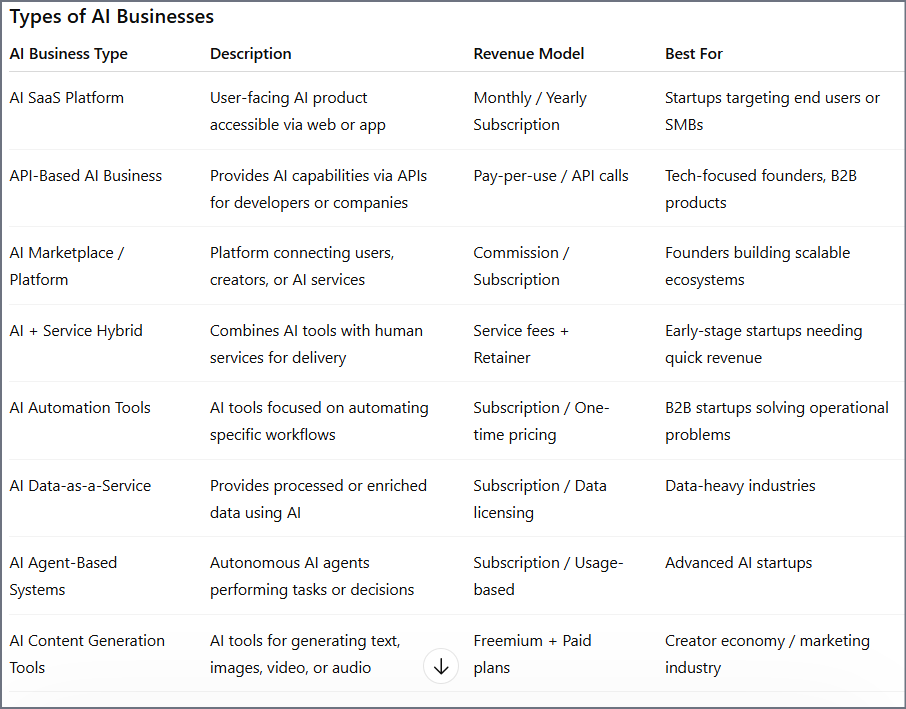
Types of AI Businesses to Start in 2026
AI SaaS Platform – Build a subscription-based AI tool users access via web/app. Best for recurring revenue models like chatbots, writing tools, or automation platforms.
API-Based AI Business – Offer AI capabilities through APIs that developers or companies integrate into their systems and pay based on usage or API calls.
AI Marketplace / Platform – Create a platform where users, creators, or AI services interact, earning through commissions or subscriptions at scale.
AI + Service Hybrid – Combine AI tools with human services to deliver results faster, helping startups generate early revenue while refining their product.
AI Automation Tools – Develop tools that automate repetitive business workflows, helping companies save time, reduce costs, and improve operational efficiency.
AI Data-as-a-Service – Provide processed or AI-enhanced data to businesses, helping them make better decisions through insights, analytics, or predictive models.
AI Agent-Based Systems – Build autonomous AI agents that perform tasks like sales, support, or decision-making without constant human involvement.
AI Content Generation Tools – Focus on generating text, images, video, or audio using AI, targeting creators, marketers, and content-driven businesses.
AI Vertical Solutions – Build AI tools for specific industries like healthcare, real estate, or legal, solving niche problems with higher conversion potential.
AI White-Label Solutions – Create ready-made AI products that other businesses can rebrand and sell, generating revenue through licensing or recurring fees.
The First Question You Must Ask Yourself (Before Starting)
Before you think about AI models, tech stack, or funding…
I always ask founders one simple question:
“What problem are you solving, and who is ready to pay for it?”
Not who might use it.
Not who will say “this is interesting.”
But who will actually pull out their wallet.
You’ll be surprised how many founders get stuck here.
At Triple Minds, when someone comes to us saying, “We want to build an AI platform,” the first thing we do is slow them down. Because building is easy today. But building the right thing — that’s where the real game is.
I remember one founder who wanted to create an AI content tool. On the surface, it sounded great. But when we dug deeper, we realized the market was already crowded. Instead of stopping, we asked him a better question:
👉 “Who exactly struggles the most with content today?”
That’s when things changed. He narrowed down to real estate agencies struggling with daily listing content. Same AI capability, but a different positioning — and suddenly, it became a business.
This is what most founders miss. AI is just an enabler. The business comes from specific problems, specific users, and clear value.
So before you move ahead, answer this honestly:
Who is your exact target user?
What pain are they facing daily?
How much is that problem costing them?
And most importantly — why would they choose your solution?
If you can’t answer these clearly, don’t start building yet.
Because I’ve seen it again and again — founders spend months building something… and then realize nobody actually needs it.
And trust me, that’s the most expensive mistake you can make.
Idea vs Problem: What Actually Builds a Successful AI Startup
Let me be very direct here.
Ideas don’t build startups. Problems do.
Every week, I see founders getting excited about ideas like:
“Let’s build an AI chatbot,”
“Let’s create an AI image generator,”
“Let’s launch an AI SaaS tool.”
But here’s the truth — none of these are businesses.
These are just features.
At Triple Minds, we’ve worked with founders who came with very “innovative ideas,” but when we asked one simple question — “Why will someone pay for this?” — there was silence.
And that silence is dangerous.
Because the market doesn’t reward ideas.
It rewards solutions that save time, reduce cost, or increase revenue.
Let me share something from my experience.
Two founders came with almost the same AI capability:
One built a general AI writing tool → struggled to get users
Second focused only on generating Amazon product descriptions → got paying clients quickly
Same technology.
Different outcome.
Why?
Because one was idea-focused.
The other was problem-focused.
This is where most AI startups fail early.
They build something “cool” instead of something useful.
They try to serve everyone instead of solving for a specific group.
They focus on AI capability instead of business value.
So if you are serious about building an AI startup, shift your thinking:
Don’t ask: “What can AI do?”
Ask: “What problem can AI solve better than humans or existing tools?”
That one shift can save you months of time, lakhs of rupees, and a lot of frustration.
Because once your problem is clear, everything becomes easier —
your product, your messaging, your pricing, even your marketing.
How We Validate AI Startup Ideas at Triple Minds
This is the stage where things actually start becoming real for a founder. In my experience, validation is the point where a startup either moves in the right direction or slowly starts heading toward failure without even realizing it. Most founders are excited to build, and honestly, I understand that feeling. But over the years, I have seen that jumping directly into development without clarity is one of the most expensive mistakes.
We follow a very different approach. Even if a founder comes to us fully prepared to start development, we intentionally slow things down and focus on validating the idea first. This is not to delay progress, but to make sure we are building something that has a real chance of working in the market. Because in today’s AI space, building is easy, but building the right product is what actually matters.
Our validation process is not theoretical. It is based on real consulting, development, and marketing experience combined together, where every decision is made with business outcomes in mind
The first thing we focus on is understanding the depth of the problem. We don’t just accept a general statement like “people need automation” or “AI can improve this.” We go deeper and try to understand how frequently the problem occurs, who is affected the most, and whether it is a critical issue or just something nice to have. If the problem is not strong enough, users simply won’t pay, no matter how advanced your AI solution is.
After that, we move towards market validation. Many founders believe they are building something unique, but in reality, there are already multiple players working on similar ideas. Instead of discouraging them, we analyze competitors, pricing models, and positioning to identify gaps. In many cases, we don’t change the core idea; we refine the positioning so that it becomes more relevant and attractive to a specific audience.
Once the market is clear, we work on business model clarity. This is where most startups struggle because they focus on building first and monetization later. We define early who will pay, how they will pay, and at what stage they will be willing to pay. Whether it is subscription-based, usage-based, or a freemium model, this clarity helps in building a product that is aligned with revenue from day one.
Then comes MVP planning, which is one of the most critical steps. Instead of building a complete product, we define the smallest possible version that can validate the idea in the real world. This approach helps founders save both time and money while still testing whether their solution actually works. Many unnecessary features are removed at this stage, and the focus remains only on delivering core value.
Finally, we think about distribution even before development begins. We ask simple but powerful questions like how the first 10 users will come, where the target audience is already active, and what message will make them care. Because no matter how strong your product is, without a clear go-to-market strategy, it will struggle to gain traction.
To be very honest, there have been multiple cases where after this entire validation process, we advised founders not to move forward with their idea. And surprisingly, they appreciated that honesty later because it saved them months of effort and significant investment.
This is the advantage of working with a team that doesn’t just build products but understands how businesses actually grow. At Triple Minds, our focus has always been on creating solutions that perform in the real market, not just on paper
Choosing the Right AI Business Model
Once your idea is validated, the next decision becomes extremely important — and honestly, this is where I have seen many founders either build a scalable business or get stuck very early.
The question is simple: what type of AI business are you actually building?
Most founders don’t think deeply about this. They just start building a product without clarity on how it will generate revenue or scale over time. But in reality, your business model decides everything — your product structure, pricing, customer acquisition strategy, and even your long-term growth.
At Triple Minds, when we work with AI startups, we always spend time defining this early because the same AI capability can be turned into completely different businesses depending on how you position it.
Let me explain this with a simple perspective.
Some founders build AI as a SaaS platform, where users pay a monthly subscription to use the tool. This works well when your product solves an ongoing problem, like content generation, customer support automation, or workflow management. The advantage here is predictable revenue, but the challenge is continuous value delivery and retention.
Others build API-based businesses, where companies integrate your AI into their own systems and pay based on usage. This model works well if your strength is in building powerful backend capabilities rather than a user-facing product. It can scale quickly, but requires strong technical reliability and developer adoption.
Then there are founders who go towards AI marketplaces or platforms, where multiple users or creators interact, and the business earns through commissions or subscriptions. This model is powerful but takes time because you are not just building a product — you are building an ecosystem.
In some cases, especially in early stages, founders start with service + AI hybrid models. They use AI internally to deliver faster and better services, generate revenue, and then gradually convert that into a product. I personally recommend this approach in many cases because it reduces risk and gives real market insights from day one.
What I have noticed is that many startups fail not because their AI doesn’t work, but because their business model doesn’t support growth. They either underprice their product, choose the wrong audience, or build something that cannot scale beyond initial users.
So when you are deciding your model, don’t just think from a product perspective. Think like a business owner:
Will this model generate consistent revenue?
Can this scale without increasing costs at the same rate?
Is this model easy for users to understand and adopt?
These questions matter more than the technology itself.
We always align business model decisions with development and marketing strategy because all three need to work together. A strong model with weak execution fails, and a strong product with a weak model struggles to survive.
So take your time here. Because once you choose the right direction, everything becomes easier to build, position, and scale.
Building Your First AI MVP (Without Wasting Money)
This is the stage where most founders lose a significant amount of money — not because they lack resources, but because they build more than what is actually required.
I have seen this pattern repeatedly. A founder comes with a validated idea, strong intent, and good budget, but instead of starting small, they try to build a complete product from day one. Multiple features, complex dashboards, advanced integrations — everything at once. After months of development, they launch… and then realize that users are not even using 70% of what they built.
That is exactly what an MVP is supposed to prevent.
An MVP is not a “basic version” of your product. It is a focused version of your product that solves one core problem effectively. The goal is not to impress users with features, but to test whether your solution actually creates value.
At Triple Minds, when we plan MVPs for AI startups, we follow a very strict approach. We remove everything that is not directly contributing to the core outcome. If your product is meant to generate AI-based product descriptions, then the MVP should do that exceptionally well — not include analytics dashboards, team collaboration tools, or unnecessary customization options in the first version.
This approach does two things. First, it reduces your development cost and time significantly. Second, it allows you to test your idea in the real market much faster.
Another mistake I often see is founders over-investing in custom AI development from day one. In many cases, you don’t need to train your own model initially. You can use existing APIs, frameworks, or pre-trained models to validate your idea. Once you start getting traction and understand user behavior, then it makes sense to invest in optimization or building proprietary systems.
The key here is to treat your first version as a learning tool, not a final product.
You should launch fast, gather feedback, observe user behavior, and then improve based on real data. This cycle is what actually builds strong products over time.
We also guide founders to think about MVP from a business perspective, not just a technical one. Even in the first version, there should be a clear path to monetization. Whether it’s a paid plan, limited free usage, or early adopter pricing — users should see value worth paying for.
Because if users are not willing to pay even at MVP stage, scaling later becomes very difficult.
How to Go to Market: Your First 100 Users
This is where reality hits most founders.
Building an AI product feels exciting. You see it working, you test it yourself, maybe your team loves it — and you assume users will come automatically. But that’s not how it works.
In fact, getting your first 100 users is often harder than building the product itself.
“Now how do we get users?”
The truth is, your go-to-market strategy should start much before your product is ready.
When we work with AI startups, we always ask early — where are your users already spending time? Because you don’t need to “find” users. You need to reach them where they already are.
For some startups, it’s LinkedIn.
For others, it’s Reddit, niche communities, or specific industry platforms.
In some cases, it’s direct outreach — emails, cold messaging, or partnerships.
The channel depends on your audience, not your preference.
Another important factor is messaging. Most founders talk about their product features — “AI-powered,” “advanced algorithms,” “automation.” But users don’t care about that initially. They care about outcomes.
Instead of saying, “We built an AI content generator,”
say, “You can create 50 product descriptions in 5 minutes without hiring a writer.”
That shift in communication makes a huge difference.
We also guide founders to focus on manual traction first. Your first 100 users will not come from automation or ads. They will come from direct effort — conversations, demos, feedback loops, and small iterations.
You should be talking to users, understanding their reactions, and improving your product based on real usage.
Another thing I strongly recommend is to avoid over-scaling too early. Don’t jump into heavy ad spend or large campaigns before your product-market fit is clear. Otherwise, you will just burn money without learning anything meaningful.
At this stage, your goal is not growth.
Your goal is validation through real users.
And once you start getting consistent feedback, usage, and even small revenue, that’s when scaling becomes much easier and more predictable.
Why Most AI Startups Fail (And How You Can Avoid It)
Let me be very honest here, because this is something most people don’t talk about openly.
AI startups are easy to start today, but they are also failing faster than ever before.
And in most cases, the reason is not lack of funding, not lack of technology, and not even competition. The real reason is wrong decisions at the early stage.
From my experience working with multiple founders at Triple Minds, I have seen a few patterns repeating again and again.
The first and most common mistake is building without clarity. Founders get excited about AI capabilities and start development without fully understanding the problem, the user, or the market. They assume that if the product works, users will come. But in reality, even a technically strong product fails if it doesn’t solve a meaningful problem.
The second major issue is trying to do too much at once. Many startups launch with multiple features, targeting multiple audiences, and solving multiple problems. This creates confusion, both for the product team and for the users. A focused product with one clear value always performs better than a complex product trying to do everything.
Another big reason is weak positioning. I have seen startups with solid technology struggling simply because they couldn’t communicate their value properly. They talk about AI, models, and features, but fail to explain how they actually help users save time, reduce cost, or grow revenue.
Then comes the mistake of ignoring distribution. Founders spend months building but don’t plan how users will discover the product. They rely on “launch and hope,” which almost never works. Without a clear go-to-market strategy, even a good product remains invisible.
One more thing I’ve noticed is unrealistic expectations. Some founders expect instant traction, quick funding, or viral growth. When that doesn’t happen, they lose direction or pivot too quickly without giving the idea enough time to mature.
So how do you avoid these mistakes?
Start with clarity. Be very specific about the problem you are solving and who you are solving it for. Keep your product focused and build only what is necessary for validation. Think about distribution from day one, not after development. And most importantly, stay patient and consistent, because real businesses take time to build.
How We Help AI Startups Go From Idea to Revenue
Now let me bring everything together from a practical perspective.
Because at the end of the day, every founder has the same goal — not just to build an AI product, but to build a business that generates revenue and sustains itself.
This is exactly where most startups struggle. They either focus too much on development and ignore marketing, or they push marketing without having a strong product foundation. In both cases, growth becomes inconsistent.
At Triple Minds, we have built our entire approach around solving this gap.
We don’t treat consultation, development, and marketing as separate services. We treat them as one continuous system, where each stage supports the next. This is something we learned over time — when these three are aligned properly, startups move faster, make better decisions, and reduce unnecessary risk.
It always starts with consultation. Before anything is built, we work with founders to validate their idea, understand the market, define the business model, and plan a clear roadmap. This stage creates the foundation, because without clarity, even the best execution fails.
Once the direction is clear, we move into development. Our focus here is not just to build features, but to build scalable and usable products. Whether it’s an AI-powered platform, chatbot, SaaS tool, or automation system, everything is designed keeping real users and real use cases in mind.
But this is where most agencies stop. And this is exactly where we go further.
Because a product without visibility does not grow.
That’s why marketing becomes an integral part of the journey. From SEO and content marketing to performance campaigns and funnel optimization, we help startups position their product correctly and reach the right audience at the right time. The goal is not just traffic, but qualified users who convert into paying customers.
What makes this approach powerful is that all three layers — consultation, development, and marketing — are connected. Decisions are not taken in isolation. Every step is aligned with the final outcome, which is growth.
This is also the reason why many AI startups prefer working with us as a long-term partner instead of just a service provider. Because we are not just executing tasks, we are actively involved in helping them build a business that works in the real market
Over time, we have helped startups move from idea stage to MVP, from MVP to first revenue, and from early traction to scalable growth. And the biggest advantage founders get is clarity — knowing what to do next, and more importantly, what not to do.
So if you are planning to start an AI startup, don’t just think about building a product.
Think about building a system that can generate, sustain, and grow revenue.
Because that’s what actually defines a successful startup.
Cost Breakdown: What It Actually Takes to Start an AI Startup
This is one of the most common questions I get from founders.
“How much does it actually cost to start an AI startup?”
And honestly, the answer is not fixed. But based on my experience working with multiple AI startups at Triple Minds, I can give you a very practical breakdown so you can think in the right direction.
The biggest mistake founders make here is either underestimating the cost or over-investing too early. Some try to build everything in a very limited budget and compromise on quality, while others spend heavily on features they don’t even need in the beginning.
The right approach is to align your cost with your stage.
In the initial phase, your goal is not to build a full-scale platform. Your goal is to validate your idea and reach your first set of users. So your spending should reflect that.
From what I have seen, most AI startups can start with an MVP budget that typically ranges between $5,000 to $25,000, depending on the complexity, features, and whether you are using existing AI APIs or building custom models.
Here’s how you should think about cost distribution.
First comes development, which usually takes the largest portion. This includes building your MVP, integrating AI models or APIs, basic UI/UX, and backend setup. If you keep your scope focused, this cost can be controlled effectively.
Then comes infrastructure and tools. This includes cloud hosting, API usage costs, third-party integrations, and basic security setup. In the beginning, these costs are usually manageable, but they grow as your usage increases.
The next important investment is marketing. Many founders ignore this initially, but even at MVP stage, you need some budget for acquiring your first users. This can include content creation, SEO setup, outreach, or small performance campaigns.
You should also consider consultation and planning costs. Whether you are working with a partner or figuring things out yourself, time and strategy have a cost. And in most cases, better planning actually saves more money in development.
One important thing I always recommend is to avoid building everything from scratch in the beginning. Use existing tools, APIs, and frameworks wherever possible. This reduces both cost and time significantly, while still allowing you to validate your idea.
As your startup grows and starts generating revenue, you can gradually invest in optimization, custom AI models, and scaling your infrastructure.
Scaling Your AI Startup Beyond MVP
Reaching MVP is a big milestone, but let me tell you honestly — it’s just the beginning.
Many founders feel a sense of achievement after launching their product, getting initial users, and maybe even generating some revenue. But scaling is a completely different game. What worked for your first 50 or 100 users will not work the same way when you try to reach 1,000 or 10,000 users.
This is the stage where your startup shifts from testing to building a system for growth.
At Triple Minds, when we work with startups beyond MVP, the focus changes from “What should we build?” to “What should we optimize and scale?”
The first thing we look at is user behavior. At MVP stage, feedback is mostly qualitative — conversations, suggestions, early reactions. But once you start scaling, data becomes your biggest asset. You need to understand what users are actually doing inside your product — where they are getting value, where they are dropping off, and what is driving conversions.
This clarity helps you prioritize improvements that directly impact growth.
The second important factor is product refinement. At MVP stage, you build a focused solution. But during scaling, you start expanding carefully — not by adding random features, but by strengthening what is already working. This could mean improving performance, enhancing user experience, or adding features that increase retention.
Another key area is infrastructure. As your user base grows, your system should be able to handle increased load without performance issues. This is especially important in AI products, where API usage, response time, and processing cost can increase rapidly. Planning scalable architecture early helps avoid major issues later.
Then comes marketing and acquisition at scale. This is where you move from manual efforts to structured growth channels. SEO, paid campaigns, partnerships, content marketing — all start playing a bigger role. But unlike early stage, now you have data to guide your decisions, which makes your marketing more predictable and efficient.
One thing I always emphasize to founders is retention. Getting users is one part, but keeping them is what builds a real business. If users are not coming back, scaling acquisition will only increase your losses. So your focus should always be on delivering consistent value that keeps users engaged.
At this stage, your startup is no longer just an idea or a product. It becomes a system where product, marketing, and operations work together.
This is exactly where many startups either grow rapidly or start struggling. Because scaling requires clarity, discipline, and continuous improvement.
Final Thoughts: Should You Start an AI Startup Today?
Let me answer this in the most honest way possible.
Yes, this is one of the best times to start an AI startup. But not because AI is trending — because the market is actively looking for solutions. Businesses are ready to adopt AI if it helps them save time, reduce cost, or improve efficiency. The opportunity is real.
At the same time, the competition is also increasing faster than ever. Every day, new AI tools are launching, and many of them disappear just as quickly. So the real question is not “Should you start?” but “How will you build differently?”
From my experience, founders who succeed in this space are not the ones chasing trends. They are the ones who stay focused on solving real problems, understanding their users, and making practical decisions at every stage.
If you approach your AI startup with clarity, keep your product focused, validate before building, and think about distribution early, you already put yourself ahead of most people entering this space.
But if you are just following the hype, building without direction, or expecting quick success, then it will become very difficult to sustain.

Join Ashish on Peerlist!
Join amazing folks like Ashish and thousands of other builders on Peerlist.
0
0
0