

Vibe Coding Cleanup Specialist: Skills, Cost, and Hiring Checklist
How a Vibe Coding Cleanup Specialist Turns Messy AI Code Into Production-Ready Software
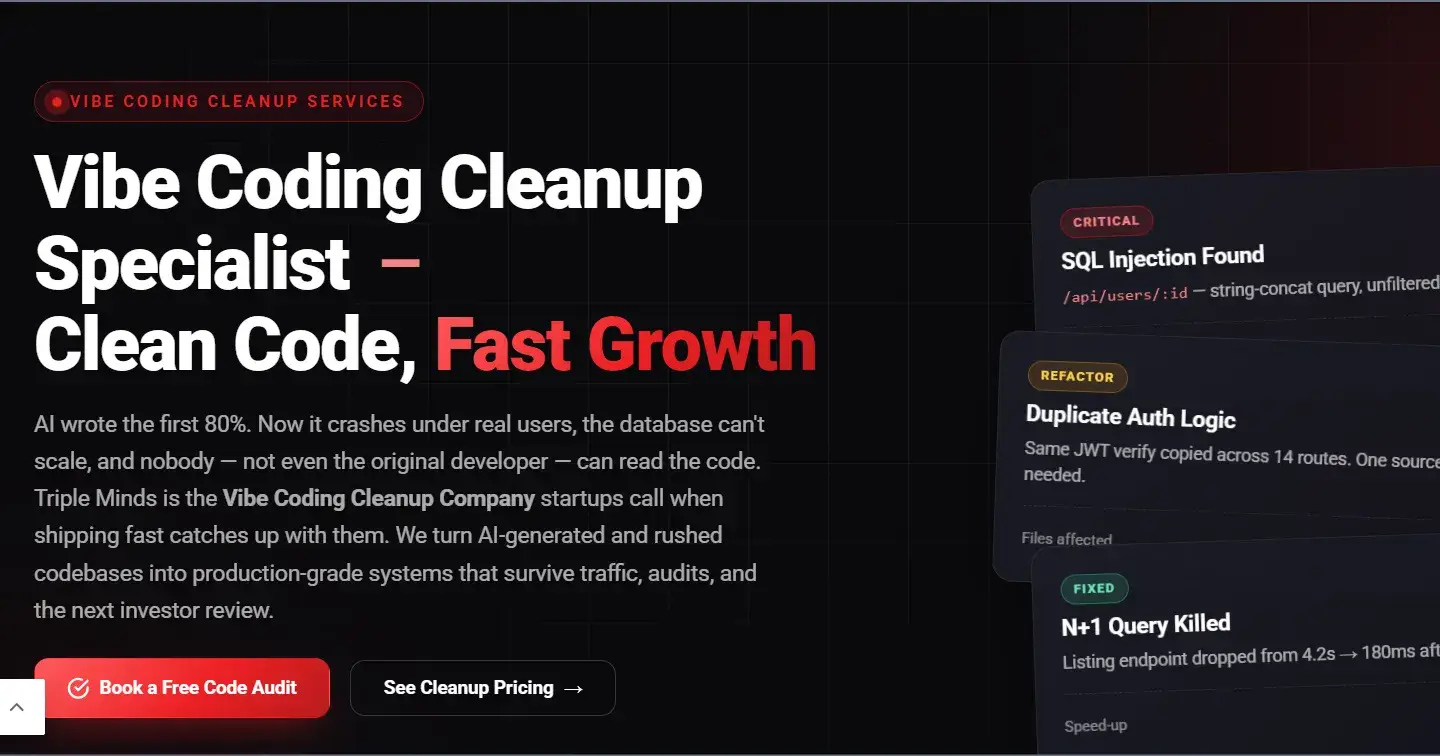
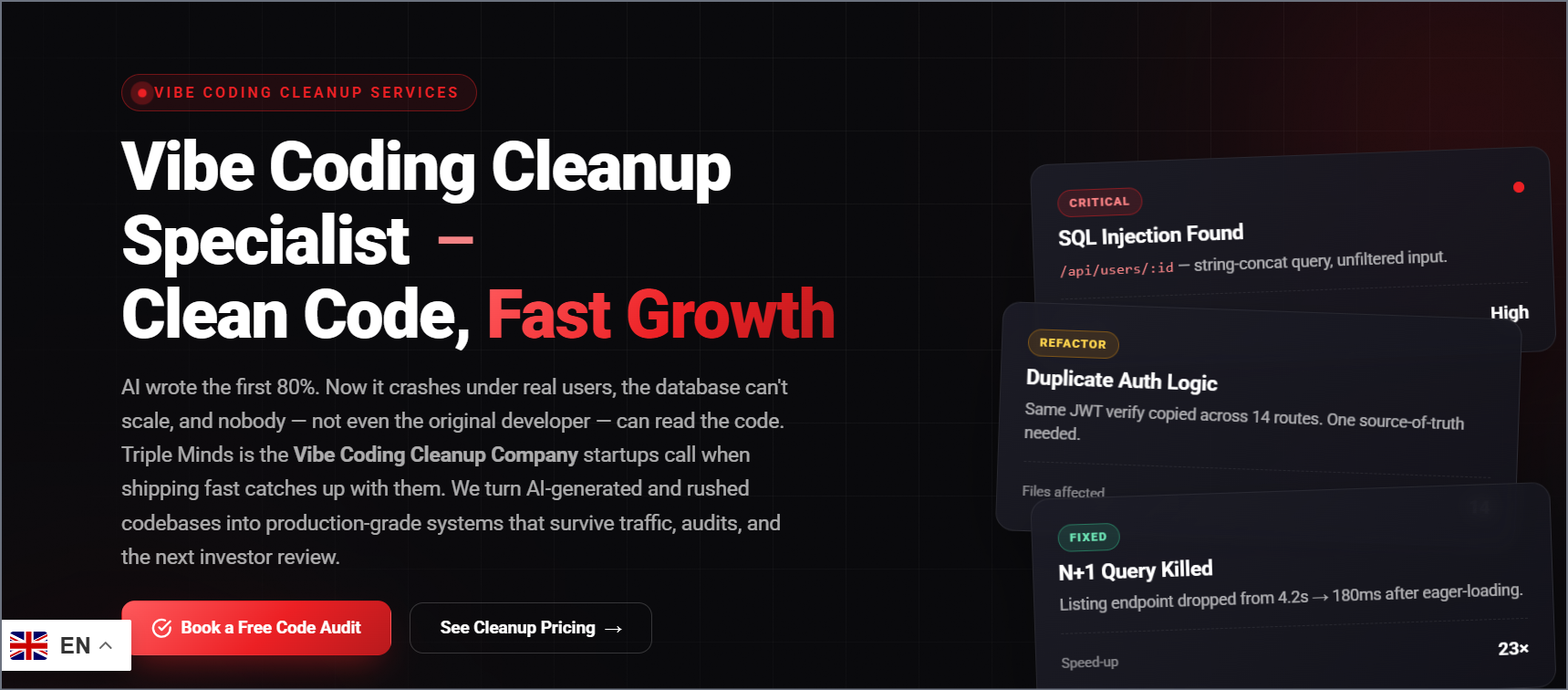
AI coding tools have changed how startups and businesses build software. Today, founders are launching MVPs, SaaS products, automation systems, and internal tools faster than ever using platforms like Cursor, Claude, ChatGPT, Copilot, Lovable, Replit, and other AI-assisted coding environments. However, there is also a growing problem most teams notice only after deployment — messy architecture, duplicated logic, security loopholes, unstable integrations, broken APIs, and code that becomes impossible to scale.
That is exactly where a Vibe Coding Cleanup Specialist becomes important.
At Triple Minds, we have seen many businesses approach us after building products quickly using AI-generated development workflows. In many cases, the product works initially, but the backend structure, database relationships, server performance, or frontend maintainability become major issues when real users start using the platform. Since Triple Minds already works across software development, SaaS engineering, API integrations, QA testing, and product modernization, cleanup and optimization naturally became a major service requirement for fast-growing AI-built products.
A Vibe Coding Cleanup Specialist is not simply a developer who fixes bugs. Their role is much deeper. They audit AI-written code, identify unstable patterns, restructure messy logic, improve performance, remove unnecessary dependencies, secure the application, and make the project production-ready for long-term growth.
As AI-generated development becomes more common, this role is quickly turning into one of the most valuable technical positions for startups, agencies, and businesses relying on rapid product launches.
What Does a Vibe Coding Cleanup Specialist Actually Do?
Many people think cleanup means fixing indentation, removing unused files, or correcting small frontend bugs. In reality, the role is far more technical and business-critical. A Vibe Coding Cleanup Specialist reviews the entire health of an AI-assisted software project and identifies areas that can create future scaling, security, maintenance, or performance problems.
For example, AI-generated projects often contain repeated functions, oversized components, unnecessary API calls, weak authentication handling, unoptimized database queries, poor folder structures, and random third-party packages added without long-term planning. Initially, these issues may not look serious because the app appears functional. However, once traffic increases or multiple developers start working on the same project, the system becomes difficult to manage.
In my experience, one of the biggest problems with vibe-coded applications is inconsistency. One section of the project may follow proper architecture, while another section looks completely different because different prompts, tools, or AI models were used during development. This creates confusion for future developers and significantly increases debugging time.
A professional cleanup specialist usually works on areas such as:
Refactoring AI-generated code
Removing duplicate or unnecessary logic
Improving code readability and maintainability
Optimizing frontend and backend performance
Fixing API structure and database relationships
Strengthening authentication and security
Standardizing project architecture
Reducing server load and infrastructure cost
Preparing the application for scaling
Improving deployment stability and DevOps workflows
The goal is not just to “clean” the code. The real objective is to transform a quickly-built AI project into a stable, scalable, and production-ready software system.
Why Businesses Are Suddenly Hiring Vibe Coding Cleanup Specialists
The rise of AI coding tools has created a new generation of software founders. Today, even non-technical entrepreneurs can build dashboards, marketplaces, CRM systems, AI chatbots, SaaS products, and automation tools without hiring a large engineering team in the beginning. This speed is impressive, but it has also created thousands of products running on unstable foundations.
As per my observation, most AI-built applications work perfectly during the demo stage. Problems usually start after real users arrive. Pages begin loading slowly, APIs fail under pressure, databases become messy, integrations break unexpectedly, and developers struggle to understand the original codebase. In some cases, businesses spend more money fixing the software later than they would have spent building it properly from the beginning.
This is why the demand for cleanup specialists is growing rapidly.
Startups are now realizing that shipping fast and scaling successfully are two completely different things. AI can generate functional code quickly, but it still cannot fully replace experienced engineering decisions related to architecture, scalability, security, maintainability, and long-term performance planning.
I have also noticed another important trend. Many agencies and freelance developers are now using AI-assisted coding internally to deliver projects faster. While this improves delivery speed, it sometimes introduces hidden technical debt into client projects. Businesses later hire cleanup specialists to audit the quality of the code before expanding the product further or raising investment.
Some common situations where companies hire a Vibe Coding Cleanup Specialist include:
After building an MVP using AI tools
Before launching a SaaS product publicly
When server costs suddenly increase
When bugs keep returning repeatedly
Before hiring a larger development team
During product scaling or migration
Before investor demonstrations or acquisitions
When app performance becomes unstable
After failed outsourcing projects
Before implementing enterprise-level security
In simple words, businesses are hiring cleanup specialists because AI can accelerate development, but experienced engineers are still required to make software reliable, scalable, and commercially sustainable.
Skills Every Good Vibe Coding Cleanup Specialist Should Have
Not every developer can handle AI-generated codebases properly. A Vibe Coding Cleanup Specialist needs a mix of software engineering knowledge, debugging ability, system architecture experience, and practical business thinking. The person must understand how AI coding tools generate projects and also know how to convert that rapidly-generated structure into maintainable production software.
One of the first skills to look for is code refactoring expertise. AI-generated projects often contain bloated components, repetitive logic, unnecessary dependencies, and inconsistent naming structures. A cleanup specialist should know how to simplify the system without breaking existing functionality.
Another critical skill is architecture understanding. Many vibe-coded applications are built feature-by-feature without long-term planning. This creates problems when scaling databases, APIs, authentication systems, or microservices later. A strong specialist understands folder hierarchy, modular architecture, backend scalability, caching strategies, API optimization, and deployment workflows.
From my experience, debugging is probably one of the most valuable abilities in this role. AI-generated code can sometimes create hidden conflicts that are difficult to identify quickly. A cleanup specialist must know how to trace issues deeply instead of applying temporary fixes that create larger problems later.
Security awareness is equally important. Many AI-generated apps unintentionally expose sensitive APIs, store tokens insecurely, skip validation layers, or use outdated libraries. A proper cleanup process includes security reviews, dependency checks, permission analysis, and authentication hardening.
A professional Vibe Coding Cleanup Specialist should ideally have experience with:
React, Next.js, Vue, or modern frontend frameworks
Node.js, Python, PHP, or backend technologies
Database optimization and schema structuring
API integrations and debugging
DevOps and cloud deployment workflows
Git version control and team collaboration
Server performance optimization
Authentication and access management
SaaS product architecture
AI-assisted coding environments like Cursor, Copilot, Claude, or ChatGPT
Most importantly, the specialist should think like a product engineer, not just a coder. Their responsibility is not limited to fixing syntax errors. They should understand how the software will behave after six months, one year, or even after the user base grows significantly.
Red Flags to Watch Before Hiring a Vibe Coding Cleanup Specialist
As the term “vibe coding” becomes more popular, many freelancers and agencies are now marketing themselves as cleanup experts without having real software engineering experience. This creates another challenge for businesses because cleaning AI-generated code requires much deeper technical understanding than basic website development.
One major red flag is when a developer only talks about UI improvements and ignores backend structure, database quality, security, or scalability. A project may look visually polished while still containing serious architectural problems underneath.
Another warning sign is when someone promises to “rewrite everything from scratch” immediately without first performing a proper audit. In many cases, large portions of an AI-generated application can actually be optimized and stabilized without rebuilding the entire system. A professional cleanup specialist first studies the existing architecture, identifies critical risks, and then decides what should be fixed, optimized, or rebuilt.
In my opinion, businesses should also avoid developers who rely completely on AI tools during the cleanup process itself. AI assistance is useful, but cleanup work still requires human engineering judgment. Otherwise, one layer of AI-generated problems simply gets replaced with another.
You should also be careful if the specialist cannot explain technical decisions in simple language. A good cleanup engineer should be able to clearly explain:
Why a particular architecture is risky
Which dependencies are causing instability
How server costs can be reduced
Why specific APIs need restructuring
Which security issues are most urgent
What parts of the codebase are scalable or non-scalable
Some additional hiring red flags include:
No experience handling production applications
No GitHub, portfolio, or technical case studies
Only frontend knowledge with weak backend understanding
Ignoring testing and QA processes
No security or deployment knowledge
Suggesting unnecessary rewrites to increase billing
Inability to work with existing developer teams
No documentation or reporting process
Lack of performance optimization knowledge
A proper Vibe Coding Cleanup Specialist should bring clarity, stability, and long-term technical direction to the project — not create additional confusion or dependency.
How Much Does It Cost to Hire a Vibe Coding Cleanup Specialist?
The cost of hiring a Vibe Coding Cleanup Specialist depends heavily on the complexity of the project, the condition of the existing codebase, the technologies involved, and how deeply the cleanup process needs to go. There is no fixed pricing because every AI-generated application has different levels of technical debt.
For example, cleaning a small MVP built with React and Firebase is very different from restructuring a large SaaS platform with multiple APIs, payment systems, AI integrations, admin panels, and cloud infrastructure. Some projects only require optimization and refactoring, while others need partial rebuilding of critical systems.
As per my experience, most cleanup projects usually fall into one of these categories:
Project TypeEstimated Cleanup CostSmall MVP or Prototype$500 – $2,000Startup SaaS Platform$2,000 – $8,000Enterprise-Level Application$8,000 – $25,000+Security & Performance Audit Only$300 – $1,500Monthly Cleanup & Maintenance Retainer$500 – $5,000/month
The final pricing usually depends on factors like:
Number of modules and integrations
Frontend and backend complexity
Quality of existing architecture
Security vulnerabilities
Database structure quality
Documentation availability
Cloud infrastructure setup
Urgency of delivery
Team collaboration requirements
Testing and deployment scope
One thing businesses should understand clearly is that cheaper cleanup often becomes more expensive later. In many cases, inexperienced developers apply temporary fixes instead of solving the root architectural problems. This may reduce issues for a few weeks, but eventually the same instability returns during scaling.
This is why many startups now prefer working with companies that already handle software architecture, SaaS engineering, QA testing, and product modernization under one roof. At Triple Minds, for example, cleanup projects are usually handled alongside performance optimization, system restructuring, deployment stabilization, and long-term scaling planning rather than isolated bug fixing alone.
Hiring Checklist for Businesses and Startups
Before hiring a Vibe Coding Cleanup Specialist, businesses should treat the process seriously because the wrong decision can increase technical debt instead of reducing it. Since many AI-built applications already contain hidden structural problems, choosing an experienced cleanup expert becomes extremely important for long-term product stability.
The first thing I usually recommend is asking for a technical audit before any development work starts. A professional specialist should first inspect the codebase, dependencies, APIs, database structure, deployment flow, and overall architecture before giving timelines or pricing. If someone provides a fixed quote without reviewing the project properly, that itself can be a warning sign.
Businesses should also evaluate whether the specialist has real-world experience with scalable applications instead of only small freelance projects. Production systems behave very differently when real traffic, payments, integrations, and multiple users are involved.
A good hiring process should include questions around:
Which technologies have they worked with?
Have they cleaned AI-generated projects before?
Can they identify architecture-level problems?
Do they understand cloud deployment and DevOps?
How do they handle security reviews?
What is their testing and QA process?
Can they optimize database performance?
How do they document cleanup changes?
Can they collaborate with internal development teams?
What happens if new issues appear after deployment?
It is also important to check whether they can work inside an existing codebase without disrupting the business workflow. Many startups cannot afford complete downtime or long rebuilding phases, so the cleanup process often needs to happen gradually while the product remains active.
From my experience, businesses should prefer specialists who focus on long-term maintainability instead of short-term fixes. The best cleanup engineers think ahead. They structure systems in a way that future developers can easily understand, maintain, and scale the product without unnecessary confusion.
Most importantly, hiring should not be based only on hourly pricing. A slightly more experienced cleanup specialist can often save months of future debugging, server instability, security risks, and redevelopment costs.
Final Thoughts
Vibe coding has completely changed the speed of software development. Today, startups can launch products in weeks instead of months, validate ideas faster, and reduce initial development costs using AI-assisted coding tools. This shift is creating massive opportunities for businesses worldwide.
However, speed alone does not build sustainable software.
As more companies rely on AI-generated development workflows, the importance of cleanup, optimization, architecture planning, and scalability is growing equally fast. That is why the role of a Vibe Coding Cleanup Specialist is becoming one of the most valuable technical positions in modern software development.
In my opinion, the future will not belong to companies that simply generate code faster. It will belong to businesses that know how to maintain, optimize, secure, and scale that code properly over time.
For startups, founders, and businesses already using vibe coding tools, the smartest approach is not avoiding AI-generated development. Instead, the real strategy is combining AI speed with experienced engineering oversight. That combination helps businesses launch quickly without compromising long-term product quality.
At Triple Minds, we have already seen how rapidly AI-assisted development is changing product engineering workflows across SaaS platforms, marketplaces, automation systems, and startup MVPs. Since our team works across consultation, development, QA testing, system integrations, and product modernization, we understand both sides of the equation — rapid development and long-term software stability.
Businesses that invest early in proper cleanup, architecture planning, and performance optimization usually save significant time, money, and operational stress later. In software development, fixing technical debt early is almost always cheaper than rebuilding everything after growth begins.

Join Ashish on Peerlist!
Join amazing folks like Ashish and thousands of other builders on Peerlist.
0
0
0