

Developer-First vs. Contract-Driven API Development: Which Approach Should You Choose?
Before you write your first API endpoint, you’re making a decision that will affect your team velocity, integration pain, and long-term maintainability.
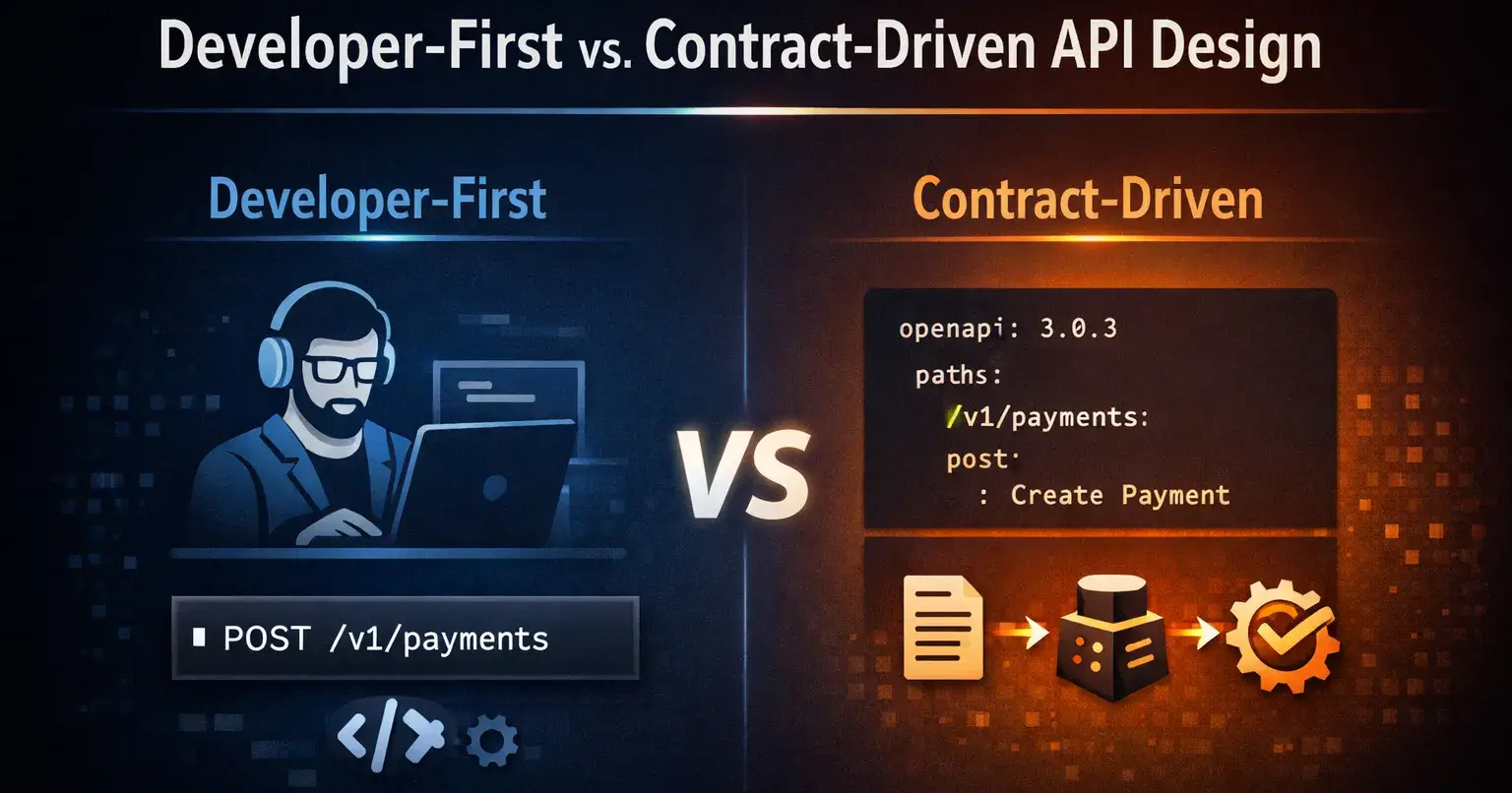
You’re about to build an API. Maybe it’s for your frontend team. Maybe it’s a public API for third-party developers. Maybe both.
Before you write your first API endpoint, you’re making a decision that will affect your team velocity, integration pain, and long-term maintainability.
That decision isn’t REST vs GraphQL.
It’s Developer-First vs Contract-Driven.
That decision: How do you approach API design?
Two approaches have become dominant in modern API development:
Developer-First — Design the API around the developer experience.
Contract-Driven— Define a formal API contract before anyone writes code.
They sound similar. They’re often confused. But they solve different problems and make different tradeoffs.
Developer-First API Approach
The Developer-First approach treats the API as a product and the developers consuming it as end users. Every design decision — naming, error messages, response structure, authentication — is driven by one question:
”How easy is this for a developer to understand and use?”
It’s not about what’s convenient for the backend. It’s about what feels intuitive from the outside.
What It Looks Like in Practice
You start by identifying the top use cases. For a payments API:
1. Create a customer
2. Charge the customer
3. Refund a payment
4. List transactions
Then you design endpoints that map naturally to these use cases:
POST /v1/customers
POST /v1/payments
POST /v1/payments/{id}/refund
GET /v1/transactions?customer_id=cus_123
Error messages are specific and actionable:
{
“status”: “error”,
“error”: {
“code”: “INVALID_CURRENCY”,
“message”: “Currency ‘uusd’ is not supported. Use ISO 4217 codes like ‘usd’, ‘eur’, ‘gbp’.”,
“field”: “currency”,
“docs”: “https://api.example.com/docs/currencies"
}
}
Documentation includes copy-paste examples. SDKs exist for popular languages. A developer can go from zero to first successful API call in under 5 minutes.
Who Does This Well?
Stripe is the gold standard. Their API is predictable, their errors are helpful, their docs are interactive, and their SDKs feel native in every language. Developers don’t just tolerate Stripe’s API — they genuinely enjoy using it.
Twilio, Resend, and Cloudflare follow the same philosophy.
Contract-Driven API Development
The Core Idea
The Contract-Driven approach makes the API specification the single source of truth. Before anyone writes implementation code, all teams agree on a formal contract — usually an OpenAPI (Swagger) spec that defines every endpoint, every field, every error, and every type.
The contract isn’t documentation generated after the fact. It’s a blueprint created before the fact.
What It Looks Like in Practice
The team collaborates on an OpenAPI spec:
openapi: 3.0.3
info:
 title: Payments API
 version: 1.0.0

paths:
 /v1/payments:
 post:
 summary: Create a payment
 operationId: createPayment
 requestBody:
 required: true
 content:
 application/json:
 schema:
 type: object
 required: [amount, currency, customer_id]
 properties:
 amount:
 type: integer
 description: Amount in cents
 currency:
 type: string
 enum: [usd, eur, gbp]
 customer_id:
 type: string
 responses:
 '201':
 description: Payment created
 content:
 application/json:
 schema:
 $ref: '#/components/schemas/PaymentResponse'
 '400':
 description: Validation error
 content:
 application/json:
 schema:
 $ref: '#/components/schemas/ErrorResponse'
 '404':
 description: Customer not found
Once this is agreed upon:
Backend implements the API to match the contract.
Frontend builds against a mock server generated from the contract.
Mobile does the same.
QA writes tests based on the contract.
Nobody waits. Everyone builds in parallel.
Who Does This Well?
Large organizations with multiple teams building against the same API. Companies running microservices where service-to-service contracts prevent cascading failures. Any team where frontend and backend developers are different people working on different timelines.
The Real Differences
Here’s where it gets interesting. These aren’t opposing approaches — they solve different problems. But they do make different tradeoffs.
1. What Drives the Design
Developer-First starts with empathy. You think about the developer using your API and optimize for their experience.
Contract-Driven starts with precision. You think about the exact shape of every request and response and formalize it before building.
2. When Does the “Contract” Exist
Press enter or click to view image in full size
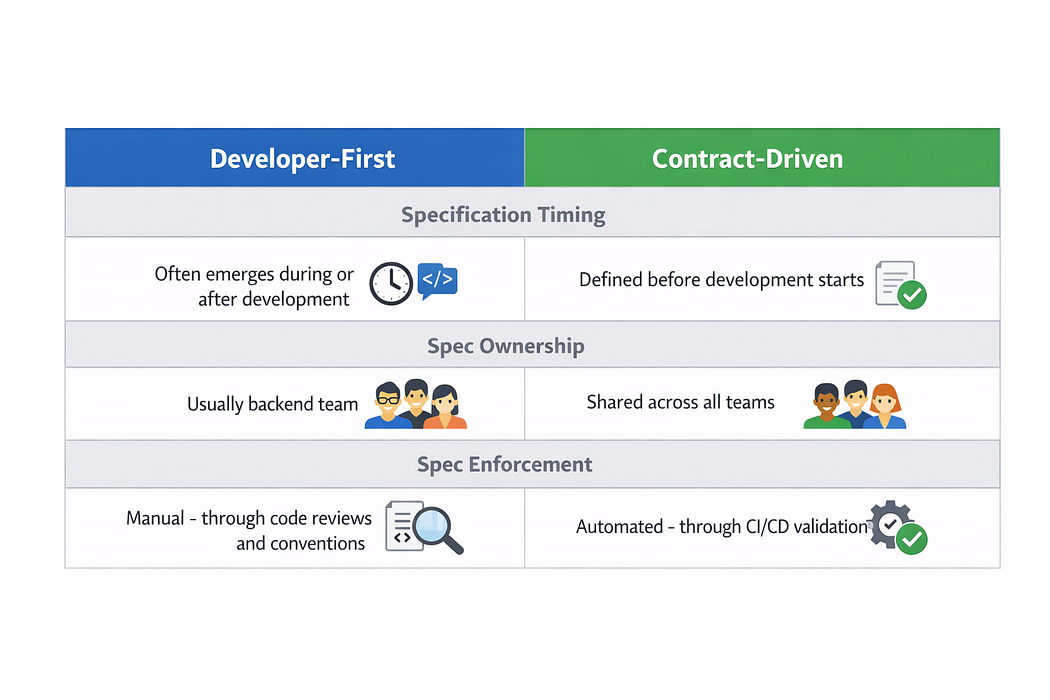
In a Developer-First workflow, you might design the interface first (and you should), but the formal machine-readable contract often comes later — sometimes auto-generated from code annotations.
In a Contract-Driven workflow, the machine-readable spec is the starting point. Everything flows from it.
3. How Teams Coordinate
This is the sharpest difference.
Developer-First:
Backend designs API → Backend builds API → Frontend integrates
(blocked until API exists)
Contract-Driven:
All teams agree on contract → Backend builds API
→ Frontend builds against mock
→ Mobile builds against mock
→ QA writes tests
(everyone works in parallel)
If your frontend and backend teams are the same person or a tiny co-located team, the coordination overhead of contract-driven development might not be worth it. If you have separate frontend, backend, and mobile teams — potentially in different time zones the contract becomes essential.
4. Error Prevention
Press enter or click to view image in full size
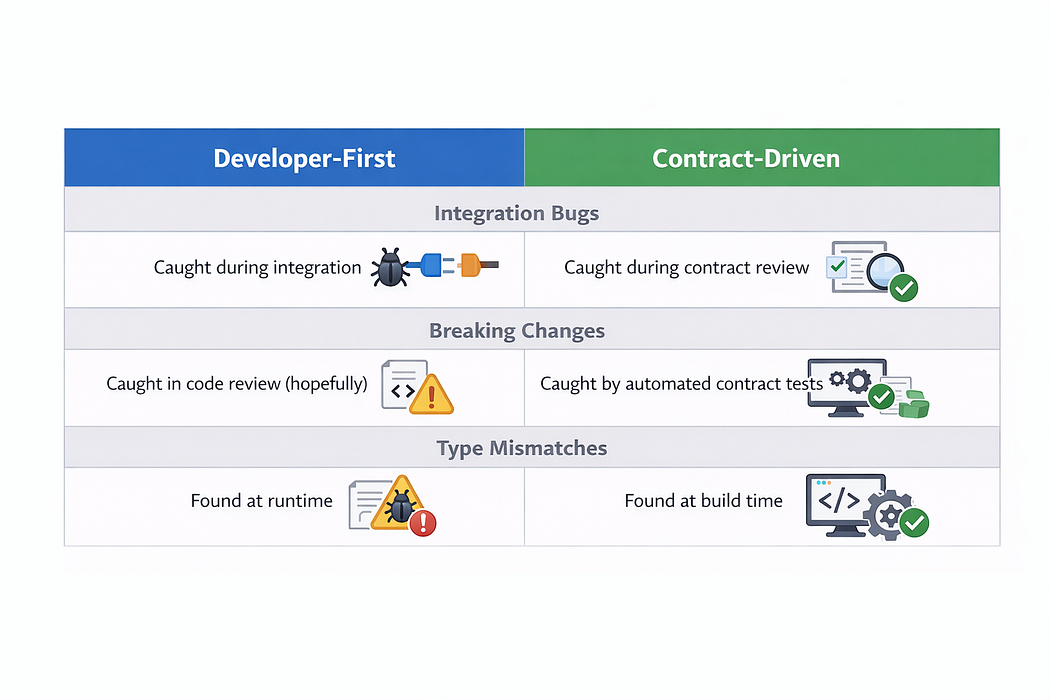
Contract-Driven development catches problems earlier because the contract is validated automatically. If the backend returns a field that isn’t in the contract, CI fails. If the frontend expects a field that doesn’t exist, CI fails.
Developer-First development relies more on good conventions, thorough testing, and careful code reviews.
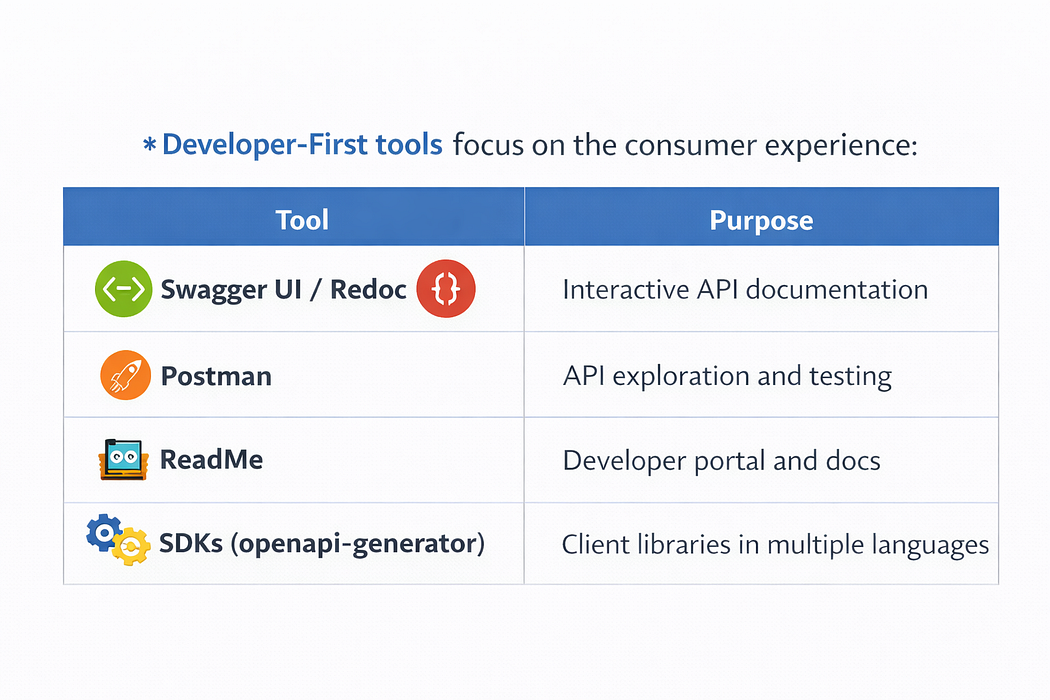
5. Tooling
Developer-First tools focus on the consumer experience:
Press enter or click to view image in full size
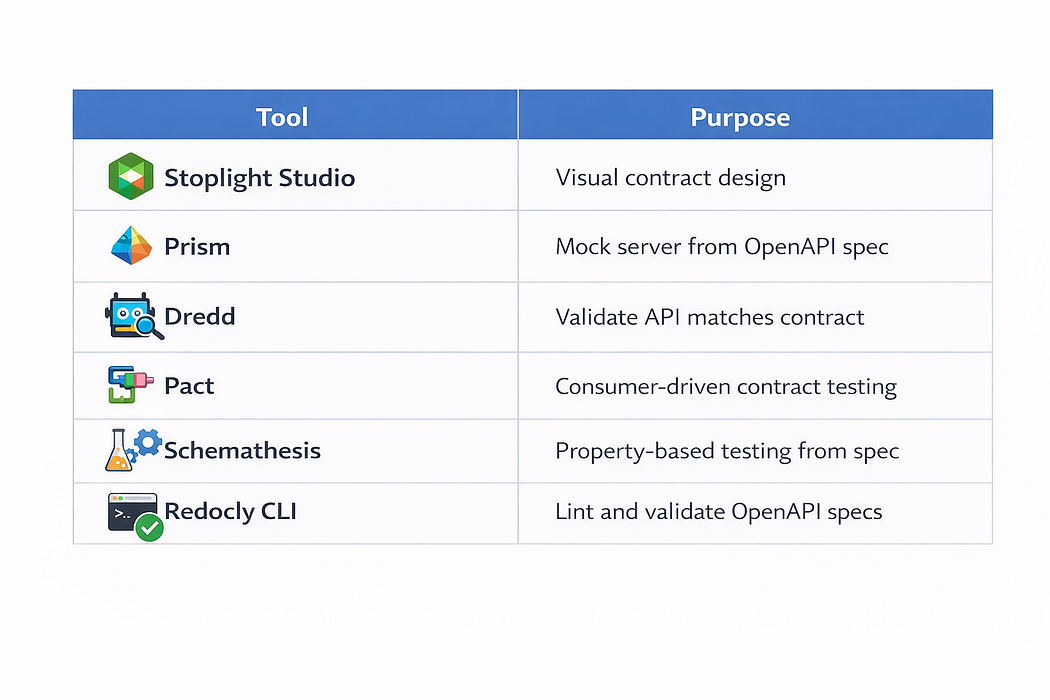
Contract-Driven tools focus on specification and validation:
Press enter or click to view image in full size
6. Change Management
Developer-First:
- Backend makes the change
- Updates docs
- Notifies consumers (hopefully)
- Consumers update their code
Contract-Driven:
- Someone proposes a contract change (via PR)
- All stakeholders review the change
- Mock servers are regenerated
- All teams update in parallel
- Contract tests validate everything matches
The contract-driven approach makes API changes visible and reviewable before they’re implemented. You’re diffing a YAML file, not trying to figure out what changed across 15 source files.
When to Use Which
Choose Developer-First When:
- You’re building a public API where developer adoption matters
- You’re a small team where the same people build frontend and backend
- You’re building a developer tool or platform (like Stripe, Twilio, Resend)
- DX is a competitive advantage developers choose your product partly because of your API
- You’re working on a greenfield project and need to move fast
Choose Contract-Driven When:
- You have separate frontend, backend, and mobile teams**
- Teams are in different time zones or work on different release cycles
- You’re running a microservices architecture where services call each other
- You need automated validation that APIs match their specifications
- Integration failures have been a recurring problem
- You need to generate client SDKs from a spec
Use Both When:
Here’s the thing most articles won’t tell you —they’re not mutually exclusive.
The best API teams do both:
1. Design with a developer-first mindset Prioritize intuitive naming, clear errors, consistent responses, great docs.
2. Formalize with a contract Write it down as an OpenAPI spec, validate it automatically, generate mocks from it.
Stripe does this. Their API is famously developer-friendly (developer-first), and internally they use rigorous API specifications and contract validation (contract-driven).
The question isn’t “which one?” — it’s “which one do you need more right now?”
The Bottom Line
Developer-First asks: ”Will developers enjoy using this?”
Contract-Driven asks: ”Are all teams building the same thing?”
If you’re a solo developer or small team building a public API start with developer-first. Make it intuitive. Make it delightful. The contract can come later.
If you’re coordinating multiple teams across a large codebase start with the contract. Get everyone aligned. Automate the validation. Then layer on developer-first principles to make the API a joy to consume.
The worst thing you can do? Neither. An API with no thought given to developer experience and no formal contract is an API that frustrates everyone the team building it and the developers using it.
Pick your starting point. Then grow into both.
If you found this comparison useful, follow me for more articles on API design and backend engineering.*

Join Asim on Peerlist!
Join amazing folks like Asim and thousands of other builders on Peerlist.
0
2
0