

Start a Prop Firm Today: Full Cost Breakdown and Development Strategy
Starting a prop firm today sounds big, but it’s actually pretty simple in idea.
Basically, it’s a setup where traders use the firm’s money instead of their own, and then share profits if they do well. That’s it.
But yeah, building one is a different story. You need a trading platform, some tech to manage accounts, risk controls, payouts, and a proper system to keep things running smoothly.
In this blog, we’ll just keep it simple and break down the real cost, the tools you need, and how you can actually start a prop firm step by step without the confusion.
Starting a Prop Firm Today: Simple Cost & Development Guide
Before building a prop firm platform, you must define the foundation of your business model and trading infrastructure.
→ Which markets will you support?
→ What funding programs will you offer?
→ Which trading platforms will you integrate?
→ What type of development approach will you choose?
These decisions will directly influence your startup costs, development timeline, and long-term operational strategy.
Prop Firm Development Strategy: White Label vs. Custom Built Solutions
Choosing the right development strategy is one of the most important decisions when starting a prop firm. Your technology setup will impact launch speed, operational costs, trader experience, scalability, and long-term profitability.
Most prop firms choose between two primary development models:
→ White Label Prop Firm Solutions
→ Custom Built Prop Firm Platforms
Each option offers different advantages depending on your budget, business goals, and technical requirements.
White Label Prop Firm Solutions
A white label prop firm solution allows you to launch using ready-made infrastructure provided by a third-party technology company. This is the fastest and most cost-effective way to enter the prop trading industry.
White-label systems typically include:
Trader dashboard
CRM system
Trading platform integration
Challenge management
Payment gateway setup
Affiliate systems
White-label prop firm solutions are ideal for startups and entrepreneurs looking to launch quickly without building an entire platform from scratch.
Custom Built Prop Firm Platforms
A custom-built prop firm platform is developed entirely based on your business requirements, branding, and operational model. This option provides complete control over the trader experience and platform functionality.
Custom development may include:
Proprietary trader dashboards
Advanced risk management systems
Custom evaluation models
Unique payout systems
Scalable cloud infrastructure
Multi-platform integrations
Custom-built platforms are better suited for larger businesses or firms planning long-term expansion in the prop trading industry.
Prop Firm Development Cost Breakdown
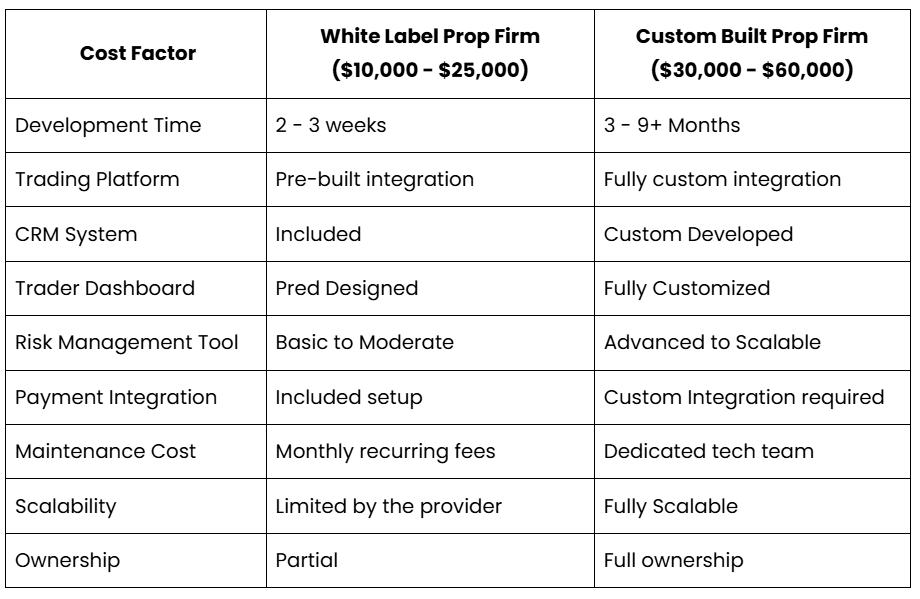
The cost of building a prop firm depends mainly on whether you choose a white label solution or a fully custom built platform.
Below is a clear comparison of both development approaches.
Ongoing Cost Structure

Planning to Build a Prop Firm? Here’s Your Next Step
Once you understand the costs and development options, the next step is to turn your idea into a simple plan.
Start with the basics. Decide which markets you want to focus on, what kind of funding program you will offer, which trading platforms you will use, and how much you are ready to spend. These decisions will shape how your prop firm is built.
Next, think about how you will actually build it. You will need a trading platform setup, a website, a system to manage traders, and payment integration. This is where your idea starts turning into a real product.
At this point, working with the right team makes the process much smoother. A good team can connect all the pieces and help you avoid delays and technical issues.
Hashcodex can help you build your prop firm from the ground up. They handle both white-label setups and custom development, depending on what you need, and help you get your platform ready for launch.
Book a Free Meeting with Hashcodex to Get Started!

Join Augustin on Peerlist!
Join amazing folks like Augustin and thousands of other builders on Peerlist.
0
0
0