

Agentic AI workflow
Agentic AI verses Traditional AI
The future of AI is evolving from static tools to dynamic, autonomous agents.
Here’s a detailed breakdown of what makes Agentic AI the next big leap:
1. What is Traditional AI?
These systems follow fixed rules for narrow tasks like spam filtering or image classification.
They lack memory, can’t adapt, and require constant human input.
2. What is Agentic AI?
Agentic AI can reason, plan, act, and adapt.
It breaks tasks into subgoals, collaborates with tools and agents, and works independently to achieve outcomes.
3. Workflow Comparison
Traditional AI gives a one-off answer based on input.
Agentic AI follows a goal-driven cycle: plans the process, uses tools, refines output using memory and feedback - just like a human team would.
4. Agentic AI Components
Powered by LLMs like GPT-4 and Gemini, agent frameworks (LangChain, CrewAI), vector memory (Weaviate, Redis), and tools like code interpreters, APIs, and browsers.
5. Core Differences
Agentic AI is autonomous, dynamic, memory-based, and tool-integrated.
Unlike Traditional AI, it can handle complex workflows and collaborate in teams of agents.
6. Why Agentic AI Is the Future
It minimizes manual prompting, automates multi-step tasks, and works in real-time - paving the way for AI co-workers and full-scale enterprise automation.
Agentic AI isn’t just smarter - it's built to think, act, and adapt like a real assistant.
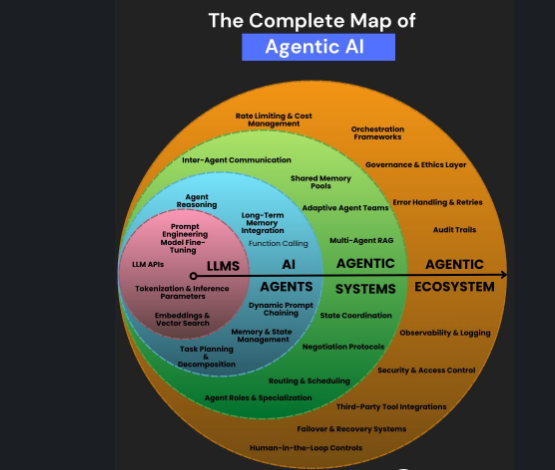
𝐓𝐡𝐞 𝐂𝐨𝐦𝐩𝐥𝐞𝐭𝐞 𝐌𝐚𝐩 𝐨𝐟 𝐀𝐠𝐞𝐧𝐭𝐢𝐜 𝐀𝐈
When we talk about AI, most people stop at LLMs.
But the real transformation is happening at the Agentic layer.
𝐓𝐡𝐢𝐬 𝐯𝐢𝐬𝐮𝐚𝐥 𝐛𝐫𝐞𝐚𝐤𝐬 𝐝𝐨𝐰𝐧 𝐭𝐡𝐞 𝐞𝐯𝐨𝐥𝐮𝐭𝐢𝐨𝐧 𝐛𝐞𝐚𝐮𝐭𝐢𝐟𝐮𝐥𝐥𝐲:
🔹 LLMs → Foundation models (APIs, embeddings, fine-tuning, tokenization).
🔹 AI Agents → Task planning, memory, reasoning, dynamic prompt chaining.
🔹 Agentic Systems → Multi-agent collaboration, orchestration, negotiation, scheduling.
🔹 Agentic Ecosystem → Governance, security, ethics, cost management, observability.
👉 𝐓𝐡𝐢𝐬 𝐬𝐡𝐢𝐟𝐭 𝐢𝐬 𝐧𝐨𝐭 𝐣𝐮𝐬𝐭 𝐚𝐛𝐨𝐮𝐭 𝐬𝐦𝐚𝐫𝐭𝐞𝐫 𝐦𝐨𝐝𝐞𝐥𝐬, 𝐛𝐮𝐭 𝐚𝐛𝐨𝐮𝐭 𝐡𝐨𝐰 𝐚𝐠𝐞𝐧𝐭𝐬 𝐢𝐧𝐭𝐞𝐫𝐚𝐜𝐭, 𝐜𝐨𝐨𝐫𝐝𝐢𝐧𝐚𝐭𝐞, 𝐚𝐧𝐝 𝐨𝐩𝐞𝐫𝐚𝐭𝐞 𝐫𝐞𝐬𝐩𝐨𝐧𝐬𝐢𝐛𝐥𝐲 𝐚𝐭 𝐬𝐜𝐚𝐥𝐞.
And for leaders, that means:
✅ Designing with governance and ethics at the core.
✅ Building scalable orchestration frameworks.
✅ Enabling human-in-the-loop systems for trust.

Join Bharat on Peerlist!
Join amazing folks like Bharat and thousands of other builders on Peerlist.
2
12
0