

AI in a Nutshell: Understanding the Layers Behind the AI Revolution
AI terminology can get incredibly confusing.
Are LLMs different from Machine Learning?
Where does Generative AI actually fit?
And why does everything suddenly seem to revolve around agents and transformers?
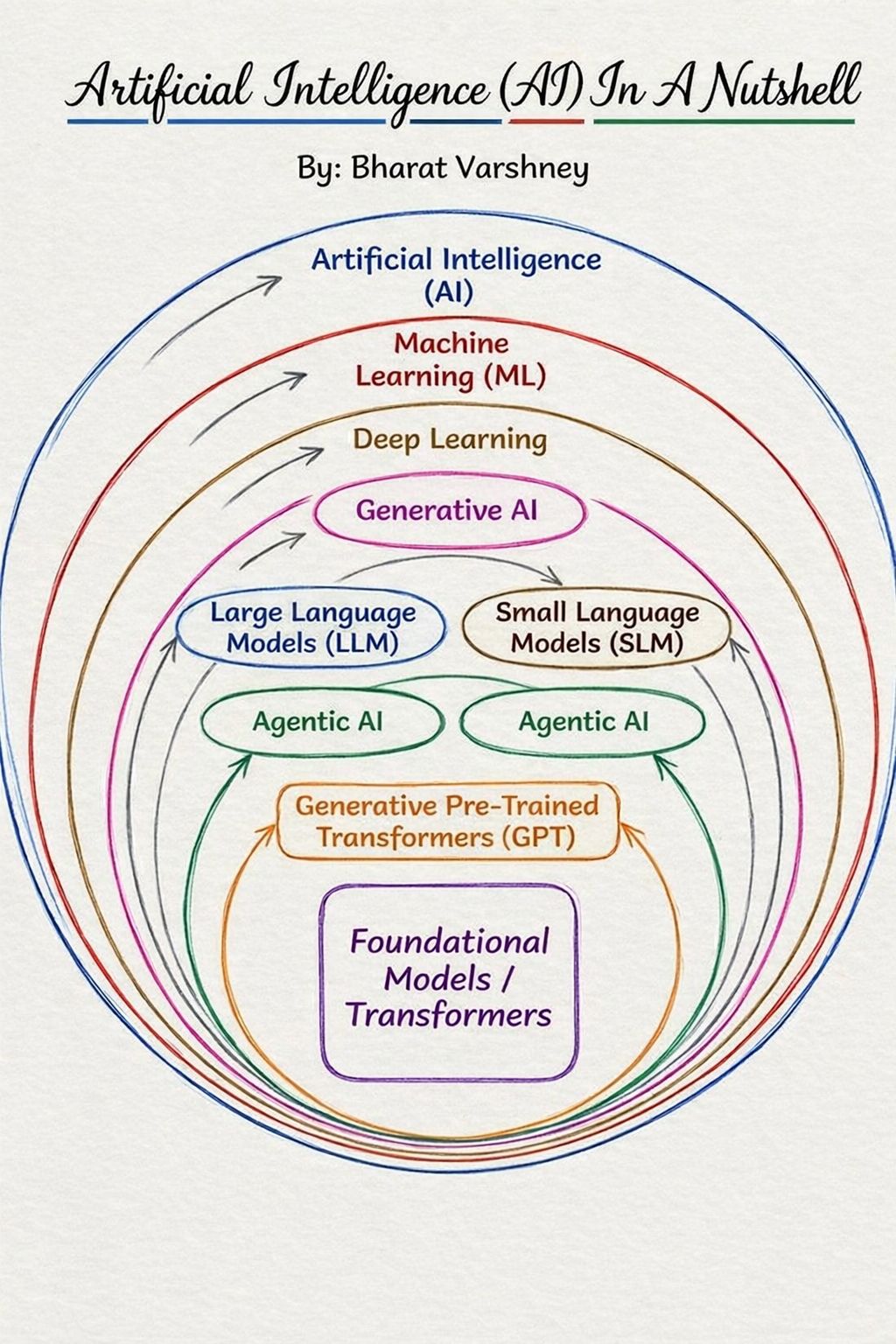
To make sense of it all, I sketched this “AI in a Nutshell” diagram to show how these concepts nest together, rather than compete with each other.
The easiest way to understand AI today is to think of it as layers of specialization, built over time.
The Outer Rings – The History
Artificial Intelligence, Machine Learning, and Deep Learning have been around for decades.
These are broad fields that include many techniques and approaches, far beyond what we commonly associate with AI today.
Not all AI is neural networks.
Not all ML is deep learning.
And most of this history existed long before the current hype cycle.
The Middle Rings – The Shift
Generative AI marks a turning point.
Instead of just analyzing or predicting, these systems create:
Text
Images
Code
Audio
Video
This is a specialized subset of deep learning, and it’s where AI started to feel truly transformative to everyday users.
The Inner Rings – The Now
This is where today’s excitement lives.
We now have:
Large Language Models (LLMs) for scale and capability
Small Language Models (SLMs) for efficiency and cost
A fast move toward Agentic AI, where systems don’t just respond—but plan, decide, and act autonomously
The Critical Nuance (The Core Matters)
Look closely at the center.
While the outer layers represent the entire history of AI, the current explosion in Generative AI is driven almost entirely by one thing:
Foundational Transformer architectures.
Transformers don’t power all of AI’s past—but they are absolutely powering the current AI revolution.
Understanding this distinction helps separate long-term AI fundamentals from today’s breakthrough moment.

Join Bharat on Peerlist!
Join amazing folks like Bharat and thousands of other builders on Peerlist.
0
7
0