

Understanding Prompting types step by step
Prompting types:
1. Zero-Shot Prompting
Give AI a task with no examples.
"Write a LinkedIn post about productivity."
Fast but generic. Use for brainstorming only.
2. One-Shot Prompting
Show AI one example first.
"Like this: [example]. Now write about X."
Better context. Still limited depth.
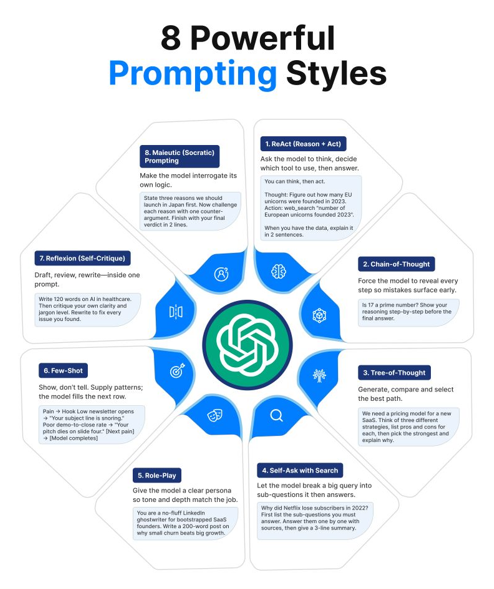
3. Few-Shot Prompting
Provide 3-5 examples before asking.
"Here are 3 eamples: [examples]. Create similar."
AI learns your pattern. Quality jumps 40%.
4. Chain-of-Thought (CoT)
Make AI think step-by-step.
"First analyze X, then consider Y, finally create Z."
Complex reasoning. Accuracy improves 67%.
5. Tree-of-Thought (ToT)
AI explores multiple paths simultaneously.
"Generate 3 approaches. Evaluate each. Pick best."
Premium results. Takes 3x longer.
6. ReAct Prompting (reason +act)
Combine reasoning with action.
"Think about X, then do Y, explain why."
Perfect for strategic content planning.
7. Multimodal Prompting
Mix text with images or data.
"Analyze this chart and write insights."
Unlocks visual AI capabilities.
8. Prompt Chaining
Link multiple prompts together.
Output 1 → Input 2 → Output 2 → Final result.
My secret weapon for complex projects.
Self consistency prompting : ask the same question multiple times and choose the most common or best answer
Contextual role prompting: tell the ai who you are
Scratchpad prompting: let the model write temporary notes or memory while solving a problem
TL;DR
Zero-shot → Fast drafts, low depth
- ToT → Multiple angles, best pick wins
- Few-shot → Style mimicry, better tone
- CoT → Better logic, step-by-step clarity
- One-shot → Quick context, modest boost
- ReAct → Smarter strategy, real reasoning
- Multimodal → Text + visuals = richer insight
- Prompt chaining → Complex workflows.

Join Bharat on Peerlist!
Join amazing folks like Bharat and thousands of other builders on Peerlist.
4
16
0