

Why Context Engineering Is the Future of Building AI Agents?
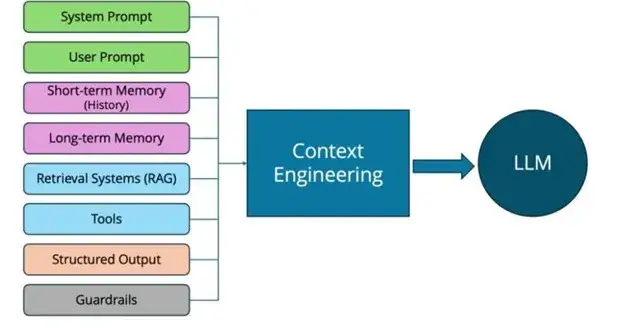
Why do LLMs Need Context Engineering and how can we make it useful for the user?
Well, Context Engineering is the process of gathering, organizing, and feeding relevant information to AI systems to generate more accurate, personalized, and actionable responses.
Unlike basic prompting, context engineering creates a comprehensive information framework that keeps track of user history, real-time data, and environmental factors.
I don't usually pay attention to all of the hype terms in the AI space....
But context engineering actually matters and here's why:
Prompt engineering was the first step, teaching us how to craft effective inputs for language models.
Then came RAG, addressing the limitations of LLMs’ short memory, hallucinations and lack of private or domain-specific knowledge by augmenting them with external document retrieval.
But as LLMs and RAG techniques matured, it became clear that the real challenge was controlling the 𝗳𝗹𝗼𝘄 𝗼𝗳 𝗰𝗼𝗻𝘁𝗲𝘅𝘁 across the entire AI system or agent workflow.
Think about it:
• How many tools can you safely give an agent before it gets confused?
• How many documents can you feed it in one go without exploding cost or latency, while still maintaining relevance?
• How do you balance semantic search, relational queries, and graph databases to pull exactly the right info?
• How do you preprocess and postprocess documents for maximum signal-to-noise?
• How do you design prompts so that the LLM focuses on the most critical information, possibly with reranking or other clever techniques?
All of these pieces are context elements we must thoughtfully manipulate and orchestrate to build AI systems that are fast, accurate, user-friendly, and cost-effective.
So if your AI pipeline still looks like vanilla RAG, it’s time to rethink your approach.
Understand differences
Context engineering verses prompt engineering
Context Engineering and Prompt Engineering aren’t the same thing.
As soon as your use case moves beyond single turn prompts, the difference really starts to matter.
𝐇𝐞𝐫𝐞’𝐬 𝐭𝐡𝐞 𝐜𝐨𝐫𝐞 𝐢𝐝𝐞𝐚:
Context = Prompt + Memory + Retrieval + Tool Specs + Execution Traces.
Prompting = Asking a good question.
Context Engineering = Setting the whole stage.
𝐋𝐞𝐭’𝐬 𝐛𝐫𝐞𝐚𝐤 𝐢𝐭 𝐝𝐨𝐰𝐧:
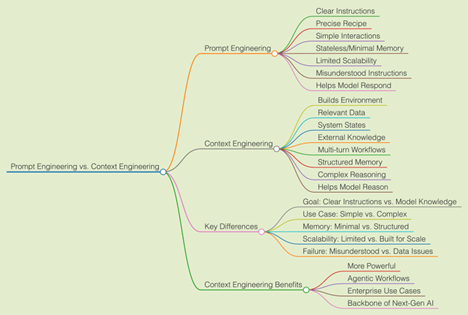
𝐏𝐫𝐨𝐦𝐩𝐭 𝐄𝐧𝐠𝐢𝐧𝐞𝐞𝐫𝐢𝐧𝐠:
- Best for summaries, rewrites, Q&A
- Works well for static, one shot tasks
- Focuses on templates, tone, and instruction clarity
- Breaks down as task complexity increases
𝐂𝐨𝐧𝐭𝐞𝐱𝐭 𝐄𝐧𝐠𝐢𝐧𝐞𝐞𝐫𝐢𝐧𝐠:
- Powers agents, multi-step workflows, and tool use
- Involves memory, retrieval, orchestration
- Built for dynamic systems that evolve mid-task
- Most failures come from context sprawl or leakage
𝐊𝐞𝐲 𝐝𝐢𝐟𝐟𝐞𝐫𝐞𝐧𝐜𝐞𝐬 𝐢𝐧 𝐩𝐫𝐚𝐜𝐭𝐢𝐜𝐞:
👉 Primary Goal:
Prompt: Write clearer instructions
Context: Manage what the model knows and remembers
👉 Use Case Fit:
Prompt: Simple interactions
Context: Multi-turn workflows, real systems
👉 Memory:
Prompt: Stateless or minimal
Context: Structured, persistent, scoped
👉 Scalability:
Prompt: Limited beyond basic tasks
Context: Built for complex reasoning at scale
👉 Failure Mode:
Prompt: Misunderstood instructions
Context: Too much, too little, or irrelevant data
👉 The Takeaway:
Prompting helps a model respond.
Context engineering helps a model reason.
If you’re building copilots, agents, or decision-making systems Context is where scale, reliability, and intelligence start to emerge.
Follow for more insightful content.

Join Bharat on Peerlist!
Join amazing folks like Bharat and thousands of other builders on Peerlist.
2
11
0