

Most asking CPP
Interview Quetions and Answers ?
Note : Basics
The latest official C++ standard is C++23.
It was developed by Bjarne Stroustrup in 1985.
#include <iostream>→ used for input/outputusing namespace std→ allows using standard functions for remove spacemain()→ starting point of programcout→ prints outputcin→ Take input from userendl→ Line Breakreturn 0→ program ends successfully
cout is pronounced "see-out". Used for output, and uses the insertion operator (<<)
cin is pronounced "see-in". Used for input, and uses the extraction operator (>>)
What is C++?
C++ most popular Object Orineted Programming Language (OOPs)
C++ was developed as an extension of C
Supports classes and objects
C++ is used for system software and games
What are the main features of C++?
Main features are:
Object-Oriented Programming
Classes and Objects
Inheritance
Polymorphism
Encapsulation
Data Abstraction
What is a Constructor?
A constructor is a special function that is automatically called when an object is created.
Same name as class
Constructor doesn't have any return type
Only called onece (automatically), Object creaction
What is a Destructor?
A destructor is a special function that is automatically called when an object is destroyed.
It is mainly used to free memory or clean up resources.
Example: Closing files, releasing memory, deleting pointers.
Destructor name is the same as the class name
It has a tilde (~) before the name
#include <iostream>
using namespace std;

class Test {
public:
 Test() {
 cout << "Constructor called" << endl;
 }

 ~Test() {
 cout << "Destructor called" << endl;
 }
};

int main() {
 Test obj;
}
It has no return type
It takes no parameters
It is called automatically
What is a Pointer?
A pointer is a variable that stores the memory address of another variable. Instead of storing a value, it stores where the value is located in memory.
int *ptr; //This means ptr is a pointer that can store the address of an integer variable.Dynamic memory allocation
Passing arguments to functions
Working with arrays
Efficient memory use
#include <iostream>
using namespace std;

int main() {
 int a = 10;
 int *ptr;

 ptr = &a;

 cout << "Value of a: " << a << endl;
 cout << "Address of a: " << &a << endl;
 cout << "Pointer value (address): " << ptr << endl;
 cout << "Value using pointer: " << *ptr << endl;

 return 0;
}
Code Meaning
int a = 10;Create variableaint *ptr;Create pointer to integerptr = &a;Store address ofainptr&aAddress of variablea*ptrValue stored at that address
5️⃣ Important Symbols
&Address-of operator*Pointer / Dereference operator
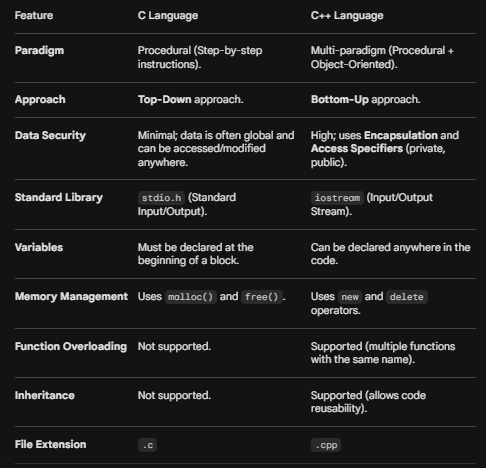
Difference between C and C++
C is a procedural language focused on functions.
C++ is an object-oriented language focused on classes and objects.
Access Specifiers
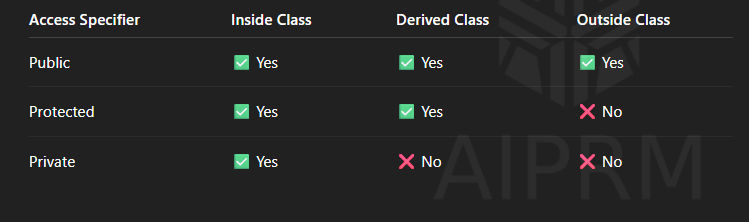
Access specifiers in C++ are used to control the accessibility (visibility) of class members such as variables and functions.
They help in data hiding and security of a program.
There are three main types of access specifiers:
Public - Members declared as public can be accessed from anywhere in the program.
#include <iostream>
using namespace std;

class Student {
public:
 int age;

 void show() {
 cout << age;
 }
};

int main() {
 Student s;
 s.age = 20;
 s.show();
}
Accessible inside the class
Accessible outside the class
Accessible by derived (child) classes
Mostly used for functions that interact with objects
Protected - Members declared as protected can be accessed inside the class and by derived (child) classes, but not outside the class.
class Parent {
protected:
 int value;
};

class Child : public Parent {
public:
 void setValue() {
 value = 10;
 }
};
Accessible inside the class
Accessible in derived classes (inheritance)
Not accessible outside the class
Mainly used in inheritance
Private - Members declared as private can be accessed only inside the class.
class Demo {
private:
 int num;

public:
 void setNum() {
 num = 5;
 }
};
Accessible inside the class only
Not accessible outside the class
Not accessible in derived classes
Used for data hiding

Join Kiran on Peerlist!
Join amazing folks like Kiran and thousands of other builders on Peerlist.
0
1
0