

How AI Software Development Services Help Organizations Modernize Legacy Systems
Enhance Business Performance with Custom AI Software Solutions
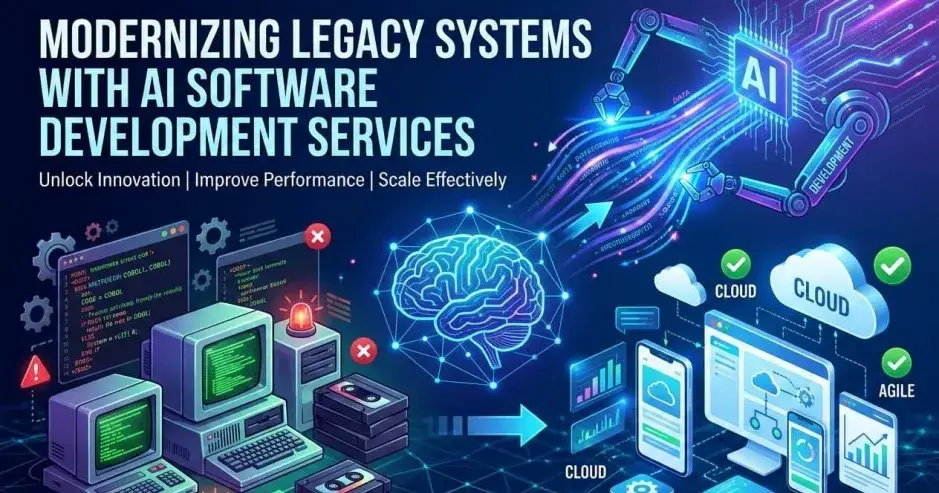
What happens when the software running critical business operations was built decades ago and can barely keep up with modern demands? Organizations face this problem constantly. Old systems that work well enough to keep, but struggle too much to ignore. Legacy system modernization sounds simple until you realize these systems comprise years of business knowledge, connect to countless other systems, and can't be shut down without disrupting operations entirely.
The financial burden is substantial. Recent research shows that enterprises spend an average of 60-80% of their IT budgets on maintaining legacy systems, leaving only 20-40% for innovation and new capabilities. Four-fifths of technology spending going to maintenance shows how legacy systems drain resources. This detailed post examines common modernization challenges and how AI solutions help overcome them. It also explores why enterprises increasingly turn to AI software development services. Lastly, it showcases how different industries are successfully modernizing legacy systems with AI-powered approaches.
What Are the Common Legacy Systems Modernization Challenges and How Does AI Software Solution Help Overcome Them?
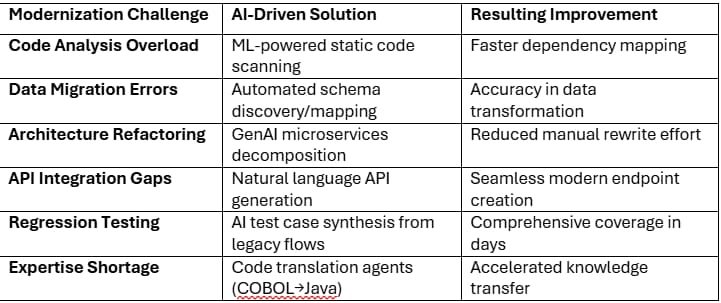
Legacy system modernization faces specific challenges that AI software solutions help solve. Explore the typical obstacles covering code analysis overload, data migration errors, and expertise shortage with AI capabilities that address them.
Why Are Enterprises Turning to AI Software Services for Legacy System Modernization?
Enterprises see real value in using AI software services for modernization efforts. Explore the key reasons, including automated code translation, predictive maintenance, and UI modernization, that enterprises find appealing.
1. Automated Code Translation
An AI software development company builds tools that read old programming languages like COBOL and automatically convert them to modern languages like Java or Python. This translation happens in weeks instead of years of manual rewriting. Companies modernize faster while reducing human errors that happen when developers manually translate thousands of code lines.
Converts COBOL programs to Java automatically
Translates Fortran code into Python rapidly
Maintains original business logic during conversion
Reduces translation time from years to weeks
Catches errors humans miss during rewriting
2. Intelligent Documentation Generation
Legacy systems often lack proper documentation since the original developers left decades ago. AI software reads through old code and automatically creates explanations of what each part does. New developers understand these mysterious systems quickly instead of spending months deciphering cryptic code nobody remembers anymore.
Generates documentation from undocumented code automatically
Explains complex business rules hidden in code
Creates visual diagrams showing system architecture
Identifies dependencies between different program parts
Documents database structures and relationships clearly
3. Dependency Mapping and Analysis
Old systems have tangled connections where changing one thing breaks five others unexpectedly. Artificial intelligence software development company solutions map all these hidden connections automatically. Teams see exactly what will be affected before making changes, preventing catastrophic failures from seemingly simple modifications.
Maps all connections between system components
Identifies which programs share data sources
Reveals hidden dependencies across applications automatically
Predicts the impact of proposed changes accurately
Creates visual maps of system relationships
4. Predictive Maintenance Scheduling
AI software monitors legacy system health and predicts when components will fail before actual breakdowns happen. It notices patterns like increasing error rates or slowing response times. Maintenance happens during planned windows instead of emergency situations, disrupting business operations completely.
Predicts hardware failures weeks in advance
Identifies software components that degrade slowly over time
Schedules maintenance during low-traffic periods automatically
Prevents unexpected system crashes during work
Alerts teams before problems become critical
5. Automated Testing Generation
Creating test cases for old systems with no documentation takes forever manually. AI software generates comprehensive tests by analyzing how the system currently works. Modernization teams verify new versions match old behavior exactly, ensuring nothing breaks during the transition to updated technology.
Creates test cases from existing code
Generates thousands of test scenarios automatically
Validates new system matches old behavior
Identifies edge cases that humans often overlook
Reduces testing time from months to days
6. Data Migration Validation
Moving decades of data from old databases to new systems risks losing or corrupting critical business information. AI software development services include tools that verify every single record transferred correctly. Automated checking catches problems that manual spot-checking misses, protecting valuable historical data completely.
Compares source and destination data automatically
Identifies missing or corrupted records instantly
Validates that data format conversions are accurate
Checks referential integrity across related tables
Generates detailed migration reports for auditing
7. User Interface Modernization
Old green-screen interfaces confuse modern employees who expect intuitive web and mobile experiences. AI software analyzes how users interact with legacy screens and designs modern interfaces automatically. New interfaces look contemporary while keeping familiar workflows employees already know, reducing training time significantly.
Converts text screens to graphical interfaces
Maintains familiar workflows in new design
Creates mobile versions of desktop applications
Designs intuitive layouts from usage patterns
Reduces employee retraining needs after modernization
8. API Generation from Legacy Systems
Modern applications need to connect with old systems that were never designed for integration. AI software wraps legacy systems with modern APIs automatically, allowing new mobile apps and cloud services to access old data. Integration happens without rewriting the entire old system from scratch.
Creates REST APIs for mainframe applications
Enables mobile apps to access legacy data
Connects cloud services to on-premise systems
Generates API documentation automatically for developers
Maintains security while enabling modern connectivity
9. Performance Bottleneck Identification
Legacy systems slow down mysteriously, but finding exactly why takes weeks of investigation. AI software analyzes system behavior and pinpoints specific code sections causing delays. Developers fix the right problems instead of guessing or optimizing parts that don't matter for performance improvements.
Identifies slow database queries precisely
Locates inefficient code loops causing delays
Finds memory leaks that degrade performance gradually
Detects network communication bottlenecks clearly
Prioritizes fixes by performance impact ranking
10. Risk Assessment During Migration
Modernization projects can fail catastrophically, costing millions and disrupting business for months. AI software evaluates migration plans and predicts which approaches carry the highest risks. Companies choose safer paths, avoiding common pitfalls that destroyed similar modernization attempts at other organizations previously.
Predicts migration success probability accurately
Identifies high-risk components needing extra attention
Recommends phased approaches that reduce overall risk
Compares different modernization strategies fairly
Warns about dependencies causing past project failures
How Are Different Industries Modernizing Legacy Systems with AI Software Development Services?
Different industries leverage AI software services for modernization in practical ways. Find out the industry examples, including banking, insurance, and education, demonstrating real AI-driven transformation projects.
1. Banking
Banks use AI software to read old loan files, match customer records, and check risk faster than manual review. Legacy systems often slow down approval steps, but AI software connects missing data and removes repeated entries. This helps banks speed up loan checks while keeping rules and customer details correct.
2. Healthcare
Hospitals keep many files in old systems that load slowly. AI software extracts medical notes, updates missing details, and links past reports in one view. This gives doctors faster access to patient history and reduces the risk of wrong entries caused by old screens and manual data entry.
3. Retail
Many retail systems cannot track new buying patterns. AI software studies old sales, current demand, and store trends to guide stock levels. It also updates slow legacy dashboards, helping teams avoid shortages or waste. This makes store planning easier without changing the entire back‑office system.
4. Manufacturing
Old factory systems store years of machine data but cannot read patterns. AI software turns these records into alerts that warn teams before a part fails. This reduces downtime, avoids sudden stoppages, and keeps production steady, even when the main system is old and hard to upgrade.
5. Insurance
Claims teams often use slow legacy screens to check files. An AI software development company builds tools that read photos, match policy details, and highlight mistakes. This reduces manual review time and helps teams finish claims faster while keeping the old system running in the background.
6. Logistics
Transport firms use legacy tools that cannot adjust to traffic or weather. AI software reads past routes, fuel use, and delay reports to guide better plans. This reduces travel time and lowers waste. AI tools sit on top of the old system, so teams do not face large changes.
7. Telecom
Telecom teams deal with thousands of faulty tickets daily. Old systems cannot group related issues. AI software reviews past cases to spot root causes and suggest quick fixes. This reduces ticket volume and helps engineers solve issues faster without replacing the entire support system.
8. Energy
Energy companies still depend on slow billing systems. AI software studies usage patterns, finds meter errors, and alerts teams about sudden spikes. This improves billing accuracy and reduces customer complaints. The old system remains in place while AI handles the heavy analysis work.
9. Education
Schools keep years of student data in outdated tools. AI software reviews attendance, scores, and learning patterns to guide early support for students. This helps teachers act quickly and reduces manual sorting. The main system stays the same while AI software improves how data is understood.
10. Public Sector
Government offices use old portals that cannot sort requests well. An artificial intelligence software development company creates tools that read each request, tag the category, and guide the right department. This reduces user wait time and helps teams clear files faster without replacing the core system.
Summing Up
Modernization isn't optional anymore. Legacy systems create too many risks and limitations. AI software development services make modernization faster, safer, and more affordable than traditional approaches ever could achieve. The industry examples prove this works across sectors. Organizations using AI assistance modernize successfully, while those attempting traditional methods struggle.

Join Christine on Peerlist!
Join amazing folks like Christine and thousands of other builders on Peerlist.
0
0
0