

Designing Emotional Architecture: Why Product Teams Must Account for Emotional Consequence
Behavioral science suggests that emotion often follows action. If product design structures behavior, then digital platforms are shaping emotional outcomes — whether intentionally or not.

Every product team tracks engagement. Few track emotional consequence. Yet behavioral science suggests something uncomfortable: emotion often follows behavior.
After presenting the concept behind HappinessAI — a system designed to make wellbeing observable and actionable — I asked a few friends a simple question:
“Would you intentionally smile, even if you didn’t feel like it, just to test what happens?”
The reaction wasn’t curiosity. It was resistance: “Why?” “What’s the point?” “I don’t feel like it.”
That resistance is revealing. We reject small behavioral interventions unless the emotional ROI is guaranteed. Yet we accept behavioral manipulation from digital systems every day without question.
The Science of the “Inside-Out” Shift
There is a long-standing psychological framework known as the Facial Feedback Hypothesis, first proposed by Charles Darwin and later formalized by William James. The premise is simple: our facial expressions do not merely reflect our emotions; they can influence them.
A widely cited experiment by Strack, Martin, and Stepper (1988) suggested that participants who held a pen in their teeth (activating smiling muscles) rated cartoons as funnier than those who held the pen in their lips (inhibiting those muscles). While a high-profile replication attempt by Wagenmakers et al. (2016) sparked debate regarding the effect size, a more recent, comprehensive meta-analysis of 138 studies confirmed that facial feedback has a small but significant influence on emotional experience (Coles et al., 2019).
This connects to Behavioral Activation, a cornerstone of Cognitive Behavioral Therapy (CBT). It operates on a counterintuitive principle: action can precede emotion. Instead of waiting for motivation to strike, individuals engage in constructive behaviors first, allowing emotional shifts to follow (Jacobson et al., 2001). This is supported by Self-Perception Theory, which suggests that we often infer our internal states by observing our own behavior (Bem, 1972).
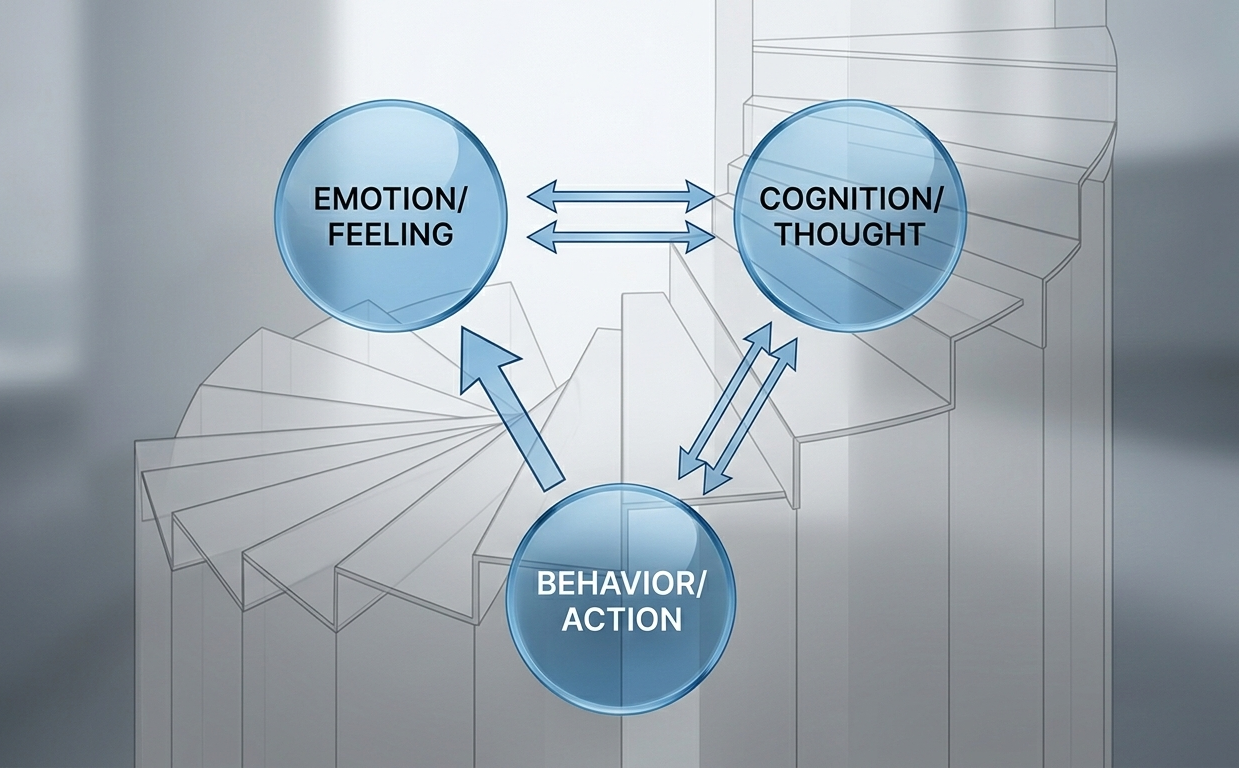
For product builders, this matters. If behavior can precede emotion, then interface decisions are not neutral. Scroll patterns, notification timing, color schemes, reward mechanics — these are emotional levers.
In short: Emotion is not always the starting point. Sometimes, it is the outcome.
The Resistance to Agency
I tested this on myself. I stood in front of a mirror and smiled — deliberately and mechanically. It felt performative, even absurd. But after a minute, something shifted. I didn’t become euphoric, but I felt lighter.
If such a low-cost behavioral adjustment can influence mood, why the resistance?
We resist because we equate engineered behavior with inauthenticity.
But we already live inside engineered behavioral systems.
The difference is not whether design shapes us — it does. The difference is whether the shaping is intentional and transparent. We are willing to optimize supply chains, A/B test product interfaces, and streamline workflows. Yet, we hesitate to “A/B test” our own internal systems. When we ask, “Why should I smile if I don’t feel like it?” the deeper question is: Why do we require a guaranteed ROI before attempting a 30-second intervention in our own wellbeing?
From Personal Behavior to Systemic Design
This resistance reveals a truth: if micro-actions influence emotional states, then happiness is not entirely accidental. It is partially designable.
If we acknowledge that behavior influences emotion, then the tools, platforms, and environments we inhabit are not neutral. They are psychological architectures. Currently, most digital platforms are designed for passive consumption or high-arousal engagement (outrage, urgency). They create behavioral loops that often lead to emotional depletion.
The question is no longer “Does smiling work?” The question is: If we know behavior shapes emotion, why are we not demanding technologies that intentionally reinforce upward emotional spirals?
At scale, small nudges compound. The companies and designers of the future will not just build products; they will build emotional ecosystems. We must decide if we want to be passive recipients of these architectures or active participants in their design.
If we accept that micro-behaviors influence emotional states, then platform designers are not just UX architects. They are emotional infrastructure engineers.
The industry tracks engagement, retention, and monetization with precision. Where are the metrics for emotional impact?
The next generation of technology companies will not compete solely on speed, scale, or personalization. They will compete on emotional consequence.
Every interface creates a feedback loop. The only question is whether that loop trends toward depletion or growth.
Platforms are not neutral.
They are behavioral systems.
Behavioral systems shape emotion.
And emotion shapes society.
The future of product design is not just usability. It is responsibility.
This exploration is part of a larger mission to redefine our relationship with digital interfaces. HappinessAI is an initiative exploring how technology can make wellbeing observable and actionable, making our world happier. This technology moves beyond passive consumption to help us observe and influence our own emotional trajectories.
An earlier version of this piece was published on Medium. This version has been modified for the Peerlist audience.
Original version
If you’re interested in moving beyond passive consumption and want to help, you can sign up to participate here.
Citations:
Bem, D. J. (1972). Self-perception theory. In L. Berkowitz (Ed.), Advances in Experimental Social Psychology (Vol. 6, pp. 1–62). Academic Press.
Coles, N. A., Larsen, J. T., & Lench, H. C. (2019). A meta-analysis of the facial feedback literature: Effects of facial feedback on emotional experience are small but sturdy. Psychological Bulletin, 145(6), 610–651.
Jacobson, N. S., Martell, C. R., & Dimidjian, S. (2001). Behavioral activation treatment for depression: Returning to contextual roots. Journal of Consulting and Clinical Psychology, 69(3), 255–266.
Strack, F., Martin, L. L., & Stepper, S. (1988). Inhibiting and facilitating conditions of the human smile: A nonobtrusive test of the facial feedback hypothesis. Journal of Personality and Social Psychology, 54(5), 768–777.
Wagenmakers, E. J., et al. (2016). Registered Replication Report: Strack, Martin, & Stepper (1988). Perspectives on Psychological Science, 11(6), 917–928.

Join Chander on Peerlist!
Join amazing folks like Chander and thousands of other builders on Peerlist.
1
5
0