

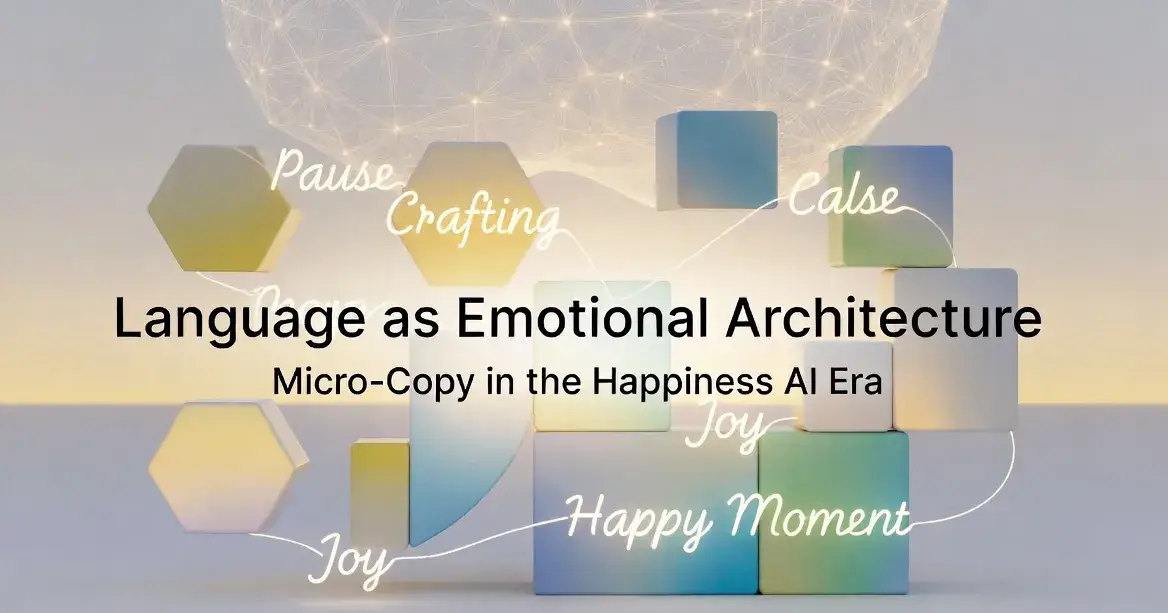
Language as Emotional Architecture: Micro-Copy in the Happiness AI Era
Micro-copy isn't fluff—it's emotional architecture shaping AI-era joy. "Delete?" sparks dread; "Save this moment?" builds trust. Design happiness deliberately.
Peerlist Edition — adapted from my Medium article.
Micro-copy is no longer a “small detail.”
It has become emotional architecture — the linguistic layer that shapes how users feel, decide, and trust digital systems. As AI tools increasingly touch our well-being, word choice becomes a design mechanism that can elevate or erode emotional experience (Lolayekar, 2026; Metyis, 2025).
In this context, semantics (literal meaning) and pragmatics (context + implication) function as emotional UX levers embedded inside every button, prompt, and micro-interaction.
1. Semantics: Tiny Words, Big Emotional Shifts
Semantics drives immediate reactions.
“Delete entry?”
→ high-anxiety, high-stakes, creates cognitive friction.“Pause this moment?”
→ softer, reversible, emotionally safer (Redlio Designs, 2025).
Even finance apps illustrate this:
“Balance low.” → neutral, informational
“Insufficient funds.” → accusatory, shame-triggering (Zigpoll, n.d.)
The underlying data doesn’t change — the emotional experience does.
2. Pragmatics: Implied Empathy Builds Trust
Pragmatics shapes a user’s interpretation of intent.
Compare:
“Loading…”
→ mechanical, cold.
vs.
“Just a sec — crafting your joy map…”
→ personal, humanized, expectation-setting (Userlytics, 2026).
This aligns with conversational principles like Grice’s cooperativeness: clarity + warmth → higher trust and smoother interaction.
In emotional UX tests, pragmatic tone shifts often outperform feature tweaks in influencing NPS.
3. Case Example: Emotion-Driven Micro-Copy in Practice
Consider the difference between a typical fitness app and an emotionally intelligent approach.
Traditional:
“Log your workout. Skip?”
→ frames the action as an obligation. Users feel pressured.
Emotion-aware:
“Capture a moment you want to remember.”
“Revisit a place that made you feel good.”
→ invites exploration and reflection rather than compliance.
This mirrors findings showing that positive affect enhances motivation and cognitive control (Frontiers in Psychology, 2011; arXiv, 2025).
Micro-copy becomes an emotional catalyst.
4. Real-World Examples: Language That Reduces Friction
Major platforms already use emotional micro-copy strategically:
Slack’s “Archived — easy access anytime” softens anxiety around removal.
Airbnb reframes dead-end searches using empowering nudges (Zigpoll, n.d.).
Emotional UX design has been shown to raise engagement or revenue by 25–100% (Metyis, 2025; Redlio Designs, 2025).
The trend is clear:
Language is a product-level differentiator.
5. Why This Matters in the AI Era
AI systems increasingly:
classify mood
infer emotional state
provide context-aware suggestions
Micro-copy becomes a governance layer — the piece that determines whether the AI feels supportive or manipulative.
We aren’t just designing interfaces anymore.
We’re designing emotional infrastructures, and language is one of its core structural elements.
6. Principles for Emotionally Intelligent Micro-Copy
Build emotional lexicons: Track joy- and trust-evoking phrasing (Userlytics, 2026).
A/B test tone, not just UX flows: Measure empathy deltas (Redlio Designs, 2025).
Localize emotional signals: “Warmth” reads differently across cultures (arXiv, 2025).
Use AI for ethical personalization: Adapt tone to user context without overstepping (UX Magazine, 2025).
These aren’t “nice-to-haves.”
They’re part of a responsible emotional design ecosystem.
What micro-copy has influenced your emotional experience?
As HappinessAI continues to evolve, I’d love to hear your experiences and examples.
Adapted from my original Medium article. Full version here.
References
arXiv. (2025). Increasing happiness through conversations with artificial intelligence.
Frontiers in Psychology. (2011). Positive Affect Versus Reward.
Lolayekar, C. (2026). Designing Emotional Architecture: Why Platforms Aren’t Neutral.
Metyis. (2025). How emotional design transforms digital experiences.
Redlio Designs. (2025). Emotional UX Design.
UX Magazine. (2025). Designing Emotions.
Userlytics. (2026). The Emotional Impact of Design in the Age of AI.
Zigpoll. (n.d.). Emotional Triggers & UX Decision-Making.
Zigpoll. (n.d.). Emotional Design and User Engagement.

Join Chander on Peerlist!
Join amazing folks like Chander and thousands of other builders on Peerlist.
0
5
0