

When Linguistics Feels Like Coding: What Historical Sound Laws Can Teach Us About AI
Most people see linguistics as a humanities field — poetic, cultural, intuitive. But the deeper you go into comparative historical linguistics, the more it starts to feel like mathematics, logic, and
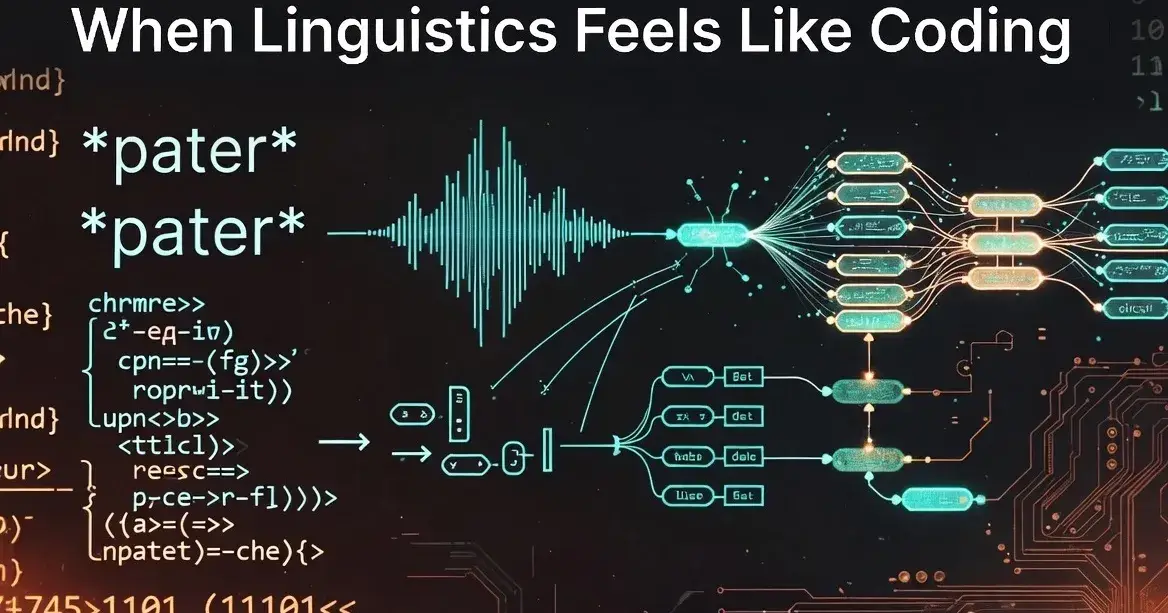
I recently completed Introduction to Comparative Indo-European Linguistics (Coursera), and what surprised me most was how algorithmic the field truly is. Working with sound laws and relative chronology feels like writing and debugging a program — except the “program” is the evolution of human speech across thousands of years.
And that realization only sharpened how I think about AI
1. Sound Laws Are Algorithms in Disguise
In historical linguistics, you don’t just “guess” how languages evolved.
You build rule-based transformations — systematic phonetic changes that apply across an entire language family.
A sound law works like a function:
*p → f / #__
# = word beginning
This represents the well-known Indo-European shift (e.g., pater → father).
It’s not poetry.
It’s logic.
You isolate variables:
environment (before/after a vowel?)
position (word-initial? word-final?)
behavior (stop → fricative?)
Then you test whether the resulting output still “compiles” — meaning whether it matches the real language data.
This is debugging.
This is pattern-matching.
This is rule ordering.
This is ...basically programming.
2. Relative Chronology = Dependency Graphs
One of the trickiest parts of historical linguistics is determining which sound change happened first.
If Law A happens before Law B, you get one set of outcomes.
If the order is reversed, everything breaks.
It’s the same logic we use in:
dependency graphs
compiler order
machine execution pathways
pipeline transformations
The “output word” is the final return value.
If your order is wrong, the system crashes — just like code.
3. Linguistics Teaches Machines What Humans Actually Mean
Studying deep linguistic structure made me appreciate something important:
Language is the interface between human cognition and machine execution.
AI doesn’t “understand” language the way humans do — it predicts patterns.
But the patterns it predicts come from thousands of years of structured evolution:
sound changes, semantic drift, syntactic constraints, cultural shifts.
When we train AI models without understanding the structure of language itself, we’re training machines on surface patterns, not meaning architectures.
Historical linguistics offers a blueprint for:
how humans structure information
how rules interact
how meaning changes
how ambiguity is resolved
how communication evolves systemically
These are directly relevant to:
NLP
language models
multimodal communication
speech processing
alignment and intent modeling
If machines are going to collaborate with humans, they must grasp the logic inside language — not just the tokens.
4. Why Sound Matters: Rhythm, Voice, and Emotional Signaling
One thing this course highlighted for me is how much meaning exists in sound alone.
We often focus on words, but human communication depends heavily on:
rhythm
tone
pitch
stress
flow
phonetic shading
A phrase can be:
comforting
threatening
questioning
joking
serious
…purely based on sound, even when the words don’t change.
In a world full of miscommunication, this matters a lot.
And in a world where AI is starting to speak for us — through voicebots, conversational agents, assistants — the rhythmic, emotional layer of language becomes essential for technology to support positive human interaction.
If we want AI that reduces conflict instead of amplifying it, we need AI that understands how humans sound when they mean something.
5. The Future: Linguistics + AI = Better Human Cooperation
So much of global tension — political, cultural, interpersonal — comes down to misunderstanding.
The more I study linguistics, the more I believe that:
Many problems can be solved if we learn to communicate just a little better.
Historical linguistics gives us tools to model meaning with mathematical precision.
AI gives us tools to scale communication support across billions of people.
Combining the two gives us:
AI that understands intent, not just text
translation models that preserve nuance
voice systems that better express human emotion
interfaces that reduce misunderstanding rather than amplify it
tools that help people listen to each other
Language is humanity’s oldest technology.
AI is humanity’s newest.
The intersection of the two may be where some of our biggest breakthroughs happen.
If you studied linguistics and work in AI, I’d love to hear your thoughts.
What linguistic concepts have changed how you think about technology?
Originally developed from notes after completing a course on comparative Indo-European linguistics (Coursera) and publishing a version on Medium.

Join Chander on Peerlist!
Join amazing folks like Chander and thousands of other builders on Peerlist.
0
2
0