

When My Writing Became "Too AI" to Prove It Was Mine
As AI shapes the language around us, are we unconsciously adapting our writing to match it?
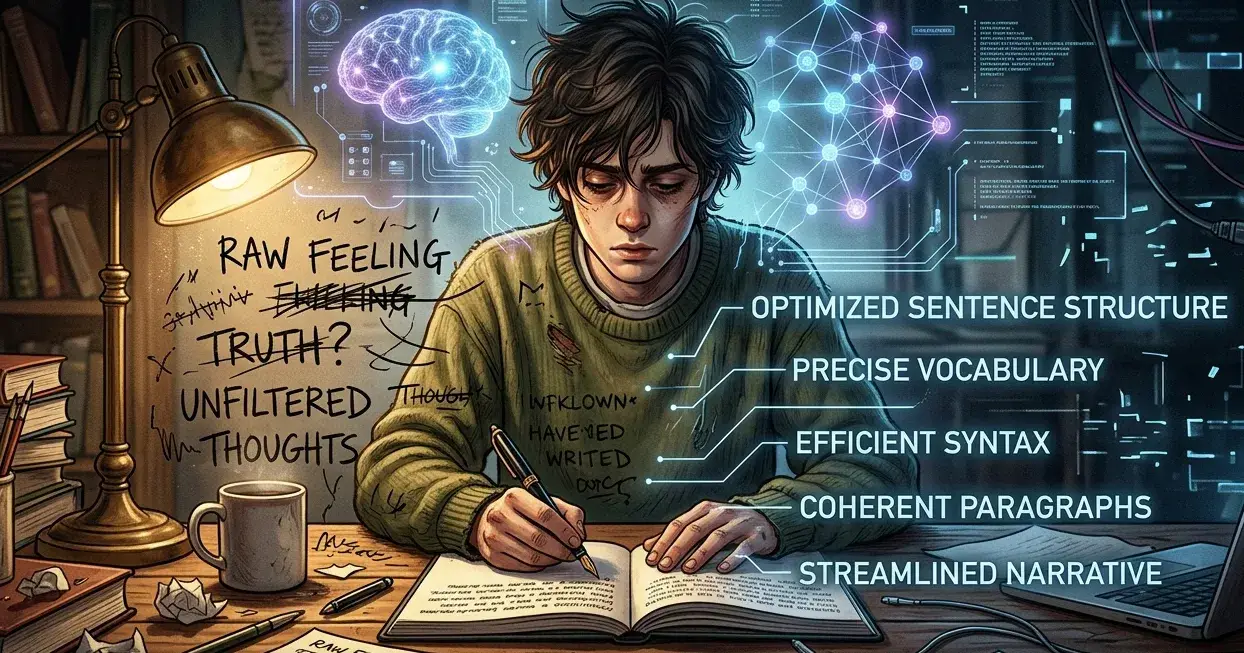
I recently had an unsettling experience while revising a psychology paper. The harder I tried to make my writing sound polished, academic, and "human," the more it drifted toward the clean, slightly flattened style that many people now instantly associate with AI-generated text. To make the irony worse, an AI detector flagged the revised version as more AI-like than my original draft.
The situation became even stranger when my professor asked me to demonstrate that the essay was actually my own work.
I had written the paper locally in Apple Pages on my Mac, then copied it into Google Docs for formatting before exporting it as a PDF. Since I wasn't working entirely in a cloud-based document with revision tracking, much of the detailed edit history disappeared during that process. Suddenly, I found myself in the odd position of needing to prove that I had written my own work.
To do so, I recorded my screen and walked through the local file versions, timestamps, and revisions stored on my computer. Fortunately, the evidence was there. But the experience left an impression on me. Going forward, I've started doing more of my writing directly in Google Docs—not because it's my preferred writing environment, but because it provides a detailed revision history that can help establish authorship if questions ever arise. As a Mac user without Microsoft Office installed, Google Docs has also become the easiest way to produce assignments in the standard double-spaced, 12-point Times New Roman format that many instructors expect.
What struck me most was how this personal experience seems to reflect a broader shift that researchers are beginning to document.
According to a 2026 study discussed by Axios, AI tools are pushing writers toward more standardized language, reducing variation in sentence structure and vocabulary across scientific papers, journalism, and social media. Linguists have similarly observed that AI-generated English often tends to be more formal, noun-heavy, and stylistically uniform than everyday human writing.
What fascinates me is that the influence flows both ways.
We train AI on human language, but we are also increasingly absorbing the patterns AI produces. The more AI-generated text we read, the more certain phrases, rhythms, and structures begin to feel "correct," "professional," or "well-written." Over time, this creates a feedback loop where even entirely original human writing can start sounding AI-generated—not because AI wrote it, but because we've unconsciously adapted to its style.
That raises an uncomfortable question: if human writers increasingly imitate the style that AI learned from us in the first place, what happens to individual voice?
I'm not talking about grammar mistakes or deliberate informality. I'm talking about the quirks that make writing feel personal: uneven rhythms, unexpected observations, unusual metaphors, and sentences that sound like someone genuinely thinking through an idea rather than presenting a perfectly optimized conclusion.
The challenge ahead may not simply be avoiding AI detection. It may be preserving the qualities that make writing feel alive.
Ironically, the safest way to prove we're human may be to sound a little less optimized.
What do you think?
Have you ever revised something to make it sound more polished, only to feel that it became less distinctive?
And how are you handling authorship, revision history, and proof of original work in a world where AI-assisted writing is becoming increasingly common?
Further Reading

Join Chander on Peerlist!
Join amazing folks like Chander and thousands of other builders on Peerlist.
0
0
0