

System Designing Corrective RAG Pipeline
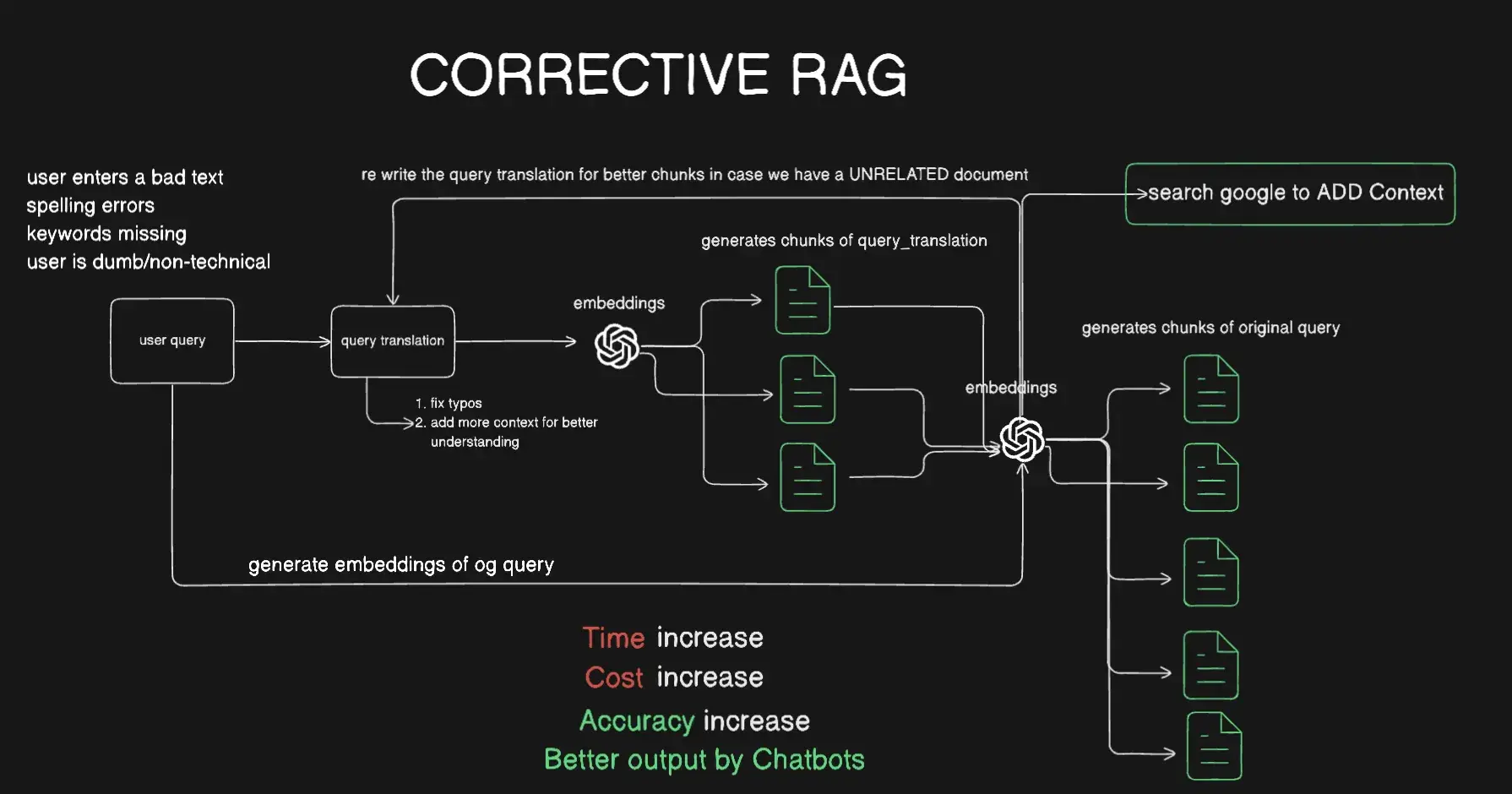
Have you ever typed something wrong into Google or ChatGPT and still got the answer you were looking for?
That’s because behind the scenes, smart systems fix your messy queries before searching.
This is exactly what a Corrective RAG (Retrieval-Augmented Generation) Pipeline does — it takes bad queries, corrects them, and then fetches better results. Let’s break it down.
What is a Corrective RAG Pipeline?
RAG (Retrieval-Augmented Generation): A system where an AI first looks up information from documents or the web, then uses that info to answer your question.
Corrective RAG: A smarter version of RAG that can handle:
Spelling mistakes
Missing keywords
Confusing, vague, or non-technical queries
👉 Think of it like a friend who understands what you mean, even if you explain badly.
Why Do We Need Corrective RAG?
Users often enter bad text: typos, missing words, or vague queries.
Without correction, the AI may fetch unrelated documents.
Corrective RAG rewrites the query for better accuracy before searching.
💡 Example:
Bad query: “wht is systm dsng rag?”
Corrected query: “What is system designing in RAG (Retrieval-Augmented Generation)?”
How Corrective RAG Works (Step-by-Step)
Here’s the pipeline explained simply:
User Query Input
The system gets a raw query.
Example: “fixing rag pipline how work?”
Query Translation
The AI rewrites the query:
Fixes typos
Adds missing context for better understanding
Example: “How does a Corrective RAG pipeline work in system design?”
Embedding Generation
Converts both original query and corrected query into embeddings (mathematical representations).
These embeddings help match the query with the most relevant documents.
Chunking Documents
Splits data into smaller pieces (chunks) for efficient search.
System compares these chunks with query embeddings to find best matches.
External Context (if needed)
If documents don’t match well, the system can even search Google to add context.
Final Output
With corrected queries and enriched context, the chatbot produces a much more accurate response.
Benefits of Corrective RAG
Accuracy ↑ → Better matching with documents and more relevant answers.
Time ↑ & Cost ↑ → Extra processing steps mean more time and slightly higher costs.
Output Quality ↑ → Chatbots sound smarter and more reliable.
👉 In short: You pay a little more, but the answers are worth it.
Real-World Analogy
Imagine you’re asking for directions:
You say: “Restro neer pakrk where go?”
A normal person might get confused.
A smart friend (Corrective RAG) rewrites it as:
“Where is the nearest restaurant near the park?”Then they give you clear directions.
That’s exactly what Corrective RAG does for chatbots and AI systems.
Key Takeaways
Corrective RAG = Regular RAG + Query Correction.
It rewrites bad queries → generates embeddings → finds better chunks → improves chatbot responses.
Increases accuracy and user satisfaction.
Slightly higher time and cost, but worth it for better results.
FAQs
Q1: Does Corrective RAG always rewrite queries?
Not always — it only corrects when user input is unclear, incomplete, or has errors.
Q2: Is Corrective RAG useful for chatbots only?
No. It’s useful in search engines, knowledge bases, customer support systems, and enterprise tools.
Up next: Designing SUB QUERY RAG Pipeline : https://peerlist.io/codewrhp/articles/system-designing-subquery-rag-pipeline

Join Raheel on Peerlist!
Join amazing folks like Raheel and thousands of other builders on Peerlist.
0
9
0