

AI “Slop” on LinkedIn and X
Evidence, Drivers, Harms, Detection, and How SlopScore Helps

Executive summary
“AI slop” (often shortened to “slop”) has become a widely used label for low-quality, high-volume digital content that is produced using generative AI and distributed through attention-driven platforms. Merriam-Webster’s 2025 Word of the Year defines slop as “digital content of low quality that is produced usually in quantity by means of artificial intelligence,” while the American Dialect Society (ADS) similarly frames slop as low-quality, high-quantity content “most typically produced by generative AI,” noting that the “AI” qualifier is often implied by context. [1]
https://peerlist.io/danielsinewe/project/slopscore
On LinkedIn and X (Twitter), “slop” is best understood not as a single content type, but as a family of behaviours and formats: templated “thought leadership,” engagement bait (“comment ‘PDF’”), generic listicles, pseudo-empirical claims without evidence, and automated or semi-automated posting pipelines that optimise for distribution rather than insight. LinkedIn’s own Professional Community Policies explicitly prohibit spam and “artificially increas[ing] engagement,” which aligns with how slop often functions as a mechanism for harvesting reactions and reach rather than communicating real information. [2]
Reliable platform-wide prevalence figures for AI-generated slop specifically remain scarce; platforms tend to report broader “platform abuse” categories (spam, scams, fake accounts, content violations). Still, primary sources provide useful proxies and trendlines. For example, LinkedIn’s Transparency Center (Community Report) documents large-scale spam/scam removals and identifies “misinformation” removals in each reporting period, showing a baseline level of content pollution and enforcement burden into which AI-assisted slop fits. [3] For X, research focused on disinformation contexts measured detectable LLM-generated content in Twitter/X datasets and observed rising shares during 2024 in at least one dataset, indicating a measurable, time-varying footprint of LLM output on the platform (even before considering lower-sophistication slop that evades detection). [4]
Detection remains hard. OpenAI discontinued its own AI text classifier due to “low rate of accuracy,” and research and industry guidance repeatedly emphasise false positives, especially with short text and evolving models. [5] This matters because slop mitigation that devolves into “gotcha” accusations can create reputational harm and chilling effects.
SlopScore (https://slopscore.in) positions itself as a practical countermeasure: it scores visible posts (not people), provides explainable reasons (signals such as template hooks, engagement bait CTAs, “AI-flavoured vocabulary,” and formatting pressure), and keeps the product claim deliberately bounded to the on-screen sample. [6] It offers free local scoring and optional “Pro” workflow layers such as synced history and public reports; its pricing page describes a single-workspace Pro plan at $24/month after a 14-day trial. [7] Its privacy posture is “local-first” with optional sync, and it specifies what is sent and stored when users enable syncing and reports, including post text and engagement metadata. [8]
Unstated assumptions used in this report are listed in the final section.
Definition and taxonomy of AI slop
Working definition for LinkedIn and X
A definition that is operationally useful for platforms, moderators, brands, and creators should separate authoring method (AI-generated vs AI-assisted vs human) from quality and intent (low-effort, deceptive, or engagement-engineered). Combining dictionary and practitioner framings:
AI slop is digital social content that is (a) produced or heavily shaped by generative tools and templated workflows, (b) low in informational value, specificity, or accountability, and (c) distributed at scale, typically to harvest attention, conversions, or algorithmic reach rather than to contribute meaningfully. This aligns with Merriam-Webster’s emphasis on low-quality content produced in quantity via AI, and ADS’s low-quality, high-quantity framing. [1]
A key nuance: “AI” is not required for slop outcomes. However, generative tools reduce production cost and increase throughput, which expands slop supply. Simon Willison’s early popularisation emphasised the social rudeness and reputational risk of publishing unreviewed machine-generated text under one’s name, reinforcing the core norm: the problem is not AI per se, but unaccountable, low-effort publication at scale. [9]
Taxonomy
The taxonomy below is designed for moderation, measurement, and product interventions (not for moral judgement of creators). It also maps cleanly to explainable “signals” of the kind SlopScore uses (template hooks, engagement bait CTAs, AI-flavoured vocabulary, formatting pressure). [6]
Signal | Human Content | AI Slop
---------------|-----------------------|----------------------
Specificity | Concrete, detailed | Vague, generalized
Experience | First-hand | Synthesized
Language | Unique voice | Familiar phrasing
Repetition | Low | High
Insight | Non-obvious | Obvious
This taxonomy deliberately overlaps with platform policy categories such as spam, misleading content, fake accounts, and artificial engagement, because slop frequently expresses as policy-adjacent behaviour rather than a new, separate violation class. LinkedIn explicitly bans spam and discourages artificial engagement tactics, providing an enforcement basis for part of the slop landscape. [2]
Prevalence and representative examples on LinkedIn and X
What we can and cannot measure reliably
A major measurement constraint is that neither LinkedIn nor X publicly provides a comprehensive “AI-generated posts” statistic for all content. Public reporting tends to cover broader enforcement buckets (spam/scams, fake accounts, misinformation removals) rather than authorship provenance. LinkedIn’s Transparency Center reports enforcement counts for spam/scams, fake accounts, and content policy violations including misinformation. [12] For X, public discourse and some regulatory-oriented reporting focus on spam/manipulation and disinformation, while academic prevalence estimates for LLM-generated text are typically dataset-bounded (topic-specific, language-specific, or limited to detectable traces). [13]
Accordingly, this section uses three evidence tiers:
Primary enforcement metrics (platform transparency reports), which measure content pollution broadly. [3]
Academic prevalence estimates for LLM-generated text in defined Twitter/X datasets. [4]
Representative anonymised examples, presented as composites to avoid doxxing and to respect platform and author privacy.
LinkedIn prevalence proxies from LinkedIn transparency reporting
LinkedIn’s Community Report provides a time series of enforcement totals and breakouts. For July to December 2020, LinkedIn reports that 22.4 million spam/scam items were removed proactively and 225,000 after member reports. [14] For the same July to December 2020 period, it reports content violation removals including 110,742 instances of misinformation (alongside harassment/abusive content and other categories). [15]
For fake accounts, LinkedIn’s Community Report states that in July to December 2020, 11.6 million fake accounts were stopped automatically at attempted registration, 3.0 million were restricted after registration and before member reports, and 111,000 were restricted after member reports. [16] It provides similar breakdowns for later periods (for instance, January to June 2022: 16.4 million stopped at registration; 5.4 million restricted after registration before member reports; 190,000 restricted after member reports). [17]
These figures do not equal “AI slop,” but they establish:
A persistent, large-scale baseline of automation, abuse, and low-quality content removal on LinkedIn. [14]
A platform environment in which AI-assisted slop can scale, especially when slop is coupled with automation or artificial engagement practices that LinkedIn policies prohibit. [2]
LinkedIn also explicitly acknowledges misinformation removals, and external reporting about its transparency reports in early 2020 highlights misinformation enforcement around the pandemic period (for example, one 2020 industry write-up cites LinkedIn removing 22,846 instances of misinformation in January to June 2020). [18]
X prevalence signals and estimates
For X, one relevant “scale” proxy is platform statements and enforcement reporting around spam and manipulation. In March 2026 reporting, X told UK MPs it suspended 800 million accounts in a year for violations related to platform manipulation and spam, illustrating the magnitude of inauthentic or disruptive activity management on the service. [19]
For LLM-generated text prevalence specifically, a 2026 study measuring “the growing presence of LLM-generated disinformation” reported detectable proportions of LLM-generated content in Twitter/X datasets. It found, for example, that in one Twitter dataset used in the study, estimated LLM-generated share increased from 0.44% in January 2024 to 2.39% in November 2024, and it reported multi-dataset estimates for 2023 and 2024 in the low single-digit percentages (dataset-dependent). [4]
These estimates likely undercount total AI-assisted slop for at least four reasons: short posts are hard to classify reliably, many creators paraphrase, many posts are partly AI-edited rather than fully generated, and detection models degrade as generators evolve. [20]
Representative anonymised examples with annotations
The examples below are composites based on widely observed patterns and on SlopScore’s published signal explanations (template hooks, engagement bait CTAs, AI vocabulary, stacked formatting). They are not direct quotes of any single user’s post.
LinkedIn example: templated hook plus gated “PDF” CTA
Composite LinkedIn post (anonymised)
I was today years old when I realised most teams are not “underperforming”…
they are under-communicating.
Here are 5 frameworks that changed everything:
1) Alignment map
2) Ownership ladder
3) Feedback loop
4) Execution cadence
5) Culture flywheel
Want my template? Comment PDF and I’ll send it.
Annotated slop signals:
Template hook structure: the opening is reusable across topics, which SlopScore treats as a structural signal that becomes meaningful when it overshadows concrete evidence. [21]
Engagement bait CTA: “Comment PDF” is a direct prompt to perform a visible action to boost distribution and enable keyword harvesting, which SlopScore flags as high-signal bait when engineered for reaction harvesting. [22]
AI-flavoured vocabulary: “frameworks,” “flywheel,” and polished business phrasing can be a language drift clue when the wording is smoother than the underlying point. [11]
Stacked formatting: short lines and staged breaks can elevate perceived depth without adding substance, a formatting-pressure pattern SlopScore explicitly discusses. [23]
X example: generic listicle thread optimised for reach
Composite X post (anonymised)
The fastest way to get ahead in 2026 isn’t working harder.
It’s building systems.
7 rules I wish I followed earlier:
1. Learn to write
2. Protect your focus
3. Ship weekly
4. Fix your sleep
5. Lift weights
6. Network intentionally
7. Buy back time
Bookmark this.
Annotated slop signals:
Template hook structure: “X rules I wish I followed earlier” is a reusable wrapper, matching SlopScore’s “template hooks” concept. [21]
Engagement prompt: “Bookmark this” is softer than “comment PDF,” but it still aims directly at distribution mechanics. SlopScore’s engagement bait guidance highlights action prompts designed to optimise spread. [22]
Low specificity: general advice without context makes it hard to verify and easy to mass-produce, aligning with slop’s “quantity over substance” dynamic. [24]
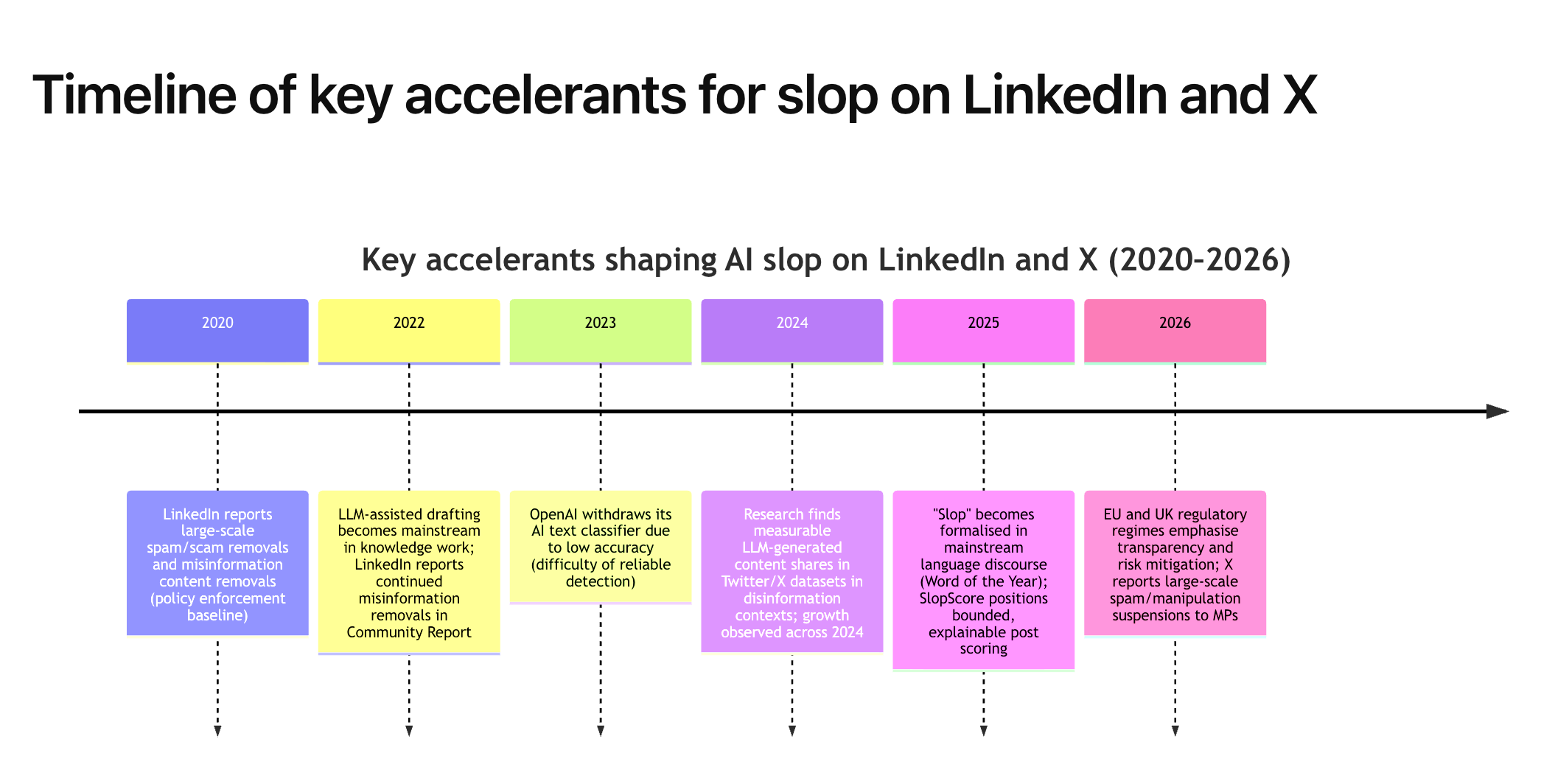
Evidence anchors for this timeline include LinkedIn Community Report metrics, OpenAI’s classifier sunset notice, the 2026 prevalence research, and 2026 reporting on X enforcement scale. [25]
Drivers and causes
Technical drivers
Model capability and cost curve: even when “slop” is low-quality, modern LLMs reduce the marginal cost of producing superficially coherent posts, enabling high-volume experimentation across formats. This is part of why “slop” is culturally understood as low-quality content produced in quantity by AI systems. [1]
Prompt reuse and template libraries: SlopScore’s signal library explicitly treats “template hooks” as reusable opening structures that make posts pasteable across topics, reflecting how teams can scale output without rebuilding structure. [21]
LLM “style priors”: SlopScore’s “AI vocabulary” signal family describes polished connector words and abstract business phrasing that can make posts sound “assembled,” a phenomenon consistent with LLM tendencies toward fluent but generic phrasing unless constrained by strong grounding prompts. [11]
Automation tooling: the slop ecosystem increasingly includes scheduled posting, reply automation, and lead-gen loops. Platforms classify some of this as spam or artificial engagement; LinkedIn’s policies explicitly discourage spam and artificial engagement tactics. [26]
Social and economic drivers
Attention economy incentives: both platforms reward engagement signals (replies, comments, dwell time, “saves”), and slop is often engineered to trigger these behaviours via hooks, CTAs, and formatting. SlopScore’s engagement-bait CTA description explicitly links these prompts to “harvesting visible reactions” for distribution and lead generation. [27]
Creator monetisation and pay-for-reach dynamics: changes in monetisation programmes can increase the payoff for high-volume posting and reply-bait strategies. Public reporting on X’s revenue sharing programme highlights that payouts relate to engagement and replies, reinforcing incentives for reach-optimised content. [28]
Compliance and enforcement gaps: where detection is noisy or enforcement capacity is limited, slop thrives. LinkedIn’s transparency material shows the magnitude of spam/scam and fake account enforcement at scale. [29]
Measurement asymmetry: creators can measure what “works” instantly (views, comments), while audiences struggle to measure what was wasted. Tools like SlopScore aim to narrow that gap by producing inspectable reasons tied to posts and feed samples. [30]
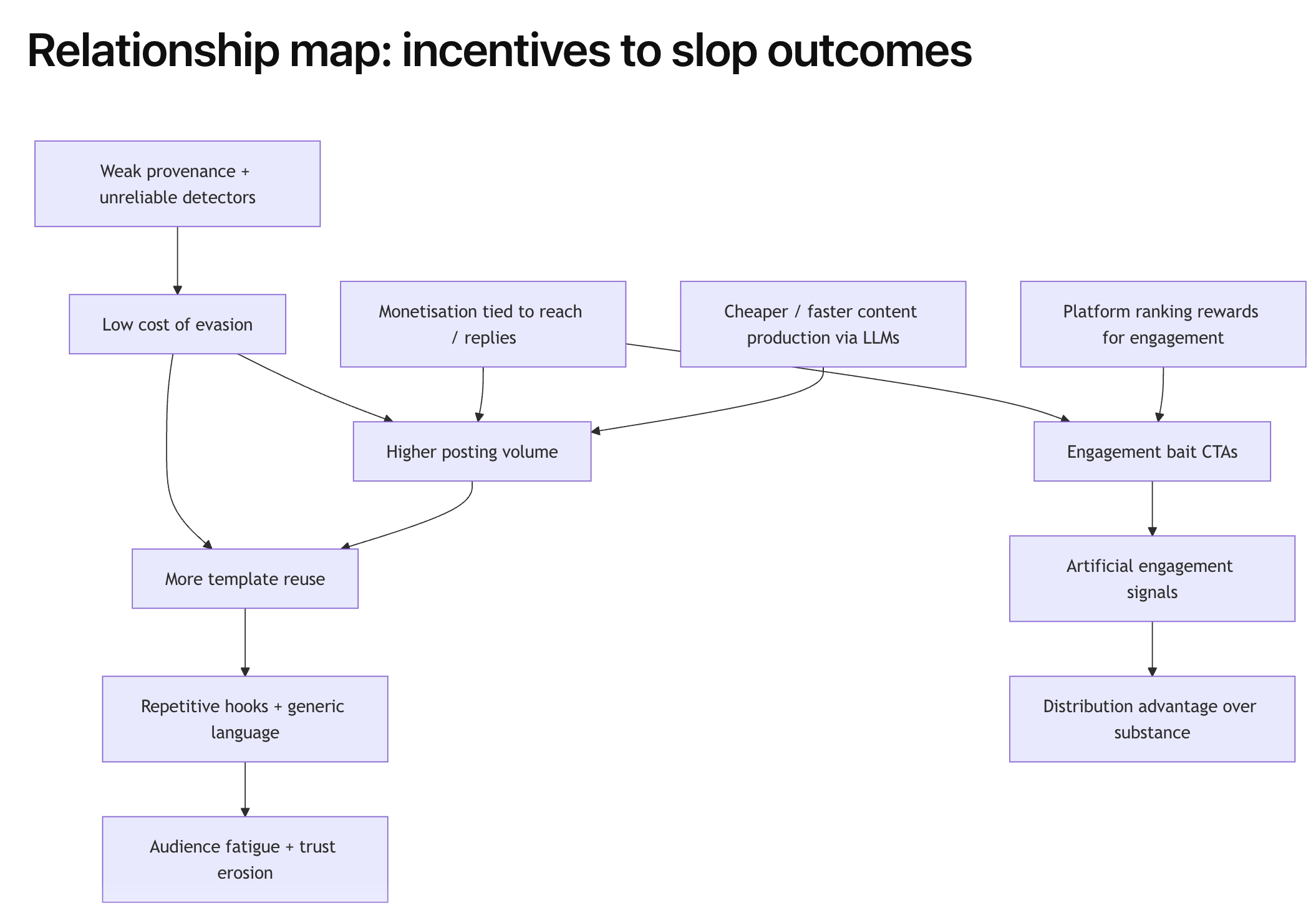
The nodes “template reuse,” “engagement bait,” and “generic language” correspond closely to SlopScore’s published signal families (template hooks, engagement bait CTAs, AI-flavoured vocabulary). [31]
Harms and externalities
Misinformation and synthetic credibility
Slop can function as misinformation even when not explicitly political: generic, confident-sounding explanations without sourcing can mislead, and AI-assisted content can scale these claims. LinkedIn’s policy stance prohibits false or misleading content and specifically addresses misinformation and inauthentic behaviour. [32] LinkedIn’s transparency reporting also shows large numbers of misinformation removals in multiple reporting periods (for example, 110,742 misinformation removals in July to December 2020, and 172,387 in January to June 2022). [15]
On X, research measuring LLM-generated disinformation found non-trivial and rising shares of detectable LLM content in certain datasets across 2024, suggesting that generative output is becoming a measurable component of the platform’s information ecosystem in at least some high-risk contexts. [4]
Reputation and brand harm
For individuals and brands, slop creates two related risks:
Direct reputation erosion: publishing templated, generic content under a real identity can reduce perceived expertise and authenticity. Willison’s framing is explicitly reputational: attaching your name to unreviewed machine-generated content is an anti-pattern. [9]
False accusation risk: unreliable detection or overconfident moderation can incorrectly label human writing as AI-generated. OpenAI’s own classifier was withdrawn due to low accuracy, and multiple analyses emphasise false positives and fragility of text-only detection. [5]
This is one reason SlopScore’s “bounded claim” design choice is strategically important: it positions output as pattern-based and tied to visible samples, not as a forensic “authorship verdict.” [30]
Engagement distortion and feed quality collapse
Engagement bait and template hooks can distort what ranking algorithms interpret as “valuable.” LinkedIn’s policies explicitly discourage doing things to “artificially increase engagement” and define spam as untargeted or repetitive content. [2] SlopScore similarly treats engagement-bait CTAs as a high-signal indicator because they shift the post’s purpose from communication to harvesting reactions for distribution. [22]
When engagement metrics become “gameable,” platforms risk a feedback loop where low-effort content outcompetes high-effort content on the same ranking signals, increasing the supply of slop and lowering the perceived ROI of thoughtful participation.
Moderation burden and system cost
Large-scale content abuse imposes direct operational costs. LinkedIn’s Community Report documents substantial spam/scam removal volumes (tens of millions per half-year) and large-scale fake account enforcement. [29] For X, public reporting indicates the company characterises its challenge as “massive” manipulation attempts and claims to have suspended hundreds of millions of accounts in a year for spam/manipulation violations. [19]
Regulatory regimes also push for transparency and risk mitigation. The UK Online Safety Act imposes duties on platforms to reduce risks of illegal activity and remove illegal content, and UK government guidance notes duties for illegal content protections are in force (and are supported by Ofcom’s regime). [33] While “slop” often is not illegal, the enforcement machinery and reporting obligations increase the cost of operating high-risk attention ecosystems, especially when slop overlaps with scams, fraud, and manipulative behaviour.
Detection and mitigation methods
Reality check: detection is probabilistic and fragile
Any mitigation plan that depends on “perfect AI detection” is brittle. OpenAI’s classifier was discontinued due to low accuracy, and academic and practitioner commentary highlights that AI detection systems can be defeated and can produce false positives, particularly as generators evolve and text becomes shorter or more edited. [5] Turnitin emphasises minimising false positives (claiming a less than 1% false positive rate in its own framing), but also acknowledges the existence of false positives as a category of risk. [34]
This strongly suggests a “defence in depth” approach: combine lightweight automated detection, human review, provenance signals where possible, ranking interventions, and UX friction.
A practical mitigation stack
Algorithmic signals: combine content-based features (template structures, engagement bait CTAs, repetitiveness), account-level behaviour (posting rate, network patterns), and interaction anomalies. SlopScore’s public signal families give a concrete example of explainable content features that can be used without claiming authorship certainty. [35]
Human-in-the-loop review: prioritise high-reach or high-risk content for review; focus on policy violations (spam, scams, misinformation) rather than “AI-ness.” LinkedIn’s content policies provide a clear basis for enforcement of spam and artificial engagement. [2]
UX and product design: reduce the payoff of engagement bait by de-weighting low-quality comments, dampening “keyword reply” loops, treating “comment bait” patterns as low-integrity signals, and giving users feed controls. LinkedIn’s policy discouraging artificial engagement is compatible with such ranking interventions. [36]
Policy and enforcement: define and enforce against spam and artificial engagement patterns; require disclosure for certain synthetic or manipulated media. LinkedIn’s policies explicitly require disclosure for synthetic/manipulated media depicting a person saying/doing something they did not, and prohibit misinformation and deception. [2]
Provenance and labelling: adopt standards like C2PA Content Credentials for media provenance where feasible. C2PA’s specification frames provenance as essential to facilitating trust online and enabling opt-in provenance techniques. [37] For text, watermarking has been proposed (for example, the “green token” watermark approach), but it is not yet a universal solution and faces evasion and deployment challenges. [38]
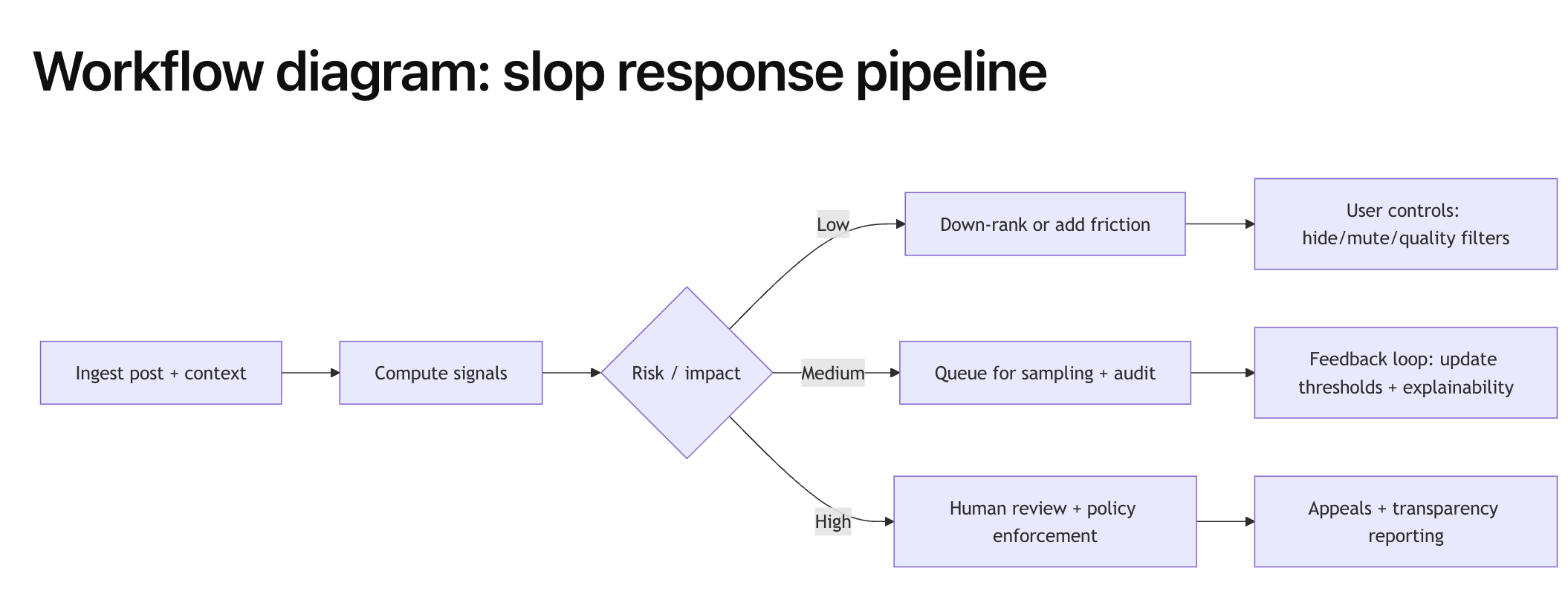
This workflow aligns with regulatory expectations that platforms be able to explain moderation actions and support appeals, as emphasised by transparency-oriented regulatory regimes, even when the slop itself is not illegal. [39]
Comparative table: detection and audit tools
The table below is intentionally split into two families: “authorship detectors” (try to infer AI vs human) and “pattern/audit tools” (flag low-quality or manipulative patterns without claiming proof of authorship). This distinction is central to avoiding false accusation harms.
SlopScore
Pattern-based signals of AI-sounding, engagement bait, and formulaic hooks on visible posts; not a definitive AI detector and not a “people score”
Output: Post-level score with explainable reasons; shareable reports; bounded to visible sample
Pricing: Pro at $24/month after 14-day trial (one workspace)
Notes: Strong explainability and bounded claims. Not an authorship detector; needs validation across communities

---

GPTZero
AI content detection (multi-model) with highlighting and reports
Output: Probability score with highlights
Pricing: Public pricing available
Notes: Subject to false positives, domain shift, and adversarial editing

---

Originality.ai
AI detection and plagiarism checking
Output: Score/report
Pricing: Public pricing available
Notes: Mixed independent benchmarks; general detector limitations apply

---

Turnitin AI writing detection
AI-writing indicators in submitted documents; focuses on low false positives
Output: Document-level indicators
Pricing: Institutional (not public)
Notes: Acknowledges false positives; recommends cautious interpretation

---

Provenance: C2PA Content Credentials
Provenance and edit history via open technical standard
Output: Cryptographic metadata and verification
Pricing: Public standard
Notes: Strong for provenance; limited adoption; weaker for plain text feeds

---

LLM watermarking (research)
Detectable watermark in model output via token sampling biases
Output: Statistical detection
Pricing: Research / open-source
Notes: Can be bypassed via paraphrasing, translation, and post-processing
A critical lesson from OpenAI’s classifier deprecation is that public-facing detectors can create overconfidence; policy and product interventions should assume detection errors and avoid turning probabilistic scores into punishments without due process. [5]
SlopScore deep dive: methodology, metrics, validation, strengths, limitations, alternatives, and case studies
Product positioning and design constraints
SlopScore describes itself as a Chrome extension for LinkedIn and X that analyses posts for “AI signals, engagement bait, and formulaic hooks” and produces a “visible-post score with explainable reasons,” explicitly noting boundaries such as “scores visible posts only” and “not a people score.” [30] It also answers “Is it a definitive AI detector?” with “No,” framing itself as a pattern-based review tool rather than forensic authorship proof. [30]
This positioning is not just marketing. It is a defensible response to the known failure modes of AI authorship detection, including false positives and rapid distribution shifts. [46]
Methodology: signal families and “bounded read” logic
SlopScore’s public signal library articulates how it interprets specific patterns:
AI vocabulary: “polished connector words, abstract business phrasing, and presentation-first language” that makes posts sound “assembled,” treated as directional not verdict. [11]
Template hooks: reusable opening structures that can be pasted across topics; meaningful when the wrapper overwhelms specific observation or evidence. [21]
Engagement bait CTA: prompts to comment/DM/type keywords; treated as high-signal when engineered for “reaction harvesting” or keyword collection. [22]
Stacked formatting: short-line dramatic formatting and formatting pressure; treated as surface signal that matters more when clustered with other stronger signals. [23]
The product’s “bounded read” principle (“visible sample only”) is emphasised across these pages: it does not claim that a signal proves AI authorship, and it does not claim to generalise beyond the visible feed sample. [47]
Metrics and outputs
From SlopScore’s product page and Chrome Web Store listing, the key metrics and outputs are:
Post-level scoring on visible posts in the feed, with explainable reasons. [48]
A “timeline score” / feed audit concept that summarises the visible sample. [30]
Shareable report pages intended to preserve score, reasons, and context together. [30]
A free local workflow and optional Pro features (synced history, baselines, reports). [49]
Pricing is intentionally “one plan” with a 14-day free trial and then $24/month for one synced workspace, according to the pricing page. [40]
Privacy model and data handling
SlopScore’s privacy policy describes a local-first approach where most scoring happens in the browser and “does not leave your device,” and it explains that Pro sync is optional. It also specifies what is sent when syncing: it may include post text, timestamps, author labels, profile URLs, and any on-screen engagement counts used for context, and it describes storage practices and telemetry. [8] This is a material differentiator versus “paste your text into a detector” workflows that require centralised processing by default.
Validation: how to test whether SlopScore works
Because SlopScore is not a forensic authorship detector, “accuracy” should be framed as usefulness and predictive validity for outcomes we care about. A rigorous validation plan should include:
Human-labelled slop judgements: sample posts from LinkedIn and X (with consent/ethical handling), have multiple raters score perceived slop (quality, specificity, evidence, engagement bait intensity), and measure correlation with SlopScore outputs; include inter-rater reliability.
Construct validity: test whether high SlopScore posts have higher rates of engagement-bait CTAs and templated hooks (as defined in the signal library) in manual coding. [50]
Outcome validity: test whether hiding/downranking high SlopScore content improves user satisfaction, reduces time spent on low-value content, or increases interaction with high-quality content.
Fairness testing: check for bias against non-native English or certain professional dialects, a known risk in text-based classification settings. More generally, detection systems have documented false positive and bias issues, motivating caution. [20]
Robustness: track “signal drift” over time. SlopScore explicitly values history as “drift, not certainty,” which aligns with the need to monitor evolving styles and adversarial adaptation. [30]
Strengths and limitations
Strengths:
Explainability by design: SlopScore focuses on inspectable reasons rather than a black-box verdict, aligning with the reality that AI detection is probabilistic. [51]
Bounded claims reduce reputational damage risk: scoring posts not people, and visible samples not hidden histories, reduces the chance of turning uncertain attribution into personal attacks. [30]
Direct alignment with platform incentives: its signal families target precisely what “slop” often optimises for (hooks, CTAs, formatting), not just lexical signatures of LLMs. [52]
Privacy posture: local scoring with optional syncing is explicitly documented. [53]
Limitations:
Not an authorship proof system: SlopScore explicitly does not claim forensic certainty. This is honest, but it means it cannot satisfy compliance needs that demand definitive provenance. [30]
Style bias risk: “AI vocabulary” and formatting signals may overlap with legitimate professional writing styles; without careful validation, the tool can penalise certain communities. [54]
Adversarial adaptation: as signals become known, creators can adjust superficial features while preserving the same low-value content strategy. This is a general limitation of surface-signal moderation.
Platform coverage reality: while SlopScore positions itself for LinkedIn and X, the currently visible Chrome Web Store listing emphasises LinkedIn-only host permissions, so X coverage may depend on extension versions and deployment details at time of installation. [55]
Case studies: SlopScore in action
These are illustrative case studies that show how an explainable, post-level “signal mix” can be used by platforms, brands, or creators. They reference SlopScore’s published signal definitions rather than claiming access to private scoring outputs.
Case study: A brand wants to stop sounding generic on LinkedIn
Problem: A B2B brand notices high posting frequency but declining qualified inbound. The social team suspects the content sounds interchangeable.
Intervention:
Run a feed audit on the brand’s last 30 visible posts and identify repeated reasons: AI-flavoured vocabulary and template hooks cluster. [56]
Rewrite playbook: replace “presentation language” with “operator language” as recommended in the AI vocabulary recovery move (add one concrete observation and one tradeoff). [11]
Remove engagement bait: replace “comment for template” with a proportional CTA after the content stands alone, consistent with SlopScore’s engagement-bait recovery guidance. [22]
Outcome metrics for validation: reduction in generic engagement (low-intent comments), increase in qualified replies, and brand sentiment in comments.
Case study: A creator uses “comment PDF” loops on LinkedIn
Problem: A creator relies on “comment PDF” to grow fast, but the comment section becomes spammy and audience complaints increase.
Signal interpretation: The CTA is explicitly engagement bait by SlopScore’s definition (keyword collection and reaction harvesting). [22] LinkedIn policy also discourages artificially increasing engagement with your content, increasing enforcement risk. [2]
Mitigation:
Publish the resource ungated (or use a landing page), then use CTAs that reinforce the content rather than gaming distribution.
If keeping a CTA, place it after concrete evidence and make it optional.
Case study: Monitoring X for thread-bait slop during an event
Problem: During a product launch or market event, a brand sees an outbreak of generic “explainer threads” that reuse identical structures, potentially distorting brand perception.
Approach:
Scan visible threads for template hook structures and engagement prompts (“bookmark,” “retweet,” “reply for part 2”). [57]
Prioritise response: only respond to threads that make falsifiable claims, and request sources.
Archive examples: shareable report pages can preserve context for internal review rather than screenshot debates. [30]
Future trends, recommendations, and assumptions
Future trends through 2026 and beyond
Expectation: more slop unless incentives change. The institutionalisation of “slop” as a term in 2025 reflects a broader cultural recognition that low-quality AI-generated content has become pervasive. [1] The economics point toward continued supply unless platforms reduce the payoff for engagement bait and templated virality.
Shift toward transparency and labelling. The EU AI Act introduces transparency obligations for AI-generated or manipulated content, and official EU guidance summarises that deepfakes and AI-generated text must be disclosed as artificially generated, with transparency obligations (Article 50) applying on the AI Act’s implementation timeline. [58] This will not eliminate slop, but it raises compliance expectations and may shift norms toward disclosure and provenance.
Regulatory pressure on platform risk management. UK Online Safety Act guidance emphasises duties for services to reduce risks of illegal activity and remove illegal content, and Ofcom guidance structures risk assessment and protections. [33] While slop itself is often legal, the same systems used to manage illegal harms are stretched by high-volume low-quality content, increasing total governance cost.
Recommendations
For platforms (LinkedIn-like and X-like):
De-incentivise “performative engagement”: de-weight low-information comments and suspicious keyword reply patterns; reduce the ranking benefit of engagement bait CTAs that SlopScore identifies as high-signal bait. [10]
Adopt explainable quality signals: integrate pattern-based signals (template hooks, formatting pressure) as ranking inputs rather than as enforcement triggers, consistent with the idea that these signals are directional not proof. [59]
Use provenance where feasible: support standards like C2PA for media content to shift from guesswork to verifiable provenance. [37]
Avoid “AI detector as judge” policies: OpenAI’s classifier sunset is a warning that brittle detectors can do harm; treat detection scores as prompts for review, not verdicts. [5]
For brands and agencies:
Adopt a “slop style guide”: ban gated keyword CTAs (“comment PDF”) unless there is a strong user-value justification, and require a minimum evidence threshold for claims. [10]
Use SlopScore as a quality audit rather than an “AI detector”: treat repeated signals as prompts to add specificity, sources, and real experience. [60]
Create disclosure norms now: align with EU AI Act direction on transparency of AI-generated content, particularly for high-impact or public-informing posts. [61]
For creators:
Replace templates with observations: SlopScore’s recovery move for template hooks is to open with the real observation so the post could only belong to that specific context. [21]
Reduce “presentation-first” language: replace polished transitions with concrete details and tradeoffs, consistent with SlopScore’s AI vocabulary guidance. [11]
Avoid engagement engineering that violates platform norms: LinkedIn explicitly discourages artificial engagement tactics; build distribution by being specific and useful, not by harvesting keyword comments. [36]
Unstated assumptions used in this report
SlopScore product claims and pages reflect the live product as of 18 March 2026; this report treats SlopScore’s own documentation as the primary source for its methodology, scope, pricing, and privacy posture. [62]
Because platform-wide authoritative statistics for “AI-generated slop posts” are not published, prevalence is estimated using enforcement metrics (spam/scams, fake accounts, misinformation removals) and dataset-bounded academic estimates for LLM-generated text on Twitter/X. [63]
The anonymised example posts are composites intended to illustrate patterns; they are not presented as verbatim quotes from specific accounts. This is necessary to avoid privacy and attribution harms and to keep the analysis focused on patterns rather than individuals.
Where detector “accuracy” is discussed, this report assumes that accuracy is context-dependent and that false positives are a meaningful harm; this follows the rationale for OpenAI’s classifier withdrawal and broader caution about detector reliability. [5]
[1] [24] https://www.merriam-webster.com/wordplay/word-of-the-year
https://www.merriam-webster.com/wordplay/word-of-the-year
[2] [26] [32] [36] https://www.linkedin.com/legal/professional-community-policies
https://www.linkedin.com/legal/professional-community-policies
[3] [12] [14] [15] [16] [17] [25] [29] [63] https://about.linkedin.com/transparency/community-report
https://about.linkedin.com/transparency/community-report
[4] [13] https://arxiv.org/html/2503.23242v2
https://arxiv.org/html/2503.23242v2
[5] [20] [46] https://openai.com/index/new-ai-classifier-for-indicating-ai-written-text/
https://openai.com/index/new-ai-classifier-for-indicating-ai-written-text/
[6] [30] [48] [49] [51] [60] [62] https://slopscore.in/
[7] [40] https://slopscore.in/pricing
[8] [53] https://slopscore.in/privacy-policy
https://slopscore.in/privacy-policy
[9] https://simonwillison.net/2024/May/8/slop/
https://simonwillison.net/2024/May/8/slop/
[10] [22] [27] [50] https://slopscore.in/linkedin/signals/engagement-bait-cta
https://slopscore.in/linkedin/signals/engagement-bait-cta
[11] [47] [54] [56] https://slopscore.in/linkedin/signals/ai-vocabulary
https://slopscore.in/linkedin/signals/ai-vocabulary
[18] https://www.socialmediatoday.com/news/linkedin-shares-its-latest-transparency-report-for-the-first-half-of-2020/588913/
[19] https://www.theguardian.com/technology/2026/mar/09/x-suspends-accounts-massive-scale-manipulation-attempts-russia
[21] [31] [35] [52] [57] [59] https://slopscore.in/linkedin/signals/template-hooks
https://slopscore.in/linkedin/signals/template-hooks
[23] https://slopscore.in/linkedin/signals/stacked-formatting
https://slopscore.in/linkedin/signals/stacked-formatting
[28] https://techcrunch.com/2023/07/28/twitter-now-x-opens-up-its-ad-revenue-sharing-program-with-global-creators/
[33] [39] https://www.gov.uk/government/collections/online-safety-act
https://www.gov.uk/government/collections/online-safety-act
[34] [43] https://www.turnitin.co.uk/blog/understanding-false-positives-within-our-ai-writing-detection-capabilities
[37] [45] https://spec.c2pa.org/specifications/specifications/2.2/specs/C2PA_Specification.html
https://spec.c2pa.org/specifications/specifications/2.2/specs/C2PA_Specification.html
[38] https://arxiv.org/abs/2301.10226
https://arxiv.org/abs/2301.10226
[41] https://gptzero.me/pricing
[42] https://originality.ai/pricing
https://originality.ai/pricing
[44] https://guides.turnitin.com/hc/en-us/articles/22774058814093-Using-the-AI-Writing-Report
https://guides.turnitin.com/hc/en-us/articles/22774058814093-Using-the-AI-Writing-Report
[55] https://chromewebstore.google.com/detail/slopscore-for-linkedin/joaomphknbknaajphcndblibgngleaek
https://chromewebstore.google.com/detail/slopscore-for-linkedin/joaomphknbknaajphcndblibgngleaek
[58] [61] https://ai-act-service-desk.ec.europa.eu/en/ai-act/article-50
https://ai-act-service-desk.ec.europa.eu/en/ai-act/article-50

Join Daniel on Peerlist!
Join amazing folks like Daniel and thousands of other builders on Peerlist.
3
2
0