

Why Chat Is the Wrong Interface for Agent Teams
It was a Monday, I spent nearly two hours moving information between AI tools.
Not because the work was difficult. Quite the opposite.
I had perplexity researching competitors, Claude helping me think through positioning, Codex writing code, and a growing collection of notes scattered across documents, screenshots, and browser tabs.
The AI was doing great.
I was the problem.
Or more accurately, I had accidentally become a middle manager.
At first, I didn’t notice it. The workflow felt normal. I’d ask claude to analyze a competitor, copy the findings into a document, send a summary to chatgpt, ask it to generate images, take the best ideas, move them into another document, then switch to codex to update parts of the product.
Every individual interaction felt efficient.
The overall process was not.
Around lunchtime, I realized I was spending more time moving context than making decisions.
The AI wasn’t waiting for answers.
The AI was waiting for me.
Whenever I switched tools, context broke. Each model knew something slightly different. Every conversation required setup. Every task required explanation. Every new agent started from zero.
The more AI tools I adopted, the more coordination work I created for myself.
That’s when I started wondering whether we were solving the wrong problem.
For the past few years, the industry has focused on making models smarter. And to be fair, they’ve improved dramatically. Today’s models can write code, conduct research, generate designs, and reason through complex problems.
But intelligence is no longer the bottleneck.
Coordination is.
Imagine hiring five brilliant employees and forcing them to work in separate rooms. None of them can see what the others are doing. None of them share context. Every time you want them to collaborate, you have to manually relay information between them.
That’s essentially how many of us work with AI today.
The problem isn’t that the agents aren’t capable. The problem is that we’re still acting as the communication layer. What struck me was how different this felt from working with actual teammates.
When I work with people, I rarely spend time packaging context. I point at something on my screen and say, “Can you look into this?” We both see the same thing. The conversation starts from shared context rather than explanation.
That made me question why AI interactions are still built around chat windows.
Why am I opening another application to discuss something that’s already visible on my screen?
Why am I describing a bug that the system could see?
Why am I pasting screenshots when the screenshot is already right there?
The more I thought about it, the more chat started to feel like a temporary interface.
Not a destination.
A bridge.
The command line was once the primary way humans interacted with computers. Then graphical interfaces arrived and changed everything. People didn’t stop computing. They simply stopped typing commands for every action.
I suspect we’re approaching a similar transition with AI.
Today, we prompt.
Tomorrow, we direct.
The future may not be about opening another chat window and writing better prompts. It may be about working alongside teams of agents that already understand the context around them.
The human’s role becomes less about transferring information and more about providing direction.
Less explaining.
More deciding.
Less coordination.
More judgment.
The irony is that AI was supposed to remove busywork. Yet many power users have found themselves doing a new kind of busywork: coordinating intelligence.
The next wave of AI products won’t win because they have slightly better models.
They’ll win because they reduce the cost of coordination.
And if that happens, the most valuable skill won’t be prompt engineering.
It will be learning how to direct teams of agents effectively.
That’s the shift I’m watching most closely right now.
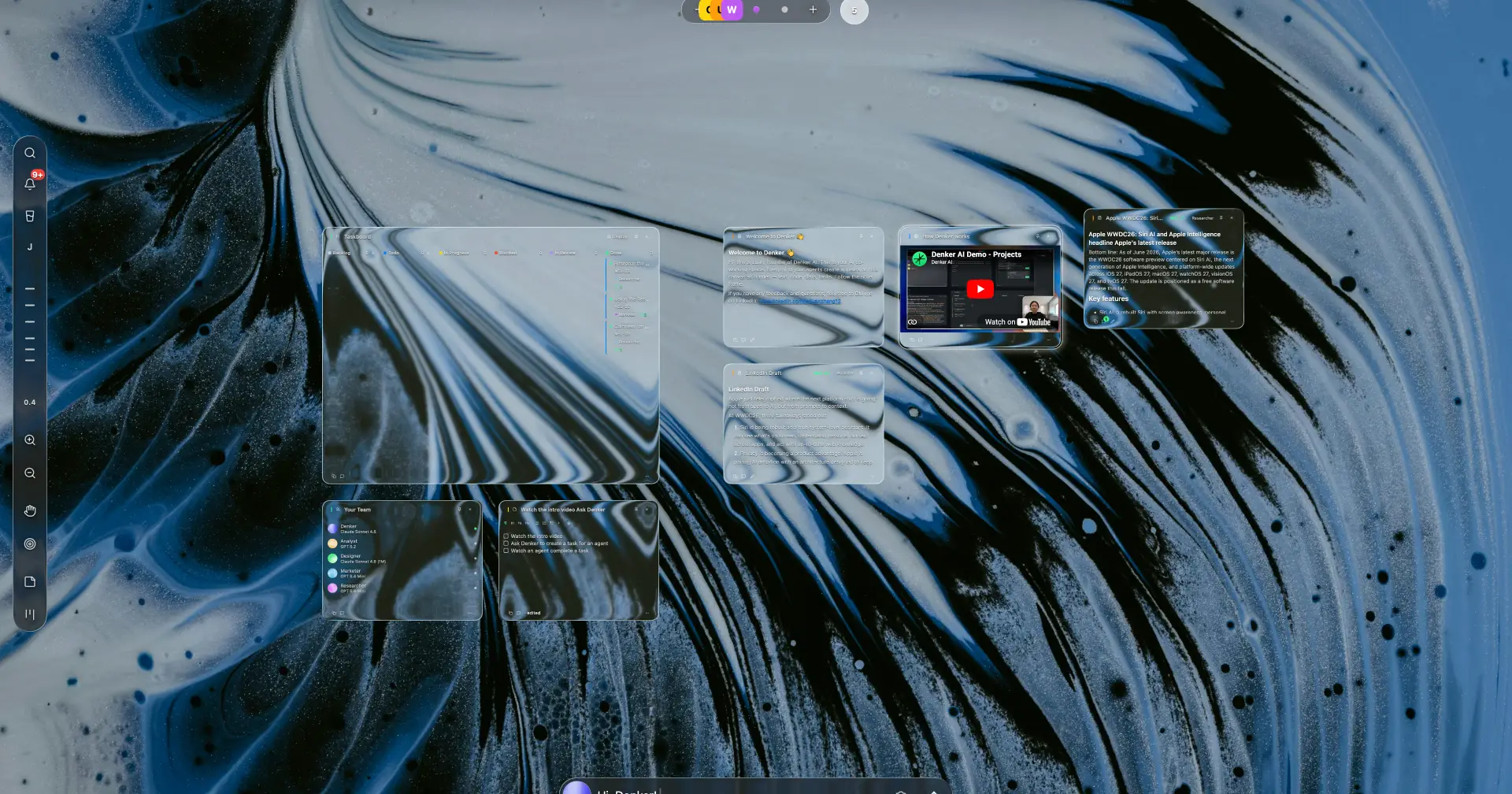
Over the past few months, while building Denker, we’ve spent less time thinking about models and more time thinking about interfaces. Not how to make AI smarter, but how to make working with multiple agents feel natural.
What happens when agents can see the same context you’re looking at?
What happens when they can coordinate with each other instead of forcing you to relay information between them?
What happens when assigning work to an agent feels as simple as pointing at something on your screen and saying, “Take care of this”?
I don’t think we have all the answers yet.
But I do think the future of AI looks less like a collection of chat windows and more like a team.
And the companies that figure out how humans direct those teams may end up defining the next generation of software.
That’s the future we’re exploring with Denker.
Join Juan on Peerlist!
Join amazing folks like Juan and thousands of other builders on Peerlist.
5
3
1