

The Biggest Productivity Problem Isn't Meetings-It's Lost Action Items
Ask most professionals what hurts productivity, and you'll hear familiar answers: too many meetings, too many tools, too many notifications.
But those aren't usually the real problem.
The bigger issue is that organizations are surprisingly good at having conversations and surprisingly inconsistent at acting on them.
Every day, teams discuss customer feedback, product ideas, operational issues, project updates, and strategic decisions. Valuable information gets shared. Important commitments are made. Responsibilities are discussed.
Then the meeting ends.
And somewhere between the conversation and the next workday, critical action items disappear.
Why Action Items Get Lost
The traditional workflow after a meeting is remarkably fragile.
Someone takes notes.
Someone else remembers a few follow-ups.
A project manager creates tasks later.
Team members interpret responsibilities differently.
A few items never make it into the project management system at all.
The result is not a lack of effort. It's a lack of structure.
Organizations often rely on people to manually convert conversations into execution, even though that process is repetitive and error-prone.
The Hidden Cost of Missed Responsibilities
When action items are missed, the consequences extend beyond a single task.
Projects move more slowly.
Teams duplicate work.
Accountability becomes unclear.
Follow-up meetings become necessary.
Managers spend time chasing updates instead of driving progress.
Over time, these small inefficiencies compound into larger operational challenges.
Many teams focus on improving meetings while overlooking the real bottleneck: what happens after the meeting ends.
Why AI Action Item Extraction Matters
Recent advances in AI are changing how organizations handle post-meeting workflows.
Rather than relying on manual note reviews, AI action item extraction automatically identifies commitments, next steps, responsibilities, and decisions directly from conversations.
Instead of simply documenting what was said, AI can help determine what needs to happen next.
This shifts meetings from information-sharing events into execution-ready workflows.
The Future of Team Accountability
The most effective teams are increasingly moving away from manual follow-up systems.
They're building workflows where responsibilities are captured automatically, ownership is identified quickly, and tasks enter operational systems without unnecessary delays.
The objective isn't to create more documentation.
It's to create more action.
Organizations that consistently execute tend to have one thing in common: they reduce friction between decisions and implementation.
How Gennie Supports Execution-Focused Teams
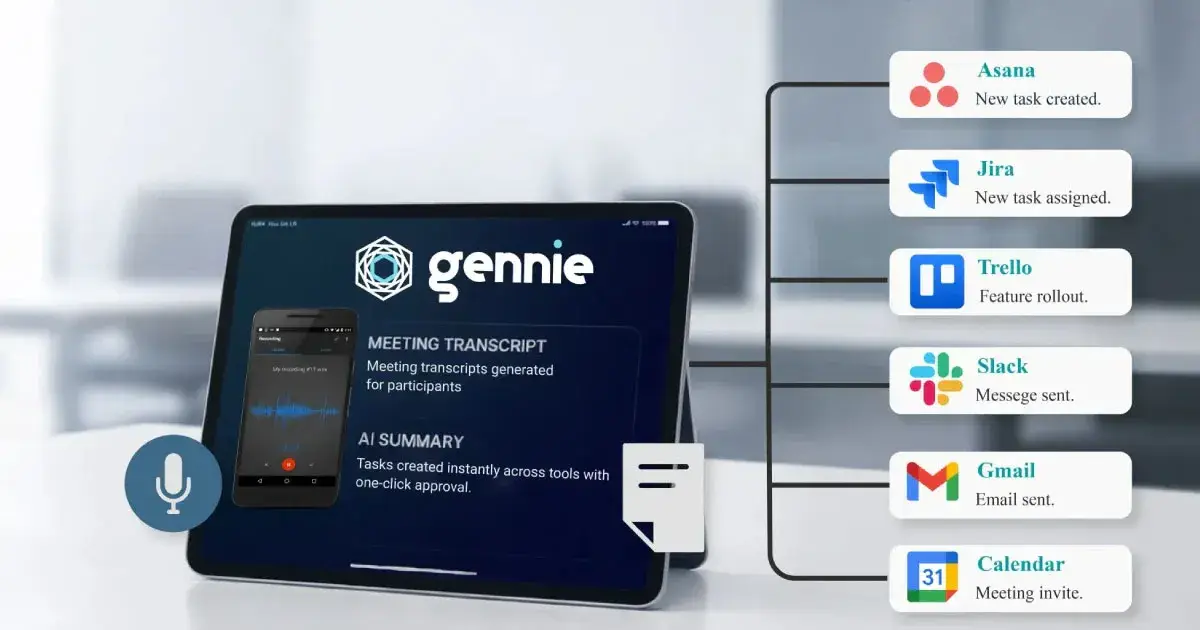
Gennie is an AI notetaker that converts meetings into structured tasks and assigns them instantly across workplace tools.
It works with existing AI notetakers, recordings, and conversations to automatically extract action items, identify owners, and organize responsibilities.
By helping teams capture what matters and turn it into assigned work, Gennie reduces manual follow-ups and improves accountability across projects and workflows.
Final Thoughts
The future of productivity isn't about attending fewer meetings.
It's about ensuring that every meaningful conversation produces meaningful outcomes.
As organizations continue adopting AI-powered workflows, AI action item extraction will become a critical part of how teams move from discussion to execution.
The teams that master this process won't necessarily hold fewer meetings. They'll simply get more value from every conversation.

Join Vishal on Peerlist!
Join amazing folks like Vishal and thousands of other builders on Peerlist.
0
1
0