

The Most Expensive Part of a Meeting Happens After It Ends
Organizations spend countless hours trying to improve meetings.
They invest in better agendas, note-taking, collaboration tools, and communication practices.
Yet one of the biggest drains on productivity doesn't happen during the meeting at all.
It happens afterward.
The moment a meeting ends, a hidden workflow begins reviewing notes, sending recaps, assigning tasks, clarifying responsibilities, updating project management tools, and chasing follow-ups.
For many teams, this process consumes more time than the meeting itself.
The Post-Meeting Bottleneck
Imagine a typical project meeting involving five people.
During the discussion, several decisions are made:
A feature needs to be updated.
A customer issue requires investigation.
Marketing needs new assets.
Leadership wants a progress report.
The conversation is productive.
The challenge begins when someone must translate those decisions into action.
Without a structured process, responsibilities often remain buried inside meeting notes, chat messages, or individual memory.
The result is delayed execution.
Why Follow-Ups Break Down
Most organizations still rely on manual workflows.
Someone reviews notes.
Someone creates tasks.
Someone assigns owners.
Someone sends reminders.
The more meetings a team has, the more administrative work accumulates.
Eventually, follow-ups become inconsistent. Not because people don't care, but because the process doesn't scale.
The Cost of Manual Coordination
When follow-up workflows depend entirely on human effort, several problems emerge:
Tasks are created late
Ownership becomes unclear
Context gets lost
Priorities change before work starts
Teams spend time tracking updates instead of making progress
Over time, these small inefficiencies compound across projects and departments.
What Meeting Follow-Up Automation Changes
Meeting follow-up automation removes much of the manual work that occurs between conversation and execution.
Instead of requiring someone to review every note and create every task manually, automation can help identify next steps, organize responsibilities, and move work into operational systems immediately.
This creates a more reliable process where discussions lead directly to action.
The goal isn't simply efficiency.
It's consistency.
Every meeting should have a clear path from decision to execution.
A Better Way to Manage Accountability
High-performing teams don't rely solely on memory or manual coordination.
They build systems that make accountability easier.
When action items are captured consistently, and responsibilities are assigned quickly, projects move faster, and fewer commitments fall through the cracks.
Automation helps teams focus on work itself rather than the administrative effort required to manage it.
How Gennie Automates Post-Meeting Execution
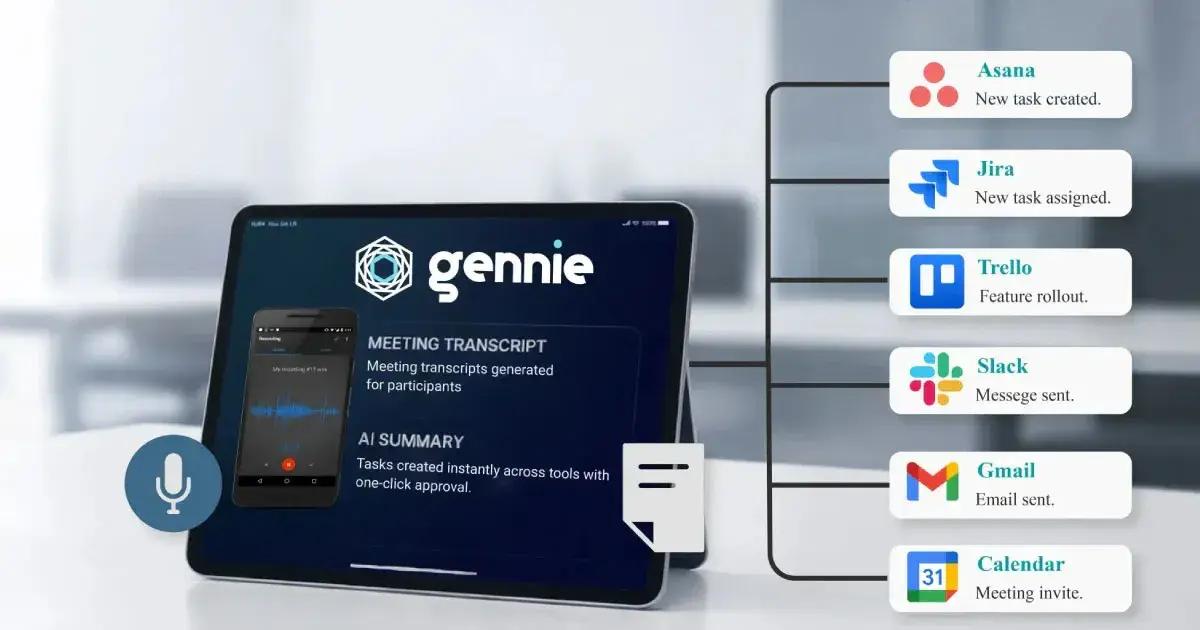
Gennie is an AI notetaker that converts meetings into structured tasks and assigns them instantly across workplace tools.
It works with existing AI notetakers, recordings, and conversations to automatically extract action items, identify owners, and organize responsibilities.
Tasks can then be synced across tools such as Asana, Trello, Jira, Slack, and ClickUp, helping teams eliminate manual follow-up processes and improve execution after every discussion.
Final Thoughts
Many organizations believe meetings are the problem. In reality, meetings often generate valuable decisions and ideas.
The real challenge is ensuring those decisions become action.
Meeting follow-up automation helps organizations close that gap by transforming post-meeting work from a manual process into a scalable system.
When follow-ups occur automatically, teams spend less time coordinating and more time advancing projects.

Join Vishal on Peerlist!
Join amazing folks like Vishal and thousands of other builders on Peerlist.
0
5
0