

AI Agent for SERP Analysis: Turning Search Data Into Better Content Decisions
Learn how an AI agent for SERP analysis helps SEO teams move beyond rankings, decode search intent, identify content gaps, and make better editorial decisions.
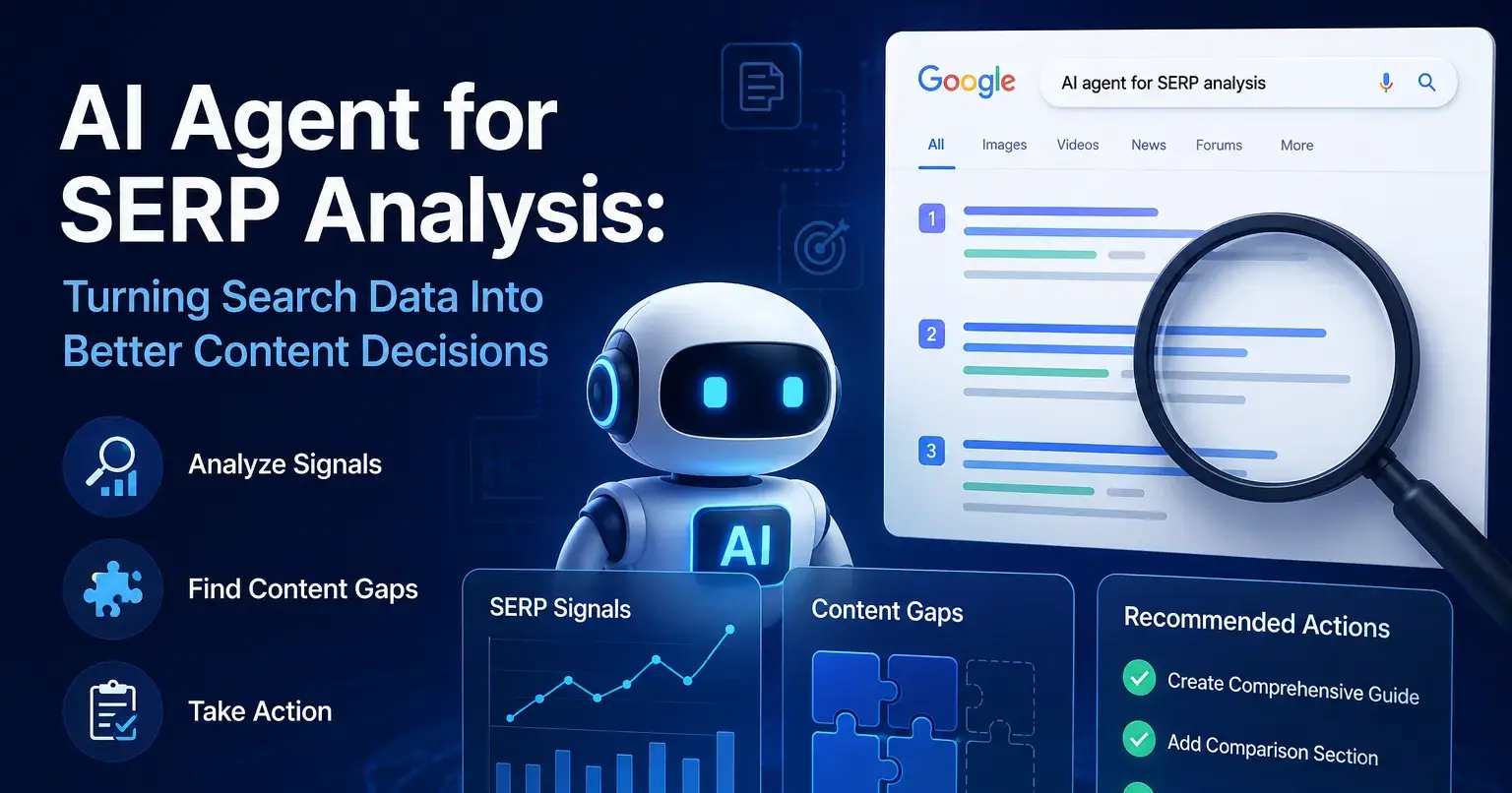
The strongest objection to using an AI agent for SERP analysis is valid: search results are not a perfect map of user intent. Google rankings can reflect domain authority, freshness, brand trust, backlinks, content format, user behavior, and many other signals that no outside tool can fully decode.
That means an AI agent should not be treated as an oracle.
But that does not make it weak. It changes how SEO teams should use it. The real value of an AI agent for SERP analysis is not to “explain Google.” It is to create a faster, cleaner, and more repeatable way to study the search landscape before a content team invests time in writing.
For B2B companies, this matters. Search is no longer just a traffic channel. It is a market research layer. Every serious query shows how buyers frame problems, compare options, test assumptions, and evaluate risk.
Why Traditional SERP Analysis Is Reaching Its Limit
Manual SERP analysis still has strategic value. A skilled SEO editor can read nuance, detect weak positioning, and judge whether a page deserves to rank.
The issue is scale.
For one keyword, manual review is manageable. For 50 priority topics, it becomes slow. For a large B2B content roadmap, it becomes inconsistent.
Teams often review the top 10 results, note common headings, scan People Also Ask, and build a brief. This process works, but it creates three gaps:
1. Intent Gets Oversimplified
Many teams label a keyword as informational, commercial, or transactional. That is useful, but thin.
A query like “AI agent for SERP analysis” may include several layers of intent:
Understanding the concept
Comparing manual and automated SEO research
Learning workflow design
Finding content gap methods
Assessing risk and quality control
A basic brief may miss these layers.
2. Competitor Content Gets Copied by Accident
When teams study ranking pages without a clear framework, they tend to reproduce the same structure.
That creates safe but forgettable content. The article may be complete, but it adds no new angle.
3. Insights Do Not Turn Into Actions
A spreadsheet full of ranking pages is not a strategy. SEO teams need clear decisions:
Should we create a new page?
Should we update an existing article?
Should we add examples, tables, or FAQs?
Should we target a narrower subtopic?
Should we ignore the keyword because the SERP is not aligned with our offer?
This is where an AI agent can improve the operating model.
What an AI Agent for SERP Analysis Actually Adds
An AI agent for SERP analysis can collect, classify, compare, and summarize search data across many queries. The practical benefit is not just speed. It is consistency.
A strong workflow can help teams answer five questions:
What type of content does the SERP reward?
What topics appear across top-ranking pages?
What important angles are missing?
Which pages win because of authority versus content quality?
What action should we take next?
This shifts SEO from keyword chasing to decision intelligence.
Why an AI Agent for SERP Analysis Needs Strategic Guardrails
The counter-risk is clear. AI can overfit the SERP. It may recommend copying competitor structures because it sees repetition as proof. It may also confuse content length with quality or mistake a common heading for a required heading.
That is why the best use case is human-led, agent-assisted analysis.
A useful agent should separate observed data from interpretation. For example:
Observed: Eight of the top 10 pages include a comparison section.
Interpretation: A comparison section may help meet search intent.
Action: Add a comparison only if it helps the reader make a better decision.
This distinction matters. Without it, AI SERP research becomes automated mimicry.
For readers who want a deeper technical view of how agents move from ranking signals to content gaps and action planning, see AIQuinta’s breakdown of AI agent for SERP analysis.
A Practical Framework for Using AI SERP Analysis
A simple framework can keep the workflow useful and controlled.
Step 1: Define the Business Context
Do not give the agent only a keyword. Add the audience, funnel stage, market, product category, and content goal.
Weak input:
“Analyze content automation.”
Better input:
“Analyze content automation for B2B marketing leaders evaluating AI workflows. Focus on risks, governance, team adoption, and content quality.”
The second prompt gives the agent strategic boundaries.
Step 2: Map the SERP Before Writing
The agent should classify the live SERP by format and intent.
Look for:
Guides
Product pages
Comparison posts
Listicles
Thought leadership articles
Videos
Forums
AI summaries
Featured snippets
This helps teams avoid writing the wrong type of page.
Step 3: Identify Gaps That Matter
Not every missing subtopic is worth adding. A useful content gap should support the reader’s next decision.
Prioritize gaps across four categories:
Concept gaps: missing definitions or frameworks
Trust gaps: weak proof, no examples, no limits
Decision gaps: no comparison, checklist, or trade-off analysis
Action gaps: no clear next step
This keeps the article focused.
Step 4: Build an Editorial Brief, Not a Content Template
The final output should not be “write these H2s.”
It should include:
Search intent summary
Audience pain points
Required topics
Differentiation angle
Examples to include
Claims that need support
Internal link opportunities
Risk notes
Recommended structure
This gives writers strategy, not a skeleton.
Example: From Keyword to Editorial Decision
Suppose a company wants to rank for “AI knowledge management.”
A weak SERP analysis may say:
“Top articles explain what AI knowledge management is. Write a 2,000-word guide.”
A stronger AI-assisted analysis may say:
“The SERP is split between basic definitions and enterprise knowledge base tools. Most articles explain benefits, but few address governance, source quality, ownership, and AI readiness. The opportunity is to write for leaders who already understand knowledge management but need a framework for making enterprise knowledge usable by AI systems.”
That insight leads to a better article.
It also prevents the team from publishing another generic “what is” page.
Checklist: When to Trust the Agent and When to Override It
Use the agent when you need to:
Analyze many SERPs
Compare page structures
Find repeated entities
Detect missing formats
Summarize competitor coverage
Refresh old content briefs
Override the agent when:
The recommendation conflicts with business positioning
The SERP rewards a format that does not fit your audience
The agent suggests adding weak or obvious sections
The topic requires expert judgment
The content could affect trust, compliance, or buyer confidence
This keeps control where it belongs: with the strategist.
Conclusion: AI SERP Analysis Is a Decision Workflow
An AI agent for SERP analysis should not replace SEO judgment. It should upgrade the workflow around that judgment.
The strategic value is simple: better inputs, faster research, clearer gaps, and more consistent content decisions.
The companies that benefit most will not be the ones that use AI to publish more. They will be the ones that use AI to understand the market faster, brief writers better, and build content that answers real buyer questions with more precision.
The next step is not full automation. It is a disciplined research-to-action system where AI handles the heavy scan, and humans own the final editorial call.
___________
AIQuinta - An Agentic Enterprise Platform, where your knowledge base powers AI.
- Website: https://aiquinta.ai/
- Email: [email protected]

Join Duc on Peerlist!
Join amazing folks like Duc and thousands of other builders on Peerlist.
0
0
0