

Building Reliable AI Agents: An Introduction to Harness Engineering Architecture
Learn how to build enterprise-ready, reliable AI agents using Harness Engineering Architecture. Explore the 5 pillars of safe AI execution, orchestration, and oversight.
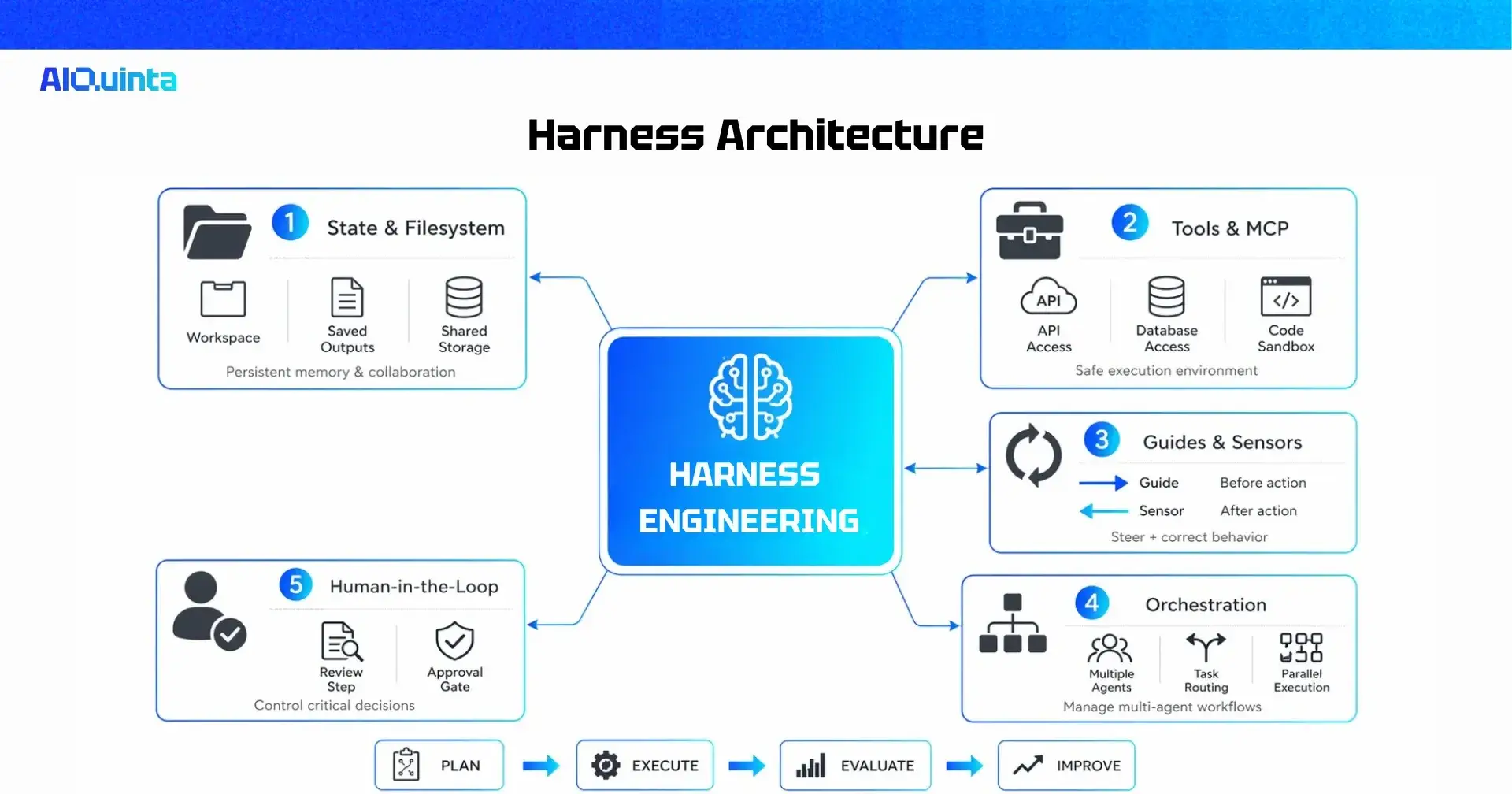
Generative AI has evolved rapidly from simple chat interfaces to autonomous AI agents capable of executing complex tasks. However, as organizations attempt to move these agents from experimental sandboxes into production environments, they face a critical hurdle: reliability.
Without the proper infrastructure, AI agents can hallucinate, get stuck in infinite loops, or make unauthorized decisions. To solve this, developers need more than just a powerful LLM; they need a robust, surrounding architecture. This is where the concept of Harness Engineering comes into play.
The 5 Pillars of Harness Architecture
Building an enterprise-grade AI agent requires a system that guides, monitors, and controls the AI’s behavior. A strong “Harness Architecture” typically consists of five core pillars:
1. State & Filesystem (Persistent Memory) For an AI agent to be truly useful, it needs context. By utilizing dedicated workspaces, shared storage, and saved outputs, agents can maintain persistent memory and collaborate seamlessly without losing track of past interactions.
2. Tools & MCP (Safe Execution Environment) Agents need to interact with the outside world, but they must do so safely. Providing structured access to APIs, databases, and secure code sandboxes ensures that the AI has the tools it needs to execute tasks without compromising system security.
3. Guides & Sensors (Behavior Correction) You wouldn’t let a junior employee work without guidelines, and AI is no different. “Guides” provide instruction before an action is taken, while “Sensors” evaluate the output afterward. This constant feedback loop steers the AI and corrects behavior in real time.
4. Orchestration (Managing Workflows) Complex problems often require multiple specialized agents. A strong orchestration layer handles task routing, manages multi-agent interactions, and allows for parallel execution to drastically speed up workflows.
5. Human-in-the-Loop (Critical Oversight) No matter how advanced the AI becomes, critical decisions should still require human oversight. Implementing review steps and approval gates ensures that humans remain in control of high-stakes actions.
The Continuous Improvement Cycle
When these five pillars work together, they create a reliable lifecycle where systems can systematically Plan, Execute, Evaluate, and Improve. Instead of crossing your fingers and hoping the AI gets it right, you have a deterministic framework ensuring safe and accurate outputs.
If your team is struggling to transition AI prototypes into robust, production-ready solutions, adopting a structured engineering framework is the next logical step.
To dive deeper into these concepts and learn how to implement this system in your own projects, read the full Harness Engineering Guide to Reliable AI Agents by AIQuinta.
___________
AIQuinta - An Agentic Enterprise Platform, where your knowledge base powers AI.
- Website: https://aiquinta.ai/
- Email: [email protected]

Join Duc on Peerlist!
Join amazing folks like Duc and thousands of other builders on Peerlist.
0
3
0