

Why Enterprise AI Needs More Than Better Models
Why enterprise AI must scale the system around the model to turn agents into reliable business operators
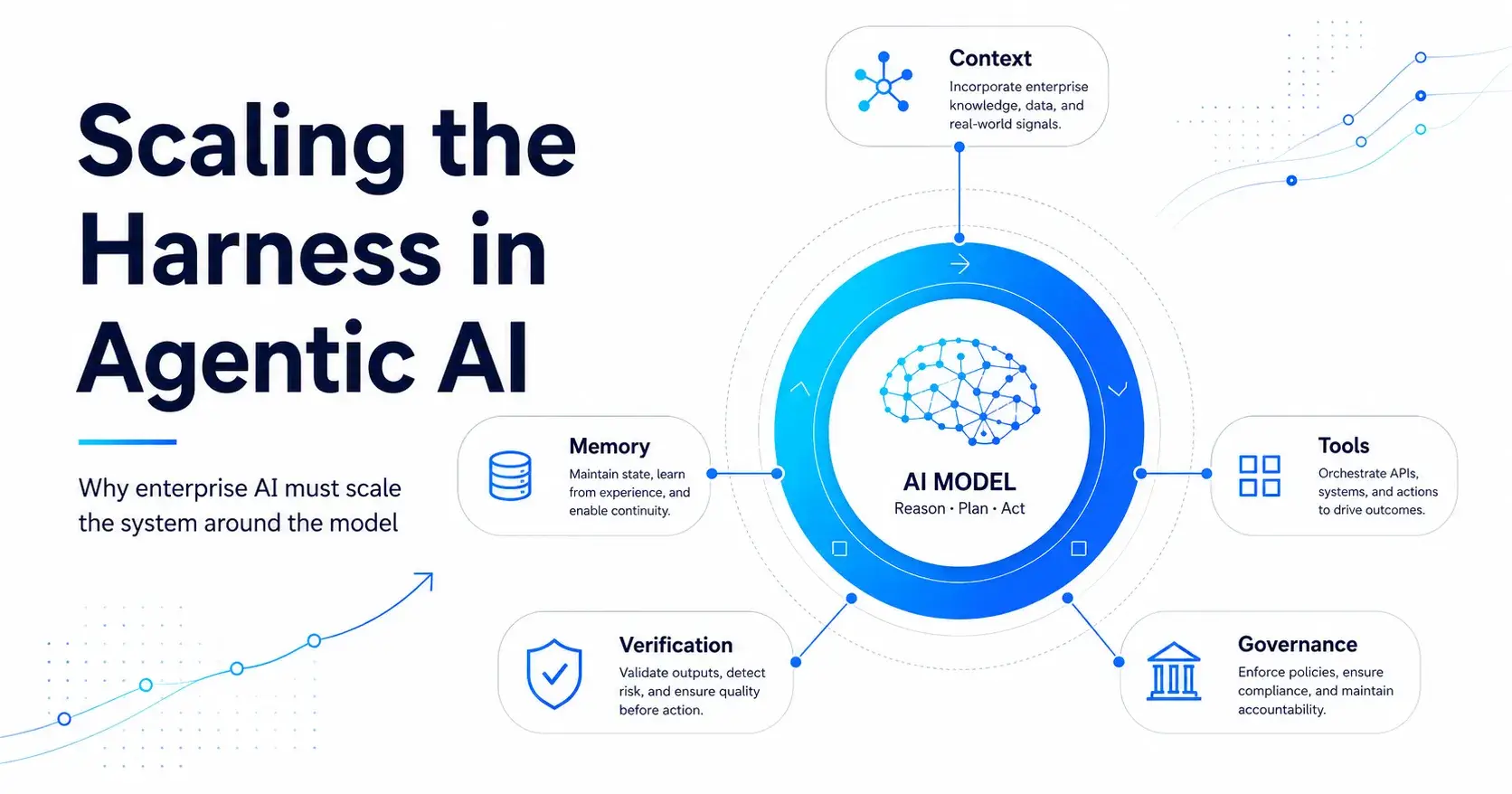
Most companies still frame AI progress around model quality. Bigger models, longer context windows, better benchmarks, and faster inference get most of the attention.
That focus is understandable. Better models do improve output quality. They reduce simple mistakes, handle harder instructions, and make AI systems easier to build.
But this view misses the main enterprise challenge.
In business environments, AI does not create value because it can answer a question in isolation. It creates value when it can work across systems, retrieve trusted context, follow rules, call tools, escalate risk, and complete workflows with control.
That is why the next phase of enterprise AI will not depend only on model scaling. It will depend on the system that surrounds the model.
The Shift From Model Scaling to System Scaling
Early AI adoption focused on chat interfaces and productivity tools. A user asked a question. The model responded. The value came from speed, writing quality, or idea generation.
Agentic AI is different.
An AI agent does not only respond. It acts. It may search internal documents, query a database, call an API, create a task, update a CRM record, generate code, trigger a workflow, or coordinate with another agent.
Once AI starts acting, the model becomes only one part of the full system.
The enterprise question changes from:
“Which model gives the best answer?”
to:
“Which AI system can complete work with accuracy, traceability, governance, and business value?”
That shift is where many AI pilots fail. Teams test a strong model, get promising early results, then struggle when they connect it to real workflows. The issue is not always the model. Often, the issue is the missing execution layer around it.
What the Execution Layer Must Handle
For agentic AI to work in production, the system must manage several layers at once.
It needs to decide what context the model should see. It needs to know which data sources are trusted. It needs to control what the agent can remember. It needs to define which tools the agent can use. It needs to verify outputs before actions move downstream.
This execution layer is often called the agent harness.
A strong harness gives the model a structured environment for action. It connects intelligence with business systems, but it also adds boundaries. Without it, even a powerful model can make poor decisions because it has the wrong context, stale memory, too many tools, or no validation step.
For a deeper breakdown of this concept, AIQuinta’s guide on scaling the harness in agentic AI explains how context, memory, routing, verification, and governance become the real performance frontier for enterprise agents.
Why Context Is a Governance Problem
Many teams assume that longer context windows solve enterprise AI problems. If the model can read more, it should perform better.
That is only partly true.
More context can help, but unmanaged context can also create noise. If the agent receives outdated policies, duplicated documents, low-quality notes, or irrelevant records, the answer may become less reliable.
The real challenge is not just giving AI more information. It is giving AI the right information at the right time.
That requires context governance.
A mature context layer should answer:
Which sources are approved?
Which documents are current?
Which records should be excluded?
Which information needs citation?
Which context should expire?
Which user or workflow permissions apply?
Without these controls, the agent may appear useful in a demo but fail in production. Enterprise AI needs relevance, freshness, and traceability. A large context window does not guarantee any of those.
Why Memory Needs Trust, Not Just Storage
Memory is another area where enterprises need a stronger operating model.
AI memory can help agents retain user preferences, project history, business rules, and workflow patterns. This makes agents more useful over time.
But memory also creates risk.
If the system remembers the wrong fact, uses outdated information, or applies one user’s context to the wrong situation, it can create serious business errors.
This is why enterprise AI memory must be managed like a governed knowledge asset. It needs source tracking, update rules, access control, and expiration logic.
For example, a procurement agent should not reuse an old vendor rule just because it was stored in memory. It should check the current procurement policy, compare it with stored knowledge, and flag conflicts before making a recommendation.
In other words, AI memory must be trustworthy, not just persistent.
Why Tool Use Creates New Risk
The more tools an agent can use, the more powerful it becomes.
It can retrieve information, create documents, run calculations, update records, or trigger workflows. This is where agentic AI begins to deliver real operational value.
But tool access also increases risk.
An agent with broad tool access can call the wrong API, change the wrong field, expose sensitive data, or take action before review. The issue is not only whether the model understands the task. The issue is whether the system gives it the right level of authority.
A production-grade agent system needs controlled tool access. Some actions can be automated. Some should require human approval. Some should be blocked entirely.
Good tool design should include:
Clear tool descriptions
Structured inputs and outputs
Permission tiers
Error handling
Action logs
Rollback options
Human review gates
This turns agentic AI from a risky automation layer into a governed business capability.
Why Verification Becomes a Core Design Layer
In traditional software, systems follow fixed rules. In agentic AI, the system often decides the next step based on reasoning.
That flexibility is powerful, but it creates a new need for verification.
A business should not trust an agent’s output only because it sounds correct. The system should check whether the output meets the required conditions.
For example:
If the agent writes code, tests should run.
If it cites a policy, the source should be shown.
If it extracts invoice data, key fields should be validated.
If it recommends an action, the reasoning should be logged.
If confidence is low, the task should escalate.
Verification is not a final add-on. It is part of the harness design.
The goal is not to remove human oversight from every process. The goal is to use AI for speed while keeping control where judgment, compliance, or risk management matters.
How Enterprises Should Start
The best way to scale agentic AI is not to build a broad “AI assistant for everything.”
That approach usually fails because the scope is too wide. The agent has unclear data boundaries, vague ownership, and weak success metrics.
A better approach is to start with one high-value workflow.
Good candidates include:
Customer support triage
Internal knowledge search
Sales proposal drafting
Finance document review
Procurement policy checks
Manufacturing issue analysis
Software engineering support
Compliance evidence gathering
For each workflow, the team should define the business outcome first. Then it should map the systems, tools, data, permissions, and approval points the agent needs.
This creates a minimum viable harness.
From there, the company can measure performance, identify failure points, and reuse the same pattern across adjacent workflows.
What to Measure
Many AI teams still evaluate agents by final answer quality. That is not enough.
Enterprise agents should be measured by process quality as well.
Useful metrics include:
Task completion rate
Context retrieval accuracy
Tool-call accuracy
Human correction rate
Escalation rate
Verification pass rate
Cost per completed task
Time saved per workflow
Error recovery rate
Audit completeness
These metrics show whether the agent is becoming more reliable, not just more active.
The long-term goal is not to create agents that do more things. The goal is to create agents that complete valuable work with less risk and more consistency.
The Real Competitive Advantage
The strongest companies will not win enterprise AI only by choosing the best model. Most organizations will have access to strong models.
The differentiator will be how well they design the system around the model.
That means better context governance, cleaner memory, safer tool access, stronger verification, and clearer operational ownership.
Model capability will keep improving. But enterprise adoption will depend on whether companies can turn that capability into controlled execution.
This is the real meaning of scaling agentic AI.
It is not about replacing the enterprise with autonomous systems overnight. It is about building the operating layer that lets AI agents work inside the enterprise with trust, control, and measurable value.
Conclusion
Agentic AI marks a major shift in how companies use artificial intelligence. The focus is moving from answers to actions, and from isolated prompts to full workflows.
Better models will help, but they are not enough.
To create reliable enterprise agents, companies need to scale the harness around the model. That harness must manage context, memory, tools, verification, governance, and evaluation.
The companies that understand this shift will move beyond pilots. They will build AI systems that can operate across real business processes and create sustained advantage.
The future of enterprise AI will not belong only to the biggest model. It will belong to the best-designed system.
___________
AIQuinta - An Agentic Enterprise Platform, where your knowledge base powers AI.
- Website: https://aiquinta.ai/
- Email: info@aiquinta.ai

Join Duc on Peerlist!
Join amazing folks like Duc and thousands of other builders on Peerlist.
0
1
0