

How developers are building profitable businesses creating apps for Whop
Developers are turning side projects into recurring revenue by building apps for Whop's creator marketplace — here's how you can too.
Peerlist is a community for tech professionals, especially designers and developers. It offers a comprehensive profile to showcase work across the internet. It's where you prove your skills with real projects, not just claims on a resume.
So here's something worth adding to your Peerlist portfolio: building apps for Whop.
It's an online business model that's actually working for developers right now. And unlike traditional app development where you're grinding for months with zero users, Whop puts your apps in front of thousands of creators from day one.
What are Whop apps?
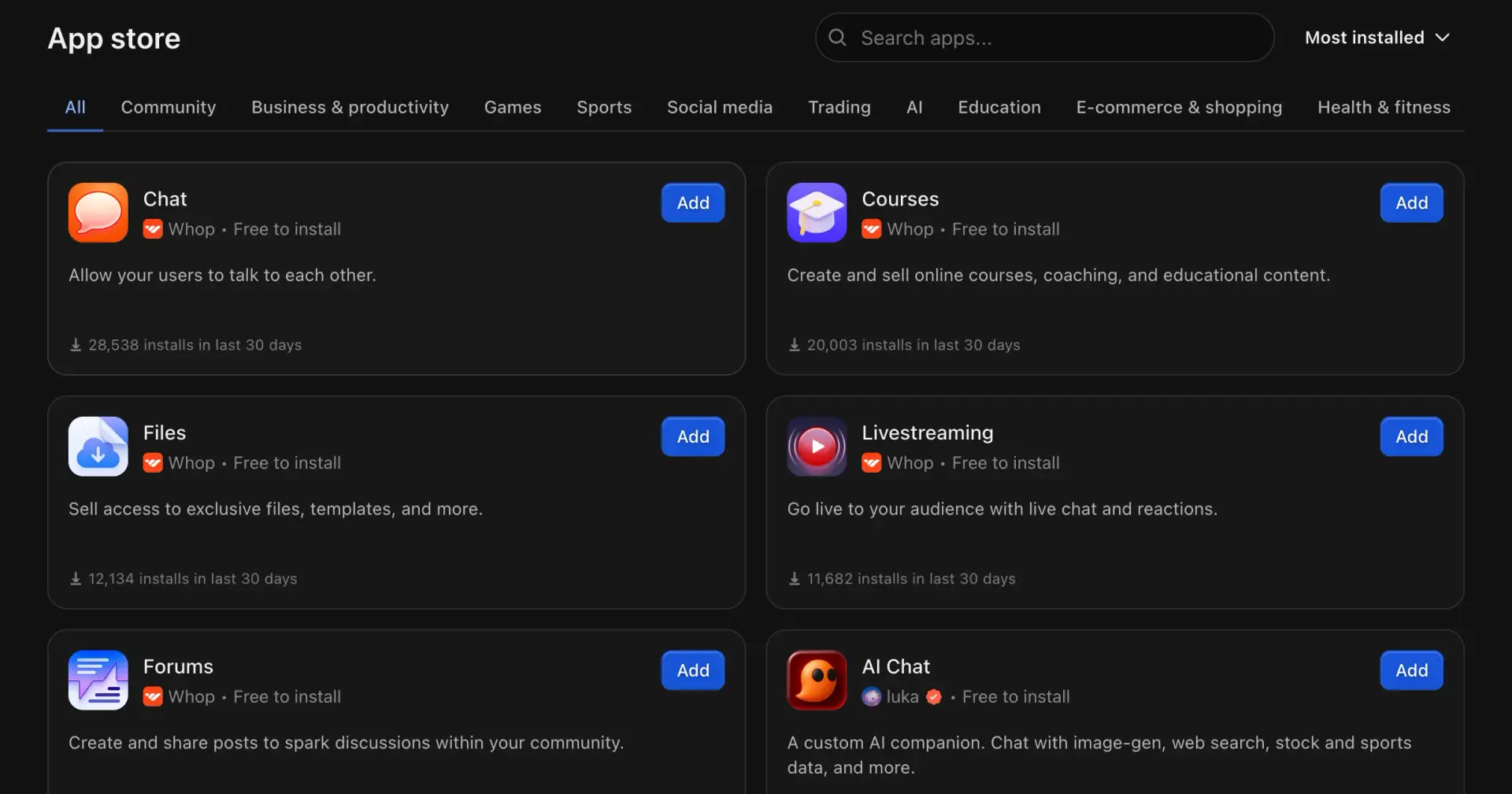
A Whop app is a web app that can be embedded into a whop community, and these apps can be installed by any Whop creator through the app store.
Think of it like building plugins, but for creator businesses instead of WordPress sites.
The app store is visited by tens of thousands of creators who are looking to offer more value to their communities. These creators run everything from trading communities to fitness coaching to online courses. They need custom tools, and they're willing to pay for them.
Why this is a profitable business for developers
Here's the model: You let Whop creators sell your app inside their community for $29/month and earn a referral fee for every customer they bring you.
The math works out pretty well:
Build one app
List it in the Whop App Store (free)
Creators install it and sell it to their members
You earn recurring revenue from every installation
As the developer, you can charge for the app using several options offered by the Whop SDK, which makes it easy to leverage the infrastructure of Whop to build full-blown apps in hours, not weeks.
No payment processing headaches. No user authentication nightmares. No server management. Whop handles all of that through their SDK.
What kind of apps are developers building?
Developers have already built Whop Wins (a wall of wins where communities can post successes), Prompt Library (create and sell AI prompts), Quizly (host trivia and quizzes), Paper Trading (practice trading with fake money), Whop FM (radio streaming app), and Anonymous AMA. Your product title matters - 'Whop Wins' immediately tells you it's about celebrating community wins
The range is wild. Some developers are building crypto trading exchanges. Others are making sports betting tools. Marketplaces. User rewards systems. Shopify competition apps.
The key is finding a niche where creators need a specific tool and building it.
The technical side (it's easier than you think)
Developers build these apps using languages like JavaScript, TypeScript, CSS, and other web-focused languages.
If you know Next.js, you're already most of the way there. Whop apps use Next.js, so the learning curve is minimal if you're already familiar with the framework.
Don't know Next.js? That's fine too. AI tools like ChatGPT or Claude can help you code.Common concerns like payment processing and user authentication? The Whop SDK handles those automatically.
That's the real advantage here. You're not building everything from scratch. You're building on top of infrastructure that already works.
How to get started
The barrier to entry is surprisingly low:
Check out the Whop developer docs for guides and tutorials
Clone the starter template to get started building your app
Build something simple first (a quiz app, a file organizer, whatever)
List it in the App Store
Watch creators discover and install it
The best part about this online business model? You can use many Whop apps for free, which means you can test and explore what's already out there before building your own.
Why this beats traditional app development
Traditional app development means:
Building everything from scratch
Marketing to get your first users
Figuring out payment processing
Dealing with customer support
Hoping someone finds your product
Building for Whop means:
You're placed in the Whop App Store, which is visited by tens of thousands of creators looking to offer more value to their communities
Built-in distribution through creator networks
Payment and auth handled automatically
Creators do the selling for you
You focus purely on building
The monetization angle
Here's where it gets interesting for a profitable business.
Let's say you build an app and 50 creators install it. Each creator charges their members $10/month to access your app. You get a cut of that.
Now scale that to 100 creators. Then 500.
The recurring revenue compounds because you're not just selling to end users — you're selling to creators who then sell to their communities.
You can now sell software (the highest leverage business model), not by learning to code, but by curating the perfect tech stack for your audience.
Adding this to your Peerlist portfolio
Proof of work is the only thing that works, and your Peerlist profile lets you showcase that in a clean and beautiful way.
Building Whop apps is real proof of work. You're shipping products that actual businesses use. That's portfolio gold.
Link to your live apps in the App Store. Show the number of installs. Share revenue screenshots if you're comfortable. This is the kind of project that gets you noticed.
If you're a developer looking for a new online business model, building Whop apps is worth exploring.
The infrastructure is there. The distribution is built-in. The monetization is straightforward. And creators are actively looking for solutions.
You don't need a massive marketing budget or years of runway. Just an idea, some coding skills (or AI assistance), and the willingness to ship.
Start with free content in the App Store to see what's already working. Then build something better, different, or more niche.

Join Karina on Peerlist!
Join amazing folks like Karina and thousands of other builders on Peerlist.
1
14
1