

What I Learned From Launching GhostPrompter on Peerlist
What I learned about preparing for launch, building an audience, listening to users, and turning attention into product growth
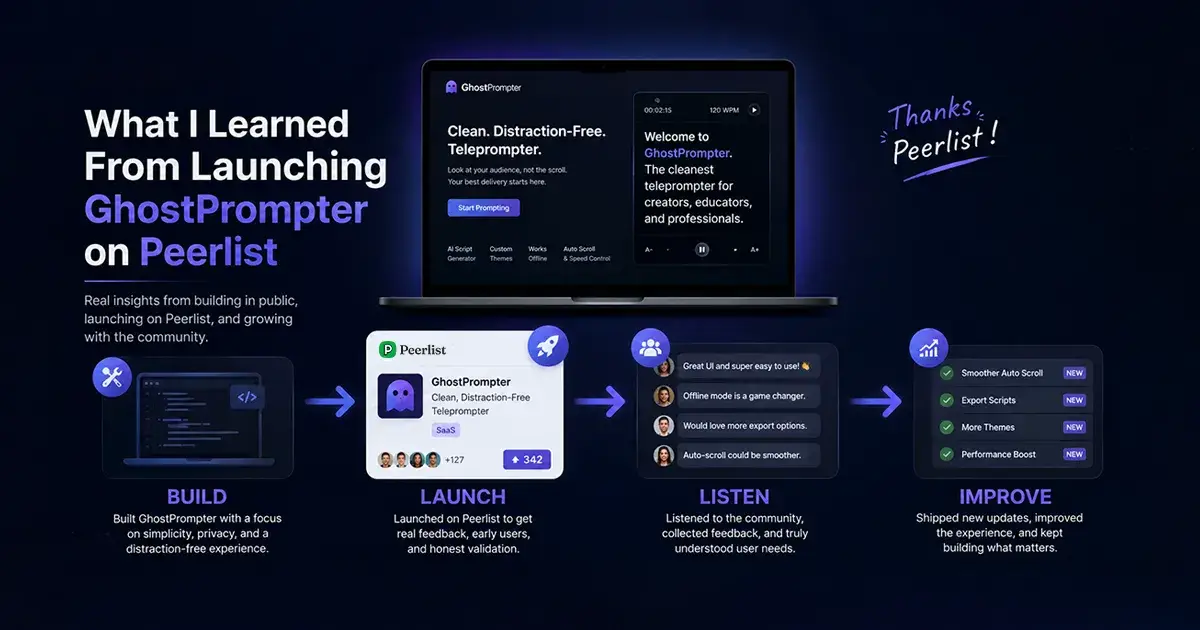
Launching GhostPrompter on Peerlist taught me something I didn't fully expect: launch day isn't really about the launch itself.
I had already spent weeks preparing the product, building familiarity on Peerlist, sharing progress, and talking with other founders before I finally hit launch.
I thought the hardest part would be getting people to notice GhostPrompter. Instead, the most valuable part turned out to be listening to what people actually said after they discovered it.
This is what I learned from the experience — what worked, what didn't, and what I'd do differently for my next launch.
I Started Preparing Before Launch Day
I didn't wake up on launch day and hope people would stumble onto GhostPrompter's page. I'd been showing up on Peerlist for around 2–3 weeks before launch, posting progress updates, sharing screenshots, and talking about the problem I was trying to solve — not just the product I was building.
That mattered for a simple reason: launching to an audience is a completely different experience than launching without one. When you launch cold, you're introducing the product and asking for attention in the same breath. When you've been present beforehand, people already have some context. They've seen the thing evolve. They know roughly what it does before they ever land on the launch page.
Part of this was also just figuring out what to say. Early on, I described GhostPrompter in fairly technical terms — cross-platform, customizable scroll speed, transparent overlay. That language didn't land the way I expected. Watching which posts got real engagement before launch helped me understand which words actually resonated with people, well before I had to get the positioning right under pressure.
Building Familiarity Before Asking for Support
I want to be honest about something: I wasn't participating in the Peerlist community simply to build a list of people who would support my launch. I did it because that's genuinely how the platform works — you learn from other founders, you see what they're struggling with, and you occasionally have something useful to add.
But there was a real side effect. Commenting thoughtfully on other people's projects, joining conversations, and sharing feedback when I actually had something to say made it much easier to talk to people once GhostPrompter was live. I wasn't a stranger showing up with an ask. I was someone who'd already been part of the conversation.
If you're preparing your own launch, the practical version of this lesson is simple: show up before you need anything. Comment on things you're actually interested in. Publish content that stands on its own, not content that's secretly a pitch. By the time you launch, the groundwork is just... already there.
Getting the Launch Assets Ready
In the days before launch, I put together everything I thought I'd need: screenshots of the app in different states, a product description that didn't read like a spec sheet, a maker comment, a few Scroll posts spaced out to avoid dumping everything at once, short demos of the core features, and updated messaging on the GhostPrompter homepage.
I also set up a simple way to track who reached out, what platform they came from, and what they said — nothing fancy, just a spreadsheet. That one habit turned out to be more useful than I expected, because it let me separate "people who upvoted" from "people who actually became users" later on.
The value of doing this ahead of time wasn't creative — it was about stress. Launch day already has enough unpredictability. Not having to write a maker comment from scratch at 7 a.m. made a real difference.
Launch Day
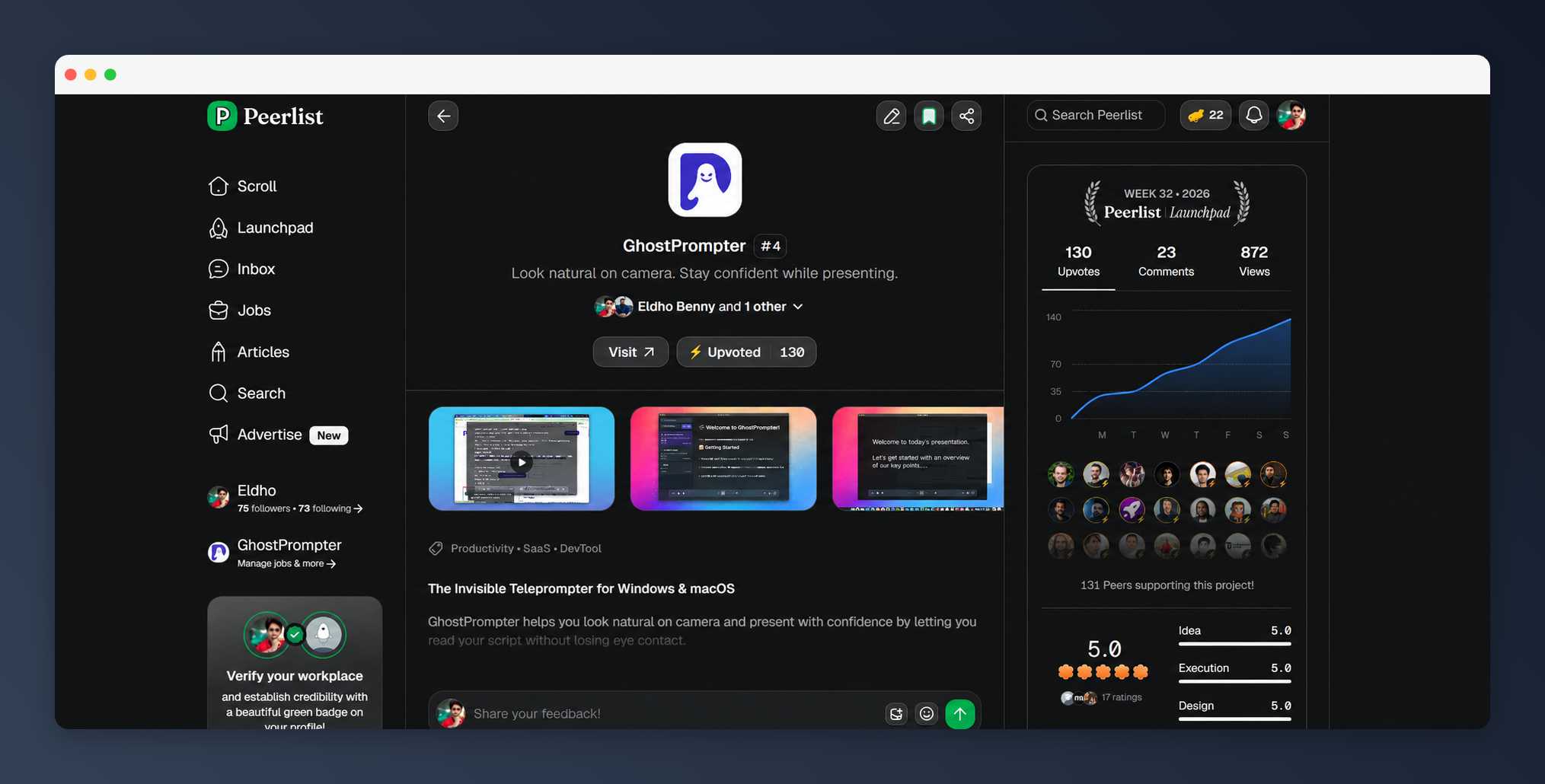
Launch day itself was a mix of momentum and noise.
GhostPrompter received 130 upvotes and 23 comments on its Peerlist launch, and the launch generated 90 website visits and 849 views.
But one thing became very clear to me: visibility, traffic, and users are three different things.
Roughly 90 people clicked through to the site that day, while only a few started a trial. Some traffic came directly from Peerlist, while some came from people sharing the launch elsewhere, which made attribution harder to separate cleanly.
What stood out more than the numbers were the conversations...
What People Actually Cared About
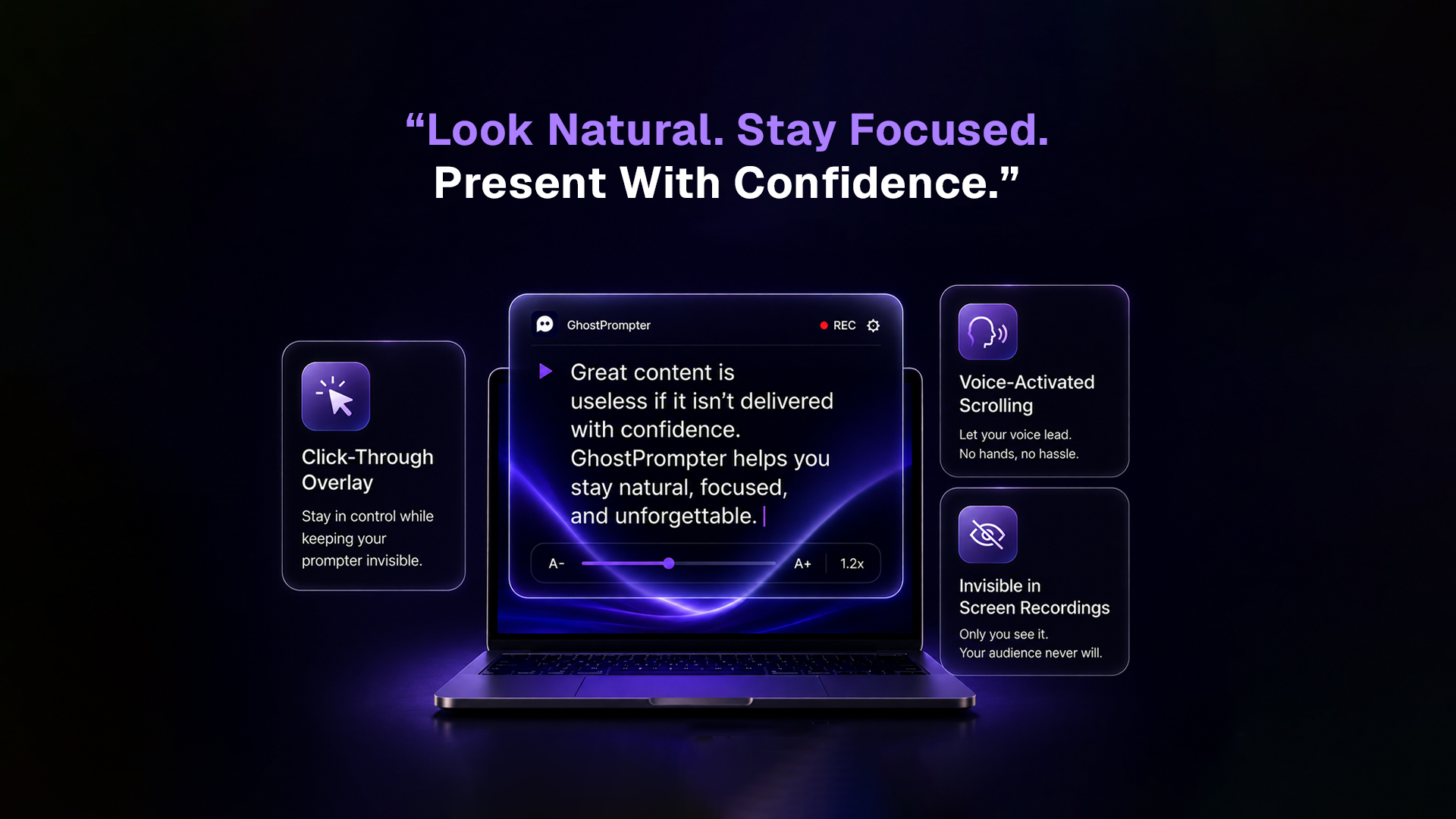
I initially expected people to focus mostly on the technical side of GhostPrompter — the click-through overlay, voice scrolling, invisible in screen recording, ghost mode and customization.
But many of the conversations ended up being about the outcome instead.
People talked about using it for presentations, YouTube videos, demos, meetings, Zoom calls, and screen recordings.
That made me rethink how I describe GhostPrompter.
The product isn't really about putting words on a screen. The bigger value is helping people stay on track while looking natural on camera and feeling more confident while presenting.
That distinction changed the way I think about the product's positioning.
That's the broader lesson:
people don't necessarily care about the feature itself. They care about the problem the feature quietly solves.
The Feedback Changed What I'm Building
Some of the most useful launch feedback wasn't praise — it was requests. One of the most useful parts of the launch was seeing people suggest workflows and features I hadn't considered.
For example, one person asked about multi-monitor support and floating mini-script modes for presentations.
Those conversations reminded me that I can only see the product from my own workflow. Other people immediately see possibilities I haven't considered.
That's something I'll carry into future product decisions: don't build the roadmap entirely from inside your own head.
What Surprised Me
One thing that surprised me was how differently people described using the same product. I built GhostPrompter around my own problem, but the launch showed me that the same workflow can be useful for presentations, YouTube videos, demos, meetings, and screen recordings.
I also noticed that while the launch created a real spike in visibility, SEO and search traffic are likely to matter more over the long run. The launch reinforced something I already believed from working on SEO: launch traffic is temporary, while search visibility can compound over time.
A launch can give a product a burst of attention. SEO, useful content, and genuine mentions can continue bringing people to the product long after launch day is over.
That's why I don't see the Peerlist launch as a replacement for SEO. I see it as one part of a larger distribution strategy.
What Worked
A few things clearly paid off:
Building relationships before launch meant I wasn't introducing myself to the community for the first time on launch day.
Preparing before launch meant I wasn't improvising messaging in real time.
Having assets ready in advance freed up energy to actually respond to people instead of scrambling to create content.
Responding to comments quickly kept conversations going instead of letting them go cold.
Continuing to post after launch day meant the visibility didn't just vanish overnight.
Treating feedback as research, not noise is what turned the launch into a source of real product direction.
Each of these worked for the same underlying reason: they all reduced how much I had to figure out under pressure, and they all treated launch day as one part of a longer process rather than the entire event.
What Didn't Work As Expected
Not everything worked.
Some promotional posts during launch week received very little engagement. Looking back, I think some of them were simply too promotional and didn't give people much reason to respond.
I also learned that getting attention doesn't automatically mean getting users. A launch can produce impressive-looking engagement while the number of people who actually visit the website or start a trial is much smaller.
That made me pay more attention to the entire journey instead of treating upvotes as the main measure of success.
The lesson for me was simple: don't confuse attention with traction.
What I'd Do Differently Next Time
If I were preparing another Peerlist or SaaS launch, here's what I'd change:
Start building familiarity earlier — weeks before launch, not days.
Get launch assets ready well ahead of time.
Test positioning and messaging before launch day.
Track the full journey from launch → website visit → trial → user, rather than focusing mainly on engagement.
Have a content plan ready for the weeks after launch.
Treat every comment as potential product research, not just social proof.
Keep investing in SEO and other distribution channels once the launch spike fades.
The Launch Wasn't the Finish Line
The days after launch were quieter, but in some ways more valuable.
I kept talking to people, responding to feedback, publishing content, improving GhostPrompter, and paying attention to where visitors were coming from.
The launch gave me a spike in attention, but the work afterward is what turns that attention into something useful.
It also reinforced why I want to keep investing in SEO, community, and content rather than relying on a single launch platform.
Most importantly, I came away with a better understanding of what GhostPrompter actually means to people.
I started by thinking about it as a teleprompter.
After the launch, I started thinking more about the outcome: helping people look natural on camera and stay confident while presenting.
That's probably the biggest lesson I took from Peerlist.
A launch gives you attention. The conversations that follow tell you what to do with it. 👻

Join Eldho on Peerlist!
Join amazing folks like Eldho and thousands of other builders on Peerlist.
2
5
1