

How I Grew a Random Video Chat Platform to 350K Monthly Search Clicks
Lessons from building Chatzyo through localized SEO, browser-based UX, and organic search growth after Omegle shut down.
A little over a year ago, I started working on a simple idea: create a lightweight random video chat platform that people could use instantly without registration, app downloads, or complicated onboarding.
That project eventually became Chatzyo.
At the beginning, I didn’t have a large team, funding, or a big marketing budget. Most of the work focused on improving the user experience, experimenting with SEO, creating localized content pages, and understanding how people actually search for online communication platforms after Omegle shut down.
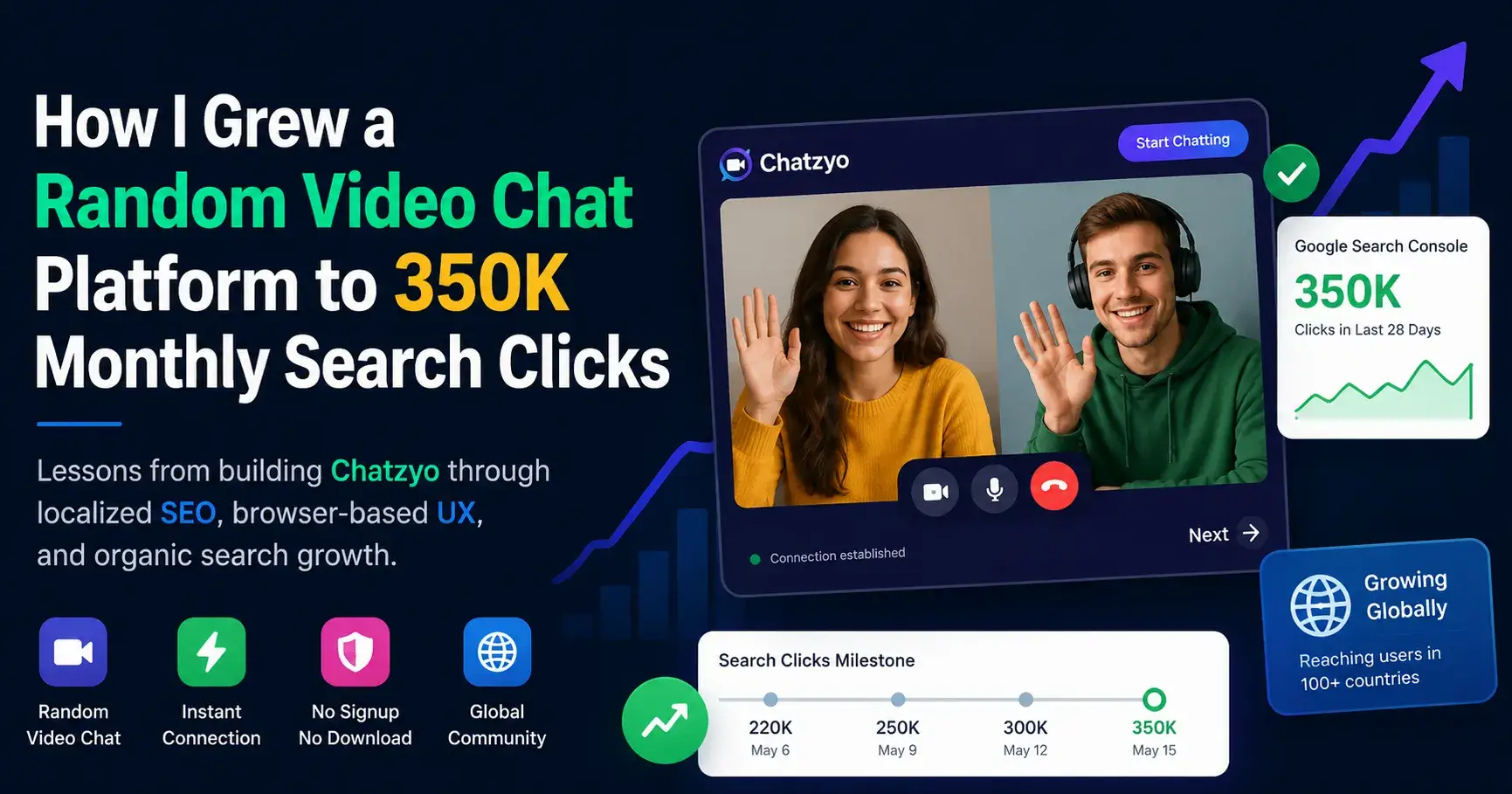
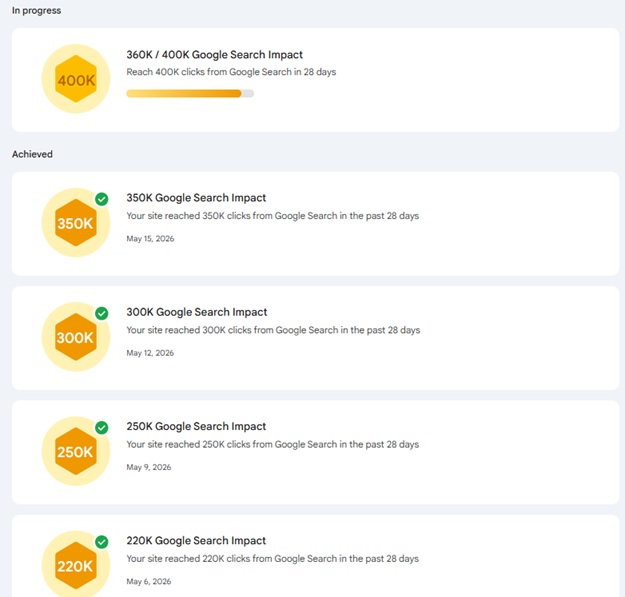
Recently, the platform crossed 350K monthly Google Search clicks according to Google Search Console, and that growth taught me several important lessons about search intent, engagement, and scaling a niche product organically.
In this article, I want to share what worked, what failed, and what I learned while growing a browser-based random video chat platform.
Why I Started Building Chatzyo
After Omegle shut down, millions of users started searching for alternatives. But while testing many existing platforms, I noticed several recurring problems:
Too many signup requirements
Forced app downloads
Slow loading interfaces
Aggressive ads
Poor mobile browser support
Fake profiles and spam-heavy experiences
Most users simply wanted a fast and frictionless way to meet new people online.
That became the core idea behind Chatzyo:
make online conversations instant, lightweight, and accessible directly from the browser.
Instead of building a complicated social platform, I focused on reducing friction as much as possible.
Users could:
open the website
allow camera access
start chatting instantly
No registration.
No installation.
No account setup.
That simplicity became one of the platform’s biggest advantages.
The SEO Strategy That Changed Everything
Initially, traffic growth was very slow.
Like many early-stage projects, I focused too much on broad keywords such as:
random video chat
chat with strangers
online video call
The competition was extremely high, and ranking was difficult.
The turning point came when I started focusing on search intent instead of only search volume.
Instead of chasing massive generic keywords, I began creating localized and intent-focused pages.
For example, one of the successful experiments was building regional pages such as the Brazil random video chat page targeting users searching for country-specific chat experiences.
Those pages had:
lower competition
clearer intent
better engagement
higher click-through rates
Users searching for localized experiences often stayed longer because the content matched exactly what they were looking for.
This completely changed how I approached SEO.
Engagement Matters More Than Most People Think
One of the biggest lessons I learned is that engagement matters far more than many people realize.
A lot of SEO advice focuses only on backlinks, domain authority, or technical optimization. Those things matter, but user behavior matters too.
Google watches:
whether users stay on the page
whether they return
whether they interact
whether they bounce immediately
In random video chat platforms, user experience becomes critical very quickly.
If the connection process is slow or confusing, users leave instantly.
That’s why I spent a lot of time improving:
page speed
mobile browser compatibility
connection flow
cleaner layouts
simplified onboarding
Even small improvements helped increase retention.
In many cases, improving usability created larger SEO gains than building additional backlinks.
Why Browser-Based Access Helped Growth
Another important factor was keeping the platform browser-based.
Many competitors force users to:
install apps
create accounts
verify emails
download software
That creates friction.
Chatzyo focused heavily on instant browser access instead.
The platform works directly through WebRTC technology inside the browser, which helped reduce barriers significantly.
This also improved discoverability because users searching for:
“no download video chat”
“browser video call”
“random chat without registration”
could immediately find relevant landing pages.
Over time, those intent-driven searches became an important traffic source.
Scaling Through Localized Pages
One of the most effective growth strategies was localization.
Instead of treating all users the same, I started building pages around different regions, countries, and languages.
This approach helped capture long-tail search traffic while also improving relevance.
For example:
Brazil-focused pages
USA-focused pages
regional language pages
city-based chat pages
I’m currently continuing this strategy with expansion into the US market through pages such as USA video chat.
Localized pages often perform better because the search intent is much clearer.
Someone searching for:
“Brazil video chat”
usually has stronger intent than someone searching only:
“video chat.”
That difference became very important for growth.
The Technical Challenges
Running a random video chat platform is not as simple as it may appear from the outside.
There are many technical and operational challenges:
WebRTC connection handling
TURN/STUN infrastructure
moderation systems
spam prevention
mobile compatibility
bandwidth optimization
One challenge I encountered early was balancing performance with simplicity.
Adding too many features made the platform heavier and slower.
So instead of trying to build a feature-heavy product immediately, I focused on:
speed
reliability
instant matching
mobile responsiveness
That lightweight approach improved both retention and search performance.
Backlinks Helped — But Contextual Links Worked Better
I experimented with many backlink sources:
startup directories
profile websites
article platforms
community discussions
SaaS listings
Some helped indexing, but the best-performing links were contextual links placed naturally inside relevant discussions or articles.
For example:
founder journey articles
SEO case studies
online communication discussions
WebRTC-related posts
Those links brought:
better referral traffic
higher engagement
stronger crawl signals
real users instead of bot traffic
I also learned that spammy backlink strategies usually create very little long-term value.
A few relevant contextual links performed much better than hundreds of low-quality directory submissions.
What I Would Do Differently
If I started again from zero, I would:
focus on long-tail SEO earlier
improve internal linking sooner
prioritize mobile UX from day one
build more informational content
avoid chasing broad keywords too early
I also underestimated how powerful localized pages could become.
Many niche search terms with lower competition eventually generated far more stable traffic than broader keywords.
Future Plans
The next phase for Chatzyo focuses on:
expanding USA traffic
improving moderation systems
optimizing mobile experiences
reducing connection failures
building stronger retention features
I’m also interested in continuing experiments around:
localized search
user engagement optimization
browser-first communication tools
The internet still has strong demand for lightweight communication platforms that don’t require complicated onboarding.
Final Thoughts
Growing a random video chat platform to 350K monthly Google Search clicks taught me that sustainable growth often comes from understanding user intent better than competitors.
Instead of trying to build the biggest platform immediately, focusing on:
simplicity
fast access
engagement
localization
lightweight UX
created much stronger long-term results.
There’s still a long way to go, but this journey proved that even in highly competitive spaces, smaller independent projects can still grow significantly through organic search and continuous product improvement.
And honestly, that has been one of the most rewarding parts of building Chatzyo.

Join Gowrishankar on Peerlist!
Join amazing folks like Gowrishankar and thousands of other builders on Peerlist.
0
0
0