

What Omegle's Shutdown Taught Me About Building Anonymous Platforms
Three hard lessons I learned building an anonymous video chat platform after Omegle's collapse
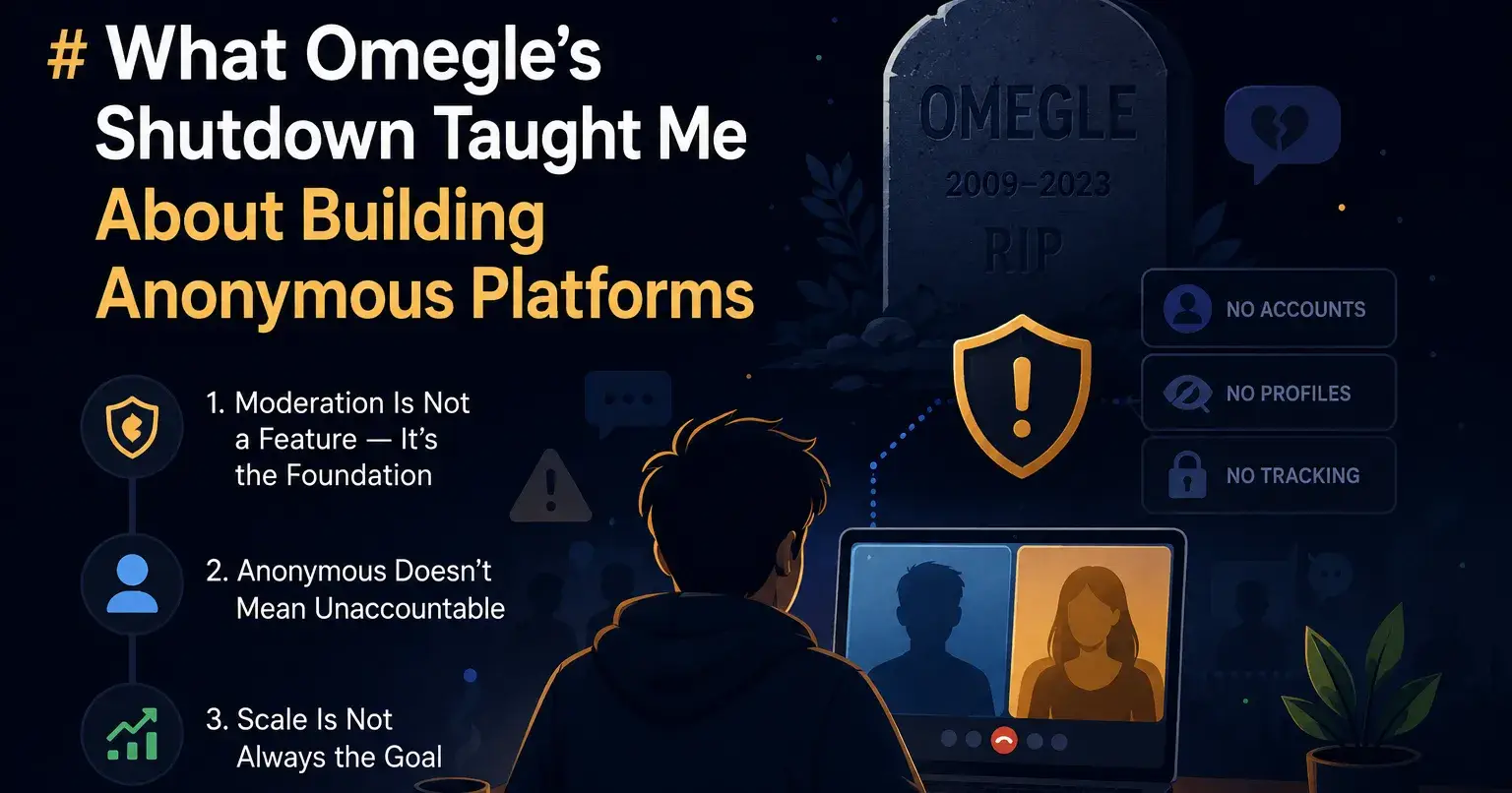
What Omegle's Shutdown Taught Me About Building Anonymous Platforms
I remember the day Omegle shut down.
It was November 8, 2023. I was in the middle of building Chatzyo — a no-registration video chat platform for Indian language communities — and I opened my laptop to find the news. Leif K-Brooks, Omegle's founder, had posted a long farewell letter and pulled the plug on a platform that had been running for 14 years.
My first reaction wasn't relief that a competitor was gone. It was something closer to dread.
Because I was building the same thing.
What Omegle Actually Was
Before we get into lessons, it's worth saying something that often gets lost in the coverage of Omegle's shutdown: the original idea was genuinely good.
Leif K-Brooks launched Omegle in 2009 when he was 18 years old. The premise was simple — connect two random strangers for a conversation, with no accounts, no profiles, no algorithm deciding who you should talk to. Just two people and an empty text box.
At its peak, Omegle had over 50 million monthly visitors. People used it to practice foreign languages, to talk through problems with strangers who had no stake in their lives, to find someone to speak to at 3am when the people they knew were asleep. The platform filled a genuine human need — the need for spontaneous, low-stakes connection with someone completely outside your existing social circle.
That need didn't go away when Omegle shut down. It never does — which is exactly why platforms built as a genuine Omegle alternative have seen real growth since 2023.
Why It Actually Failed
The public narrative around Omegle's closure focused heavily on the lawsuit — a case accusing the platform of connecting an 11-year-old with a predator. That lawsuit was real and serious. But Leif's farewell letter was more honest and more complicated than the headlines suggested.
He wrote about the moderation cost becoming unsustainable for a solo founder. About lawsuits multiplying to the point where the personal financial risk was untenable. About the psychological toll of spending years defending a platform that was genuinely trying to be good while being used by some people to do genuinely terrible things.
Reading that letter while building my own anonymous platform was one of the most clarifying experiences I've had as a founder. Not because it scared me off — but because it forced me to think about problems I was going to face whether I was ready for them or not.
Three things in particular.
Lesson 1: Moderation Is Not a Feature — It's the Foundation
The biggest mistake Omegle made — and I say this with full respect for what Leif built — was treating moderation as something that would be solved incrementally as the platform grew.
It wasn't. It grew faster than the moderation did.
When you build an anonymous platform, you are making a specific promise to users: come here and connect with someone, no identity required. That promise is valuable. It's also an open invitation to bad actors, because they are anonymous too.
The thing I took from Omegle's story is that you cannot solve this with technology alone. AI content moderation, keyword filters, image classifiers — these are necessary but not sufficient. They fail at cultural context. They fail at edge cases. They fail in languages they weren't trained on.
For a platform like Chatzyo, which serves Tamil, Telugu, Hindi, and Malayalam speakers, this is not abstract. A phrase that is aggressive in Tamil might be playful in a different context. A keyword filter trained on English data is basically useless for this.
The decision I made early — and stuck to even when it was expensive in time — was human review with a fast response SLA. Every report goes to a real person. A real person makes the judgment call. This doesn't scale infinitely, but it's the only approach that actually works at the scale I'm at.
Lesson 2: Anonymous Doesn't Mean Unaccountable
One of the hardest tensions in building anonymous platforms is this: the more seriously you take moderation, the more you need to track user behaviour. And the more you track user behaviour, the less anonymous the platform actually is.
Omegle never fully resolved this tension. Neither have I, honestly.
What I've landed on is a layered approach. IP-based rate limiting handles the majority of repeat offenders — most people causing problems aren't sophisticated enough to use VPNs consistently. Browser fingerprinting through WebRTC connection data gives me a loose identifier for serious violations without storing anything that maps to a real identity.
But I'm transparent about the limits of this. Someone determined to evade accountability on an anonymous platform will eventually find a way. The goal isn't perfect enforcement — it's making bad behaviour annoying enough that most people don't bother.
Lesson 3: Scale Is Not Always the Goal
Here's something Omegle's story made me think about that I don't see discussed much.
Omegle's problems were, in a meaningful sense, scale problems. At a few thousand daily users, the moderation burden is manageable. At 50 million monthly visitors, it becomes impossible for a solo founder without institutional infrastructure.
The conventional startup instinct is to grow as fast as possible. More users, more revenue, more leverage. But for a platform where the user experience is fundamentally about who you're connected with, unchecked growth is a liability, not just an asset.
A Tamil video chat room with 500 active daily users who trust the platform and come back regularly is more valuable — and more defensible — than a Tamil video chat room with 50,000 users where moderation has broken down and nobody trusts the experience anymore.
I'm not anti-growth. But I've made a deliberate choice to grow the moderation capacity in parallel with the user base, not as an afterthought to it. That means the platform scales more slowly. It also means it's still running.
What I Think About When I Think About Omegle
I think about Leif K-Brooks sometimes. A guy who built something genuinely interesting at 18, ran it for 14 years, and had to shut it down because the weight of it became more than one person could carry.
There's a version of that story where the lesson is "don't build anonymous platforms." I don't think that's the right lesson. The need that Omegle served didn't disappear when it shut down. Traffic to random chat sites increased 300% in 2024 after Omegle's closure — those users went somewhere, because the need was real.
The lesson, for me, is more specific: build the moderation infrastructure before you need it, not after. Be honest with users about what the platform can and can't guarantee. Don't try to be all things to all people — serve a specific community well enough that they have a reason to self-moderate because they care about the space.
And don't build it alone if you can help it.
Chatzyo is still running. Small, deliberately. Serving Tamil, Telugu, Hindi, and Malayalam speakers across India, Malaysia, UAE, and a handful of other countries. No app, no account, no algorithm — just a browser tab and whoever happens to be on the other end.
I don't know if it'll still be running in 14 years. But I know what I'm watching for.
Gowrishankar Rangasamy is the founder of Chatzyo, a free browser-based random video chat for Indian language communities. Built in Coimbatore, Tamil Nadu.

Join Gowrishankar on Peerlist!
Join amazing folks like Gowrishankar and thousands of other builders on Peerlist.
0
0
0