

The workflow gap behind Task Bar Hero Wiki
A builder-first note on workflow friction, scope discipline, and the small product choices that make a tool feel complete.
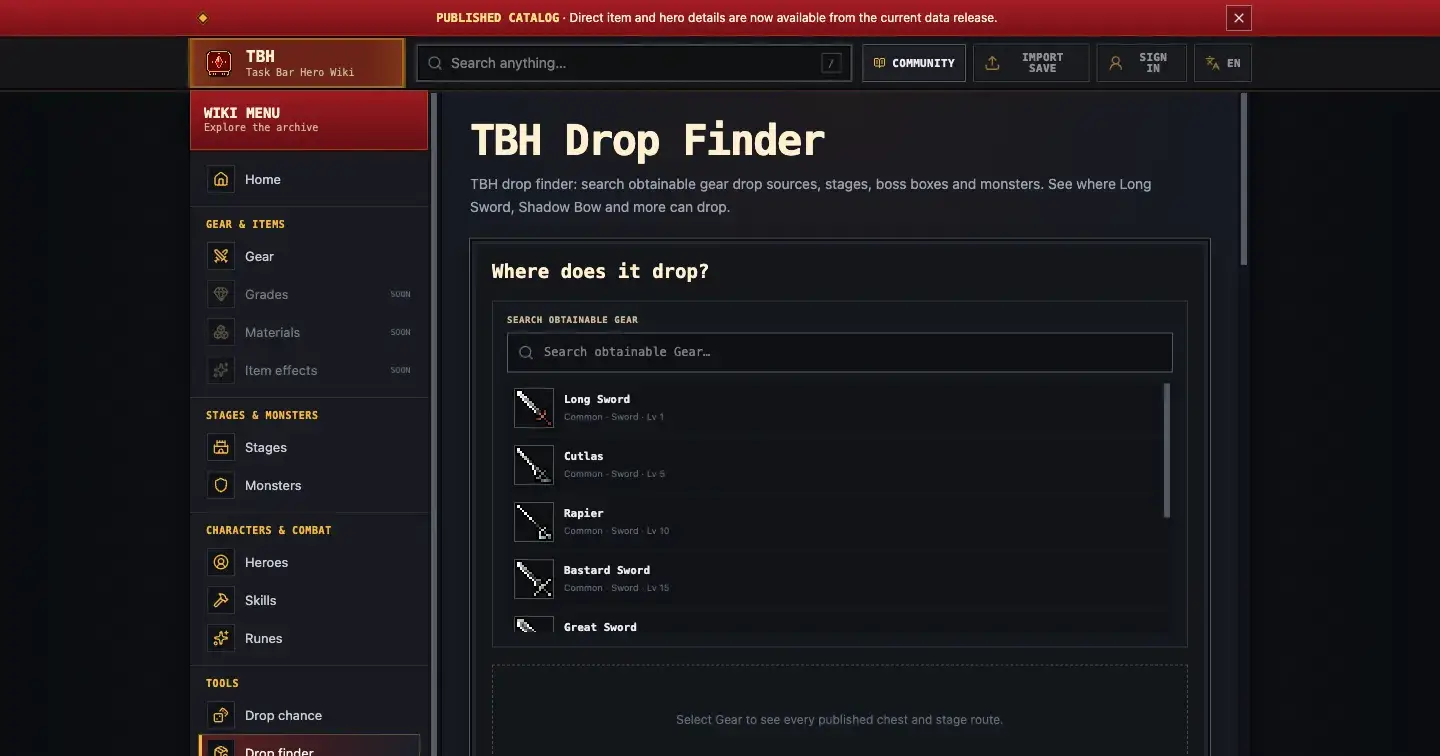
A game item lookup becomes a product-design problem as soon as the player needs to act on the answer. “Where does this Gear drop?” sounds like a single-field search, but a useful result has to preserve the exact variant, its source container, the stage route, the difficulty, and the scenario attached to the published value.
That is the workflow gap I have been exploring with a small Task Bar Hero reference tool. The goal is not to manufacture a universal farming ranking. It is to make the source relationship legible enough that a player or guide writer can check what the catalog actually says before adding personal observations.
The Record Comes Before The Route
The first design choice is to make the exact obtainable Gear record the starting point. Display names are not always sufficient. Rarity, level, variant, and obtainable status can change the meaning of a source relationship, so a lookup should not silently merge records that only look similar.
Once the record is confirmed, the result can follow one direction:
Gear variant → named box or chest → stage → difficulty → scenario
That sequence is more useful than displaying a detached percentage. If a player later questions the result, each relationship can be checked independently instead of forcing them to trust a single compressed claim.
Context Is Part Of The Value
Scenario labels deserve first-class treatment. Base, Hunter, Slayer, and combined values may describe different play contexts, and averaging them into one number would make the interface simpler at the cost of accuracy. The same is true of difficulty and release scope: a route note without those fields can outlive the data that originally supported it.
The interface pattern I am testing is an evidence card with these fields:
exact Gear identity and variant details;
named box or chest source;
stage route and difficulty;
scenario label and displayed catalog value;
release context or date checked;
a separate area for account-specific clear time and repeatability.
The last item is intentionally not part of the catalog claim. A player’s clear time, build, party, loading time, and failure rate can change the practical choice without changing what the published source record says.
Discovery Is Not A Promise
Keeping the source chain visible also makes the limitation easier to state. A published value is not a guaranteed result on the next run. Catalog data may be incomplete, delayed, or incorrect, and the tool does not know whether a particular account can clear a stage consistently. “The active catalog lists this relationship” is a narrower and more defensible statement than “everyone should farm here.”
Empty results need the same honesty. If no source relationship is published for the selected record, the product should show that the catalog has no matching entry rather than infer that the item is unobtainable or attach a remembered route from another variant.
A Small Scope With Room To Grow
This narrow scope is deliberate. The first useful job is source tracing. Probability planning and items-per-hour comparisons can come later, after the correct Gear, box, stage, difficulty, and scenario are verified. Separating those jobs keeps a calculator from giving precise-looking output for an incorrectly selected record.
The Task Bar Hero Drop Finder is the current source layer for this workflow:
https://taskbarherowiki.app/tools/drop-finder
It is an independently maintained community reference, not an official publisher source or a guarantee of drop outcomes. The product question I am still testing is whether preserving this much context makes the lookup easier to trust without making the first answer feel heavy. If you build catalog-plus-observation tools, where do you draw the line between an auditable result and too much friction?

Join Ethan on Peerlist!
Join amazing folks like Ethan and thousands of other builders on Peerlist.
2
0
0