

From Almost Right to Exact Match: Why Startups Eventually Upgrade Their Domains
A closer look at why growing startups eventually outgrow “good enough” domains and come back for the name they always wanted.
There is a quiet moment in many startup stories when the brand finally grows into its name.
Not the logo. Not the slogan. Not the Series B announcement with everyone wearing matching black T-shirts.
I'm talking about the Domain Name.
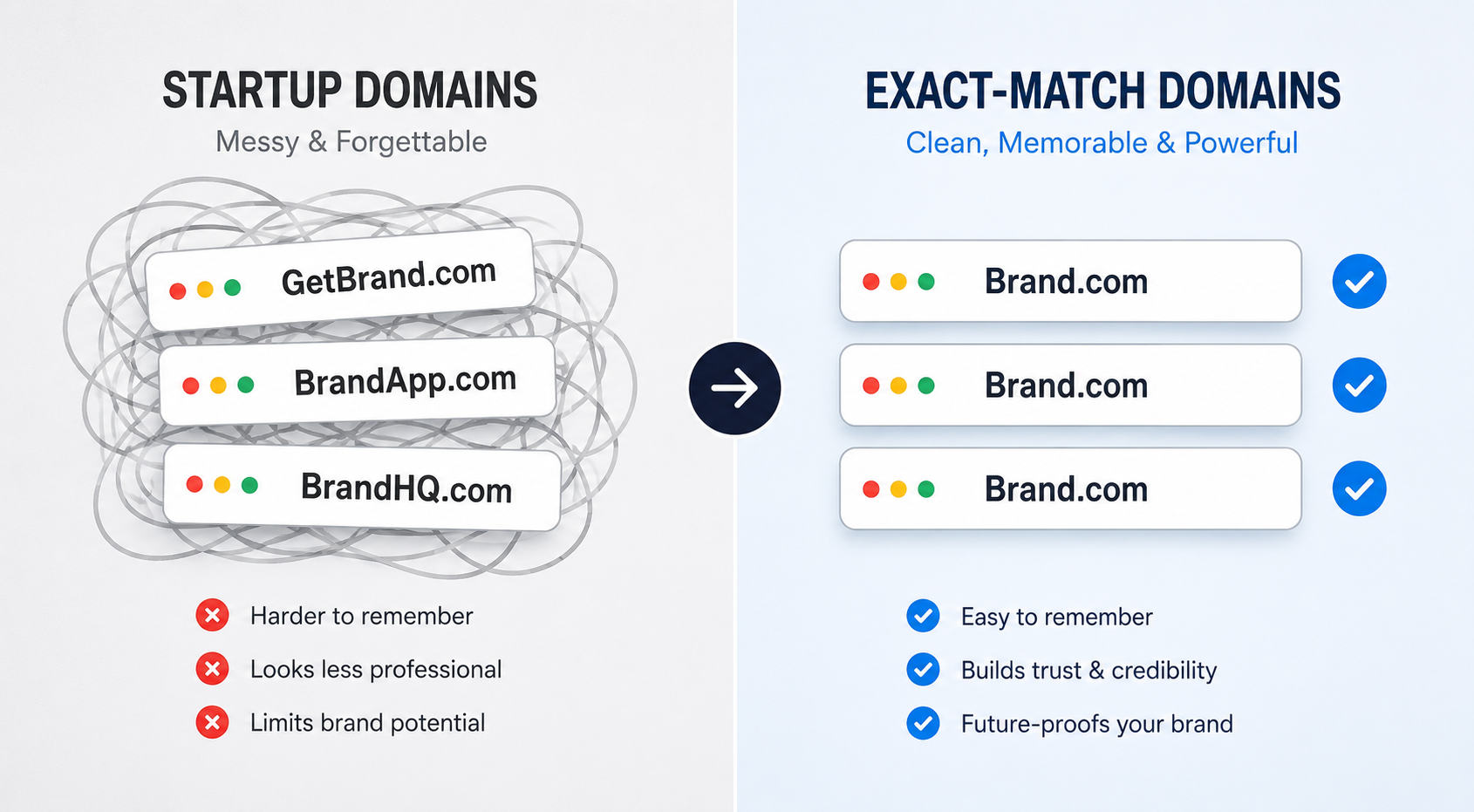
Early on, companies usually launch on whatever domain they can get: a prefix, a suffix, a country-code extension, a “get” in front, an “app” at the end, or the classic startup escape hatch: HQ.
And to be fair, that is perfectly fine. Nobody should delay launching a real business just because the dream .com is parked, expensive, or owned by a guy named Dennis who registered it in 1997 and “might use it someday.”
But once a company becomes known, the workaround starts to show.
A domain name like DiscordApp.com, Zoom.us, or SlackHQ.com can work in the early days. But when the company becomes the name people say out loud, the exact-match domain starts looking less like a luxury and more like the front door.
This is not a comprehensive list of all company domain upgrades. Instead, this is a in-depth look at well-known companies that upgraded to cleaner, stronger, exact-match domains after the brand already had momentum.
The pattern is simple:
Bootstrap in the beginning, build demand, then buy the domain name you probably wanted from day one.
1. DiscordApp.com → Discord.com
Discord launched publicly in 2015 as a voice and chat platform for gamers. In the early days, the company used DiscordApp.com, which made sense. Discord was an app, and the domain told people exactly what they were getting.
But then Discord grew.
It became more than a gamer voice tool. It became a community platform, a social layer, a place for creators, crypto groups, friend circles, developers, fan communities, and millions of people who somehow all joined 42 servers and actively use three of them.
By 2020, the “app” part felt unnecessary. Discord officially moved from DiscordApp.com to Discord.com on May 4, 2020. The company even had to explain why users’ password managers might suddenly stop autofilling, because browsers had saved credentials under the old domain. That is a very modern kind of brand-upgrade problem. (Discord Support)
For domain investors, this is the cleanest kind of upgrade. The company did not need to change its name. It simply removed the extra word.
DiscordApp.com described the product. Discord.com owned the brand.
2. Zoom.us → Zoom.com
Before “Zoom” became a verb, the company operated on Zoom.us.
That domain was not bad. In fact, for a young software company, it was short, clean, and workable. But there is a big difference between a domain that works and a domain that captures natural type-in behavior.
When people hear “Zoom,” most of them do not think “Zoom dot U.S.”
They think Zoom.com.
Zoom acquired Zoom.com in late 2018, with domain industry reporting pointing to a possible $2 million purchase price. (Domain Name Wire) NamePros also discussed the acquisition and connected it to Zoom Video Communications’ purchase from Media Options. (Name Pros)
Then 2020 happened.
Suddenly, Zoom was not just software. It was school, work, birthdays, court hearings, awkward family check-ins, and that one coworker who still could not find the mute button.
The domain upgrade became even more obvious in hindsight. When your brand becomes part of everyday language, the exact-match .com is not just prettier. It catches confusion before it leaks somewhere else.
Domain investor takeaway: sometimes the perfect domain looks expensive only until the company becomes huge enough to make it look cheap.
3. SlackHQ.com → Slack.com
Slack’s origin story is one of the better startup pivots.
The company behind Slack, Tiny Speck, originally built a game called Glitch. The game did not become the massive success they hoped for, but the internal communication tool they created while building it turned out to be the real prize. Slack eventually became one of the most recognizable workplace collaboration platforms in the world. (Wikipedia)
Before owning Slack.com, the company used SlackHQ.com.
That “HQ” suffix was a popular startup workaround. It said, “Yes, we are the brand, but we could not get the main .com yet.” It was not embarrassing. It was practical. But it still required a tiny explanation.
According to domain industry coverage, Slack acquired Slack.com in 2013, with co-founder Cal Henderson buying the name from an individual in California. (NamePros)
That upgrade mattered because Slack was not trying to stay a small team chat tool. It was moving toward enterprise software, public markets, and eventually a Salesforce acquisition valued at more than $27 billion. (Wikipedia)
SlackHQ.com felt like a startup. Slack.com felt like a platform.
4. DJI-Innovations.com → DJI.com
DJI is now one of the most recognizable drone brands in the world. Its products are used by hobbyists, filmmakers, surveyors, emergency teams, farmers, and creators who want sweeping aerial footage of things that probably looked fine from the ground too.
But before the company had the crisp three-letter DJI.com, it used the much longer dji-innovations.com.
That old domain was descriptive, but clunky. It sounded like a trade-show badge. It worked for a young hardware company, but it did not have the simplicity of a global consumer tech brand.
In 2013, DJI bought DJI.com through Sedo for $300,000. Domain Name Wire also covered the sale, noting that DJI Technology Co. was the buyer. (Domain Name Wire)
Looking back, that purchase feels almost painfully smart. A three-letter .com matching a fast-growing hardware brand is exactly the kind of asset that becomes more valuable as the company scales.
There is also a trust factor here. Buying a drone is not like downloading a free app. Customers are spending serious money on hardware that flies through the air with a camera attached. In that world, DJI.com feels cleaner, safer, and more official.
5. Notion.so → Notion.com
Notion is one of the most interesting modern examples because Notion.so was never really a bad domain.
In fact, it became part of the company’s early identity. It felt minimal, modern, slightly technical, and very startup-world. For a productivity tool beloved by creators, startups, students, and people building dashboards for their dashboards, Notion.so worked.
But the .so extension also came with baggage. Some users and companies were less familiar with it, and in certain corporate environments, less common country-code domains can create trust or filtering issues. SmartBranding documented Notion’s exact-brand-match upgrade and quoted a Notion employee explaining that the company chose .so early because other companies used the Notion name and .so was available. The employee also noted that Notion had acquired Notion.com and planned to switch when engineering had the bandwidth. (Smart Branding)
Domain industry observers noticed Notion.com forwarding to Notion.so around 2020, suggesting the company had acquired it by then. (Impreza Host)
For domain investors, Notion is a reminder that alternative extensions can be powerful launchpads. But for a global software company, the exact-match .com still has a gravitational pull.
Notion.so was cool. Notion.com is canonical.
6. GetStripe.com → Stripe.com
Stripe is now one of the most important payments companies in the world, but it did not start with the clean domain it has today.
The company originally used GetStripe.com, another classic startup workaround. It was direct, simple, and action-oriented. If you were a developer who wanted to accept payments online, “get Stripe” was the point.
But Stripe’s ambition was always larger than a simple checkout tool. It became payments infrastructure for internet businesses, powering startups, marketplaces, SaaS companies, platforms, and global commerce.
The upgrade from GetStripe.com to Stripe.com mirrors the company’s broader evolution. “GetStripe” sounds like a product download. Stripe.com sounds like financial infrastructure.
And that is exactly what happened.
Domain investor takeaway: the “get” prefix is often a clue. If the company becomes important enough, the exact-match version may eventually become a strategic need.
7. TeslaMotors.com → Tesla.com
Tesla is one of the more famous examples, but it belongs here because it perfectly shows how a company can outgrow a descriptive domain without changing the core brand.
For years, Tesla operated on TeslaMotors.com, and at the time, it was perfectly logical. The company was selling electric cars, fighting to make EVs feel desirable, and trying to convince the world that a startup could compete with century-old automakers.
But Tesla was never going to stay just “motors.”
As the company expanded into batteries, solar, energy storage, charging infrastructure, robotics, AI, and whatever category Elon Musk decides to casually disturb next, the word “Motors” started to feel too small. It described the original business, not the full ambition.
That is what makes the move to Tesla.com so powerful. It was not just a shorter domain. It was a broader container for the company’s future.
A narrow domain can be useful early because it explains what you do. But once a company becomes bigger than its first product, that same clarity can turn into a cage.
TeslaMotors.com said electric cars. Tesla.com said Tesla.
For domain investors, this is one of the cleanest examples of why exact-match domains matter. The best names do not just describe where a company is today. They leave room for where the company might go next.
TeslaMotors.com was a car company. Tesla.com could be anything Elon wanted it to be, which is both powerful and slightly terrifying.
8. BookCameo.com → Cameo.com
Cameo is one of those business ideas that sounds strange until you see it work: pay a celebrity, athlete, creator, or internet personality to record a personalized video message.
The company launched with the domain BookCameo.com, which was actually a smart early-stage choice. It told users exactly what to do. You do not just visit Cameo. You book one.
That kind of action-based domain can be helpful when a marketplace is new and people do not yet understand the behavior.
But once Cameo became the brand, “BookCameo” started to feel like the instruction manual taped to the front door.
The company later upgraded to Cameo.com, giving it a broader and more authoritative brand home. Cameo’s business is widely described as a marketplace for personalized video messages from celebrities and creators. (Contrary Research)
This is a great example of a domain upgrade that follows brand maturity. Early on, the verb helped. Later, the exact-match domain gave the company room to feel like a media platform, not just a booking page.
BookCameo.com explained the transaction. Cameo.com elevated the brand.
9. SquareUp.com → Square.com
Square is a fascinating case because SquareUp.com was not just a compromise domain. It also had personality.
“Square up” is a phrase. It felt active. It fit the company’s early payment-reader product: small merchants could square up with customers anywhere.
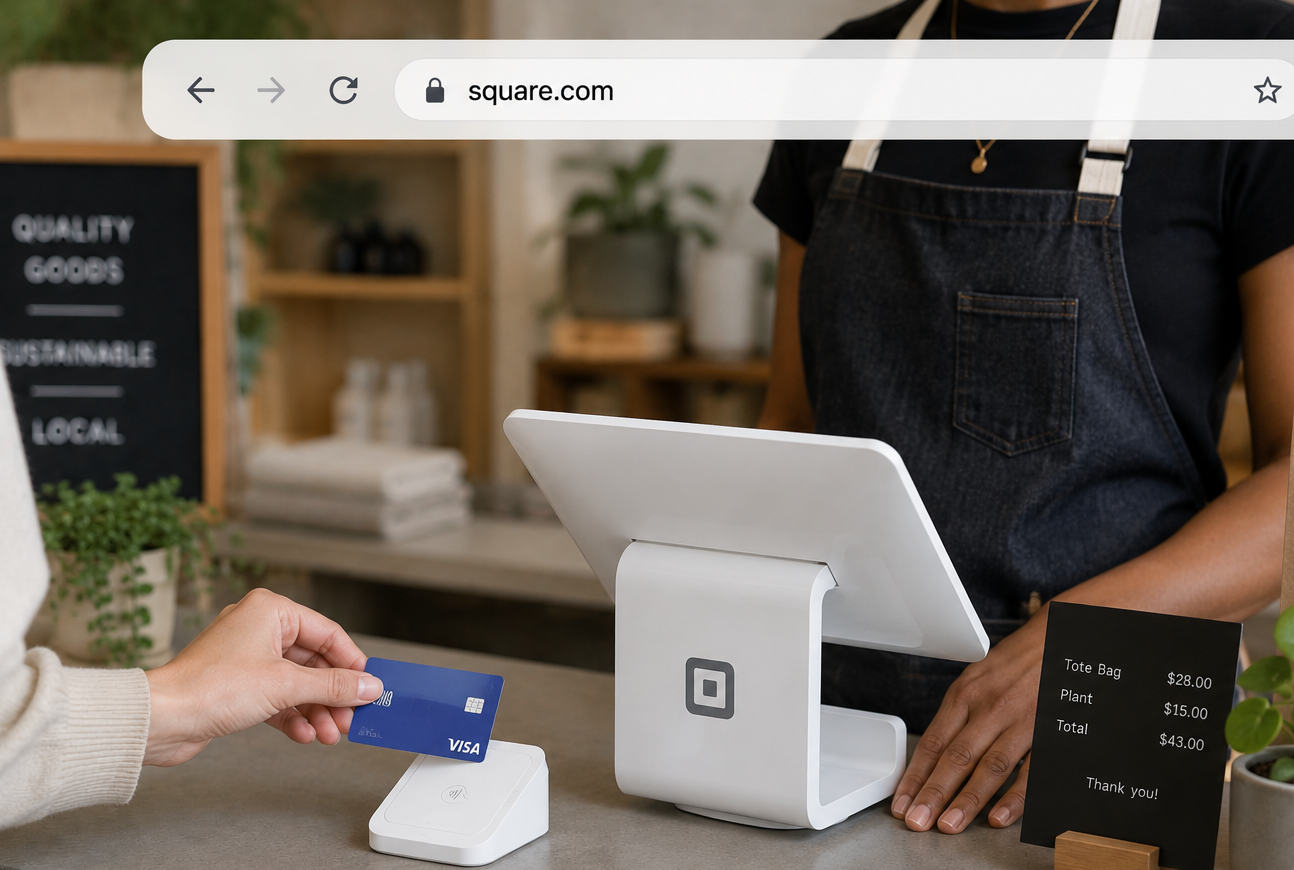
But Square grew far beyond the original card reader. It expanded into point-of-sale systems, payroll, banking tools, commerce, Cash App, and a broader financial ecosystem. The company eventually became Block, but Square remains a major product brand.
The uploaded research notes include Square among companies associated with an upgrade from SquareUp.com to Square.com.
This is the classic expansion problem. A domain that perfectly describes the first product can become limiting when the business grows into a platform.
SquareUp.com had charm. Square.com had range.
10. RazerZone.com → Razer.com
Razer is one of the most recognizable gaming hardware brands in the world. For years, the company used RazerZone.com, which actually fit the gaming culture of its era. It sounded like a place. A zone. A lair for people who cared deeply about mouse DPI.
But as Razer became a global brand across peripherals, laptops, chairs, software, and lifestyle products, Razer.com was cleaner and stronger.
This is a good reminder that trendy domain add-ons age. “Zone” may have sounded cool in one internet era, but exact-match names age better because they do less. They do not chase style. They just point to the brand.
Why Companies Make the Switch
When you look across these examples, the domain upgrades are not random. They usually happen for one or more of the same reasons.
The company outgrows the descriptor
Discord dropped “app.” DJI dropped “innovations.” Tesla dropped “motors.” These extra words helped early, but eventually became limiting.
The brand becomes the product
People say “Zoom,” “Slack,” “Loom,” and “Postman.” When the market naturally uses the short brand name, the exact-match domain becomes the obvious destination.
Trust starts to matter more
This is especially true in fintech, enterprise SaaS, hardware, and productivity. A premium .com domain can quietly reduce doubt before a user even thinks about it.
The company wants fewer leaks
Every extra word, unusual extension, or non-exact domain creates room for lost traffic. Some users will type the .com automatically. Some will forget the prefix. Some will email the wrong domain. The bigger the company gets, the more expensive those leaks become.
The domain becomes a moat
A great exact-match .com does not just help customers find you. It prevents anyone else from owning the cleanest version of your brand.
That is why premium domains are not just marketing assets. For the right company, they are defensive infrastructure.
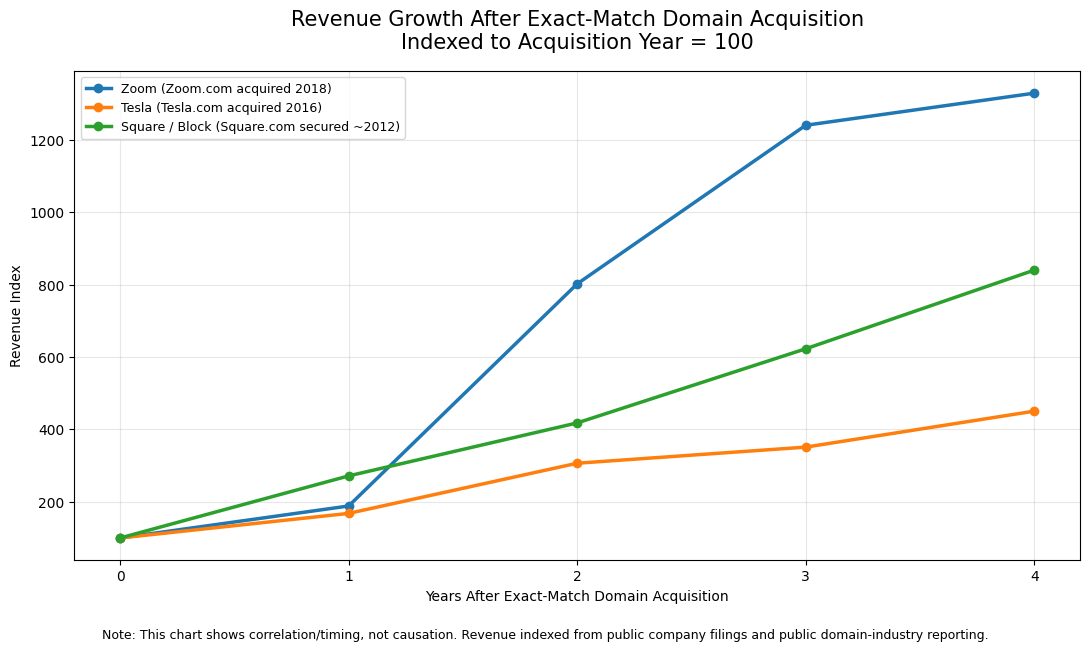
This chart does not prove that exact-match domains caused revenue growth. That would be a stretch. What it does show is timing: companies often acquire their cleaner domain as they are entering a more serious growth phase.
The Real Lesson for Founders
The lesson is not “buy the perfect domain before launching.”
That advice sounds nice until you are staring at a six-figure asking price. Nobody wants to spend six or seven+ figures on a domain while your product still breaks on the checkout page.
The better lesson is this:
Launch on the best domain you can get, but know what your upgrade path is.
A bridge domain is fine. A “get” domain is fine. A .io, .co, .so, or “HQ” domain can absolutely work. Some of the best companies in the world started that way. However, the “get” prefix is startup duct tape. Useful, common, and not something you want on the front door forever.
But if the brand works, the exact-match domain may eventually become one of the cleanest investments the company can make.
The Real Lesson for Domain Investors
For domain investors, these stories are a reminder of why exact-match domains still matter. Not because every parked one-word .com has a buyer waiting in the shadows. Most do not. And not because a great domain magically turns a weak business into a winner. It does not.
But when the right company grows into the right name, the domain changes categories.
It stops being a speculative asset.
It becomes strategic infrastructure.
The strongest domain upgrades usually have a few things in common:
The company already has traction.
The brand is short, memorable, and easy to say out loud.
The current domain has a prefix, suffix, extra word, or weaker extension.
The company operates in a trust-heavy or high-value market.
Customers naturally assume the exact-match .com is the official home.
That is the moment a domain becomes more than a URL.
It becomes the cleaner version of the company’s identity.
And that is why these upgrades are so fascinating. A founder may launch on the domain they can get. But if the brand works, if the company grows, and if the name becomes valuable enough, they often come back for the domain they wanted all along.
Sometimes the only thing standing between an “almost right” startup domain and a category-defining brand is time, revenue, timing, and one very patient domain owner.
Honorable Mentions
A few more domain upgrades are worth mentioning, even if they do not need full case studies.
GetPostman.com → Postman.com
A classic “get” domain that made sense when Postman was a developer tool people needed to download. As the company became a full API platform, Postman.com gave the brand more authority. “Get our product” became “we are the product.”
Box.net → Box.com
Box is a great reminder that the old domain does not have to be bad. Box.net was short and memorable. But for an enterprise software company, Box.com was cleaner, stronger, and more definitive.
Intercom.io → Intercom.com
Intercom.io worked well in the startup and SaaS world. But as Intercom grew into a serious customer support and AI service platform, Intercom.com felt more permanent, global, and trusted.
UseLoom.com → Loom.com
“UseLoom” was a helpful early call to action. But once people started saying, “I’ll send you a Loom,” the extra word became unnecessary. Loom.com is what happens when the product name becomes a noun.
Mercury.co → Mercury.com
Mercury.co was already a respectable startup domain. But fintech is a trust-heavy category. When money is involved, perception matters. Mercury.com feels institutional in a way Mercury.co never quite could.
The common thread is not that the old domains were terrible. Most were perfectly usable. The company simply became too important for anything less than the exact match.
Further reading for founders and domain investors:
If you are interested in domain investing, expired auctions, or startup naming strategy, here are a few useful resources to keep exploring:
Domain Investor Resource List
A practical resource page for investors who research expired domains, compare sales, monitor auctions, list inventory, study trends, and close secure deals.Best expired domain sites and tools
A practical guide to the best tools, auction platforms, and research sites for finding valuable expired domains before other investors do.The hidden goldmine in expired domain auctions
How to Spot Undervalued Expired DomainsExpired Domain Auction Newsletter
Get the highest-rated expired domain auctions delivered every morning. Free, curated, and ranked for domain investors who want better names without digging through endless auction lists.

Join M on Peerlist!
Join amazing folks like M and thousands of other builders on Peerlist.