

I Built an AI-Powered Portfolio. Here's What Nobody Tells You About It.
A honest account of building something that genuinely surprised me — and the lessons that came with it.
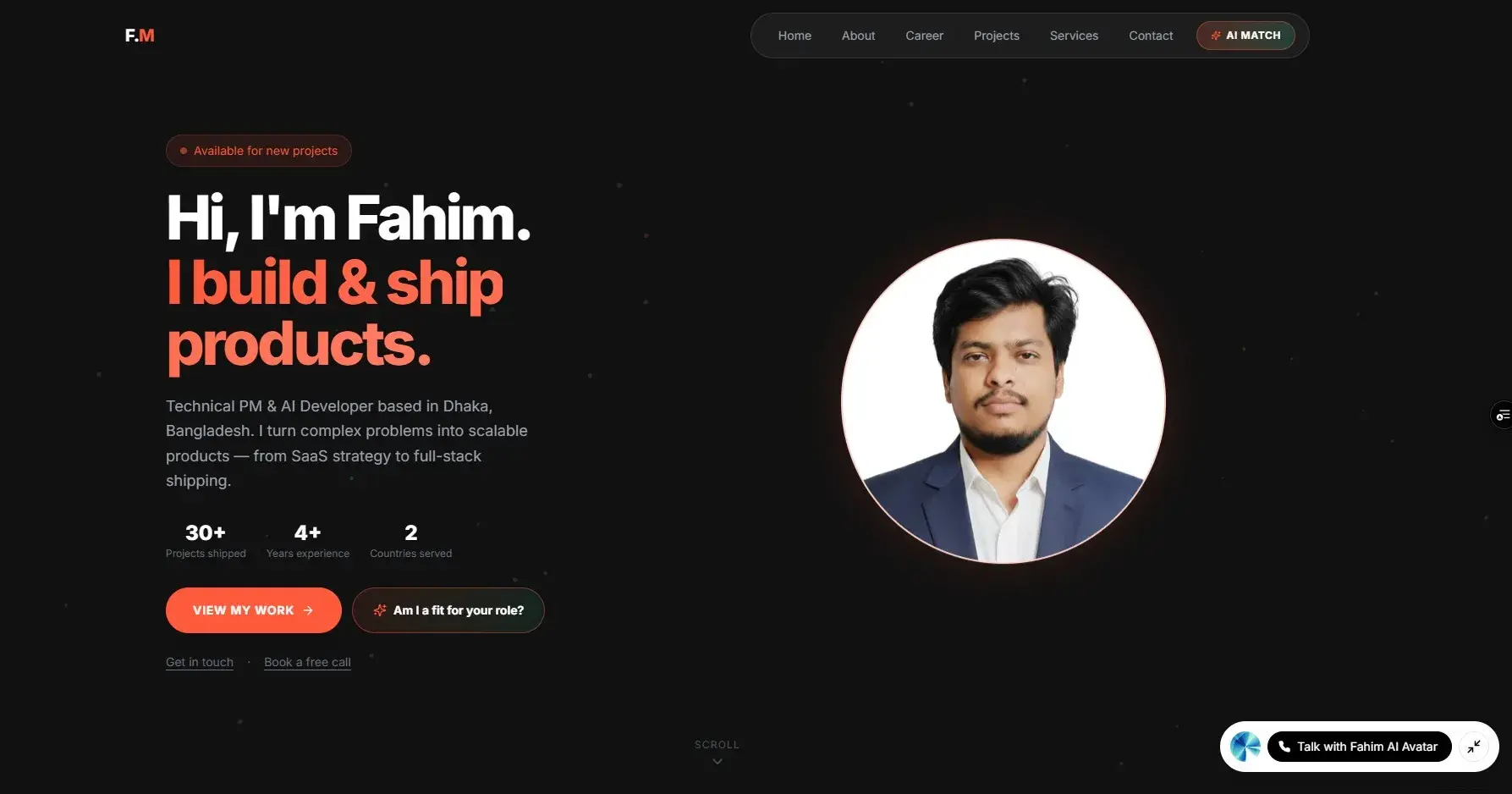
A few months ago I sat down to rebuild my portfolio.
I had the usual intentions. Clean design. Good case studies. Fast load times. The things everyone says you should have.
But somewhere along the way, I started asking a different question.
What if a recruiter didn't have to guess whether I was a fit for their role? What if the portfolio could just... tell them?
That question led me somewhere I didn't expect.
The Problem With Portfolios
Most portfolios are static documents dressed up as websites. You scroll through projects, read some bullet points, maybe watch a demo video. Then you close the tab and go back to the job description wondering if this person can actually do the thing you need.
The gap between "looks impressive" and "is actually right for this role" is where most candidates lose.
I've been on both sides of this. As someone who's hired 20+ engineers for international clients, I know how hard it is to evaluate fit quickly. And as someone applying for roles, I know how frustrating it is to not be able to demonstrate that fit clearly.
So I built something to bridge that gap.
Feature One: The AI Profile Matcher
The idea was simple. Give recruiters a text box. Let them paste a job description. Then have AI analyze my entire profile — career history, projects, skills, certifications — against those requirements and return a scored, structured assessment.
Simple in theory. Less simple in practice.
The core of it is a Gemini AI call with a carefully constructed system prompt that contains my complete professional context. Every role I've held. Every project I've shipped. Every skill I've developed. When a recruiter pastes a JD, the model compares it against all of that and returns:
A match score from 0-100
A written analysis of the fit
Key strengths relative to the role
Potential gaps or missing qualifications
What I learned building it:
The system prompt is everything. My first version returned generic, almost useless assessments. Not because the model was bad — because I hadn't given it enough context to work with. Once I included structured data about my career timeline, project outcomes with measurable impact, and specific technical stack details, the quality jumped dramatically.
The other thing I learned: the score creates honesty. When a recruiter sees a 71% match with a "Good Match" label and a clear list of gaps, it's more useful than a 100% marketing-speak response. I deliberately tuned it to be honest rather than flattering. That trust signal matters more than the number.
Feature Two: The AI Voice Assistant
After the matcher, I wanted to go further.
I integrated an ElevenLabs conversational AI agent directly into the portfolio. You can literally have a voice conversation with my portfolio. Ask it about my experience at Shwapno. Ask it to explain what I did at CTFN. Ask it whether I've worked with FastAPI before. Most importantly, you can directly book my calendar just with it without any manual intervention.
It answers in real-time, in natural language, with accurate context drawn from my career history.
What I learned building it:
Voice AI changes the emotional register of an interaction in a way that text doesn't. When someone hears a voice explaining a project, it feels less like reading a CV and more like talking to the person. That's a powerful thing.
The practical challenge was grounding the agent — making sure it only answers questions about me and my work, doesn't hallucinate roles I haven't held, and routes confidently to "I don't have information on that" when needed. Getting the agent instructions right took more iteration than the technical integration.
Feature Three: The Email Intelligence System
This one was less flashy but arguably more useful for me personally.
Every time someone runs the AI Profile Matcher, I get an email notification. Not just "someone used the feature" — but the full job description they pasted, the match score, the strengths identified, and the gaps called out.
This means when a recruiter from a fintech company in Singapore runs the matcher against their Senior PM role, I see exactly what they're hiring for before I've said a single word to them.
What I learned building it:
This is lead intelligence, not just analytics. The difference between knowing "someone visited my portfolio" and "someone at a healthcare startup is hiring for a Technical PM with Agile experience and I scored 84%" is enormous. The second gives me something to act on.
The Technical Stack
For those interested: the portfolio is built on Next.js 15 with full SSR, which solved a separate problem — Google indexing. The previous Vite SPA version was barely indexed because Googlebot couldn't read client-rendered content. After the migration, indexed pages jumped from 2 to 15 within 3 months.
The AI features sit on top of:
Gemini AI for the profile matcher (structured JSON output with schema validation)
ElevenLabs Conversational AI for the voice assistant
Brevo for transactional email notifications
Next.js API routes as the serverless backend
The entire thing is deployed on Vercel and costs essentially nothing to run at portfolio traffic levels.
What I Actually Learned
Three months in, here's what I know that I didn't before:
1. AI features only work when the underlying data is good. The matcher is only as smart as the context I give it. Vague job descriptions get vague analysis. Rich career data gets rich analysis. The quality of the output is a direct reflection of the quality of the input.
2. Novelty has a short shelf life. Utility doesn't. People are impressed by an AI portfolio for about thirty seconds. What keeps them engaged is whether it actually helps them make a decision. Every AI feature I built had to earn its place by being genuinely useful, not just technically interesting.
3. Building your own tools teaches you things products can't. I've used Workday, Greenhouse, LinkedIn Recruiter. But building a simplified version of the "candidate fit" problem from scratch gave me an intuition for how these systems think that I couldn't have gotten any other way. The best way to understand a tool is to build a bad version of it yourself.
4. The notification system changed my job search behavior. Before, I would check my analytics dashboard and see "47 visitors this week" and feel good or bad about a number with no context. Now I see "a Series B startup in Dubai is hiring a Technical PM with supply chain experience and you're a 78% match." That's actionable. The analytics that matter are the ones that tell you what to do next.
Should You Build Something Like This?
If you're a developer or PM job hunting right now — yes, with a caveat.
The AI features took meaningful time to get right. If you build them quickly just to put "AI-powered" on your portfolio, they'll be a liability rather than an asset. Recruiters will test them and a bad experience is worse than no feature at all.
But if you're willing to iterate — to tune the prompts, to handle edge cases, to make the feature genuinely useful rather than just impressive — it's worth it.
Not because it guarantees you get the job. But because the process of building it teaches you things about product thinking, AI integration, and user experience that you can't learn any other way.
And that's probably the most honest thing I can say about the whole project.
You can try the AI Profile Matcher at fahimsium.com — paste any job description and see what it returns. I'm genuinely curious what score you get.

Join Fahim on Peerlist!
Join amazing folks like Fahim and thousands of other builders on Peerlist.
0
4
0