

A Designer’s Eye is Still the Sharpest Algorithm: Beyond the Pixel, Into the Pulse
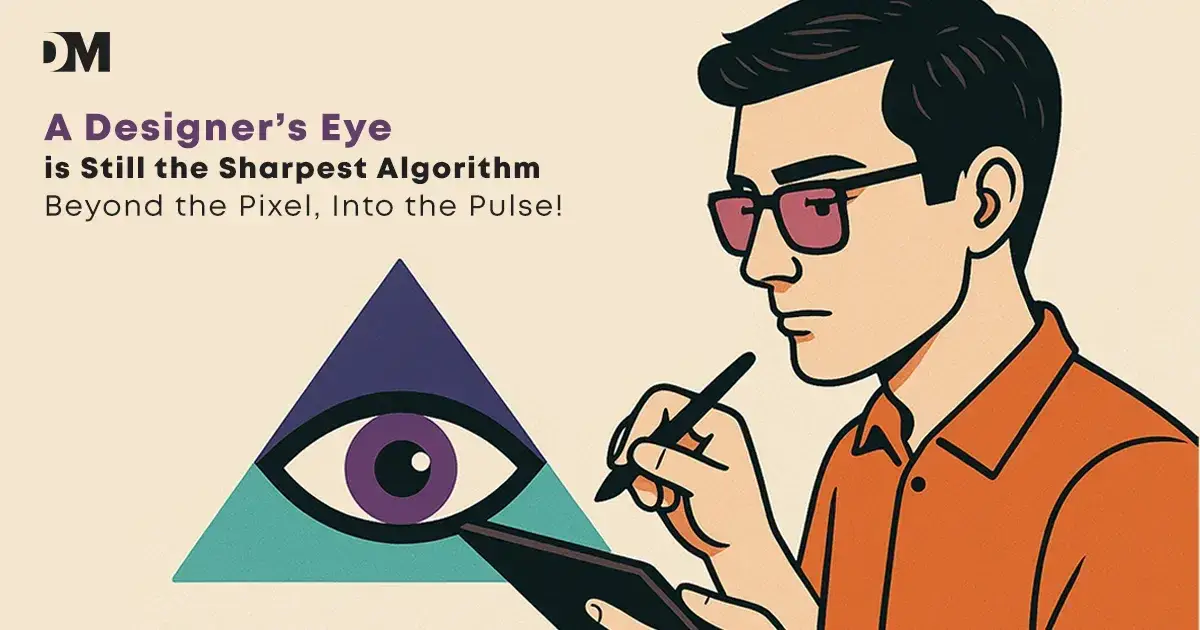
I’ve spent countless hours, years really, wrestling with white space, arguing with clients about the perfect shade of ‘not quite red, but definitely not orange,’ and occasionally, just staring blankly at a screen until a solution finally, mercifully, unfurls itself. And more recently, every water cooler discussion, every industry webcast, every client presentation, appears to revolve around the same shining orb: AI. “Efficiency!” they bellow. “Scalability!” they yell. “Endless iterations!” they murmur, as if it’s some kind of holy grail.
And sure, I like a good tool as well as the next guy (My Wacom stylus is essentially an extension of my own hand), but this notion that an algorithm can really create is… well, it’s like going to say that a very sophisticated spatula can prepare a Michelin-starred meal. It can flip, it can spread, it can even scrape the bottom of the pan with breathtaking accuracy, but it lacks a palate, a memory of a grandmother’s secret ingredient, an appreciation of the subtle dance of flavor.
The Echo of Human Intent: Beyond Replication, Into Resonance
AI, magnificent as it stands, is a master imitator. It consumes great oceans of human-generated design, recognizes patterns at dizzying speeds, and then projects. It informs you what’s statistically likely to be popular, what has worked in the past. It’s an incredible rearview mirror, indicating where we’ve been.
But design, genuine design, is to drive where we must go. It’s about that strange sting in your head when you know something’s not quite right, even when you can’t quite put your finger on why. It’s the emotional jump that bridges seemingly unrelated concepts: a passing conversation, a street art mural out of the corner of your eye, light catching a particular texture and breaks it down into a visual language for a brand. A machine can’t sense the heaviness of a client’s hopes, the unsaid fears, or the silent pride they expect their new brand to evoke. It cannot possibly sense the near-physical unease in a room when a design idea fails, or the heavy release when it finally registers with everyone.
Consider the implicit tempo of a layout, the near-musical beat of type on a page. An AI could optimize legibility and visual hierarchy from eye-tracking data, but can it imbue a block of text with a sense of restrained authority, or mischievous rebellion, solely through its space and the implicit weighting of its characters? We don’t merely lay out items; we dance them onto the page to draw a particular dance of attention and feeling. It’s the near-imperceptible ‘hum’ of a balanced piece, the one that causes you to pause an extra fraction of a second without realizing why. That’s the ghost in the machine, and it’s very much human.
The “Undesignable” Nuance: Cultural Code and the Whisper of Subtlety
This is where the algorithms falter. A machine can learn from cultural data sets, but can it actually understand the currents of a given culture — the unwritten rules, the in-group jokes, the historical weight riding behind some shade of green or certain typographic gesture? It can’t sense the communal memory of a people, how colors get people nostalgic, or how an icon of a certain kind can unintentionally offend in a situation it wasn’t intended for. We’re not just designing for the eye; we’re designing for hearts and minds that’ve been immersed in a lifetime of collective experiences.
I’ve worked on projects where the “right” or “data-driven” answer rang completely hollow. It was weeks, sometimes months, of drawing, scrapping, and that slightly manic sensation of conferring with me, until something began to come together that felt right. It wasn’t a more efficient algorithm; it was the slow, messy, frustrating process of intuition bubbling up. It’s the distinction between a flawlessly drawn portrait and one whose eyes appear to track you, with an intensity of soul beyond mere color and paper. That “soul” in layout is the designer’s special gift — the intuitive sense of fit.
The Imperfect Human Touch: Strategic Messiness and the Pleasure of the “Aha!” Moment
Algorithms demand perfection, sameness, and conformity to trained norms. But human imagination tends to flourish in the intentional breakdown of those patterns. We understand how to introduce a touch of deliberate chaos, when an asymmetrical composition is more dynamic than a strictly balanced one, when a hand-drawn aspect infuses a sense of humanity missing from a vector graphic. It is not inefficiency; it’s messy strategy. It’s the intention to risk something that transforms a competent design into an engrossing one. It’s the recognition that sometimes, the things that are most memorable contain a small, endearing flaw, such as the perfectly imperfect fold of a beloved book.
And then there is the discovery process. An AI can be given a short and generate possibilities. But can it sit down across from a client, hear their hesitant description of “we want it to feel. more aspirational, but also accessible,” and then, through a series of instinctive mental leaps, take that amorphous feeling and turn it into a tangible visual plan? Can it experience the rush of exhilaration when you finally solve what seemed like an insurmountable puzzle, that instant when the puzzle pieces in your mind fall suddenly into a unified, lovely picture? That “aha!” is not a calculation; it’s a richly human neurological payoff for solving things that are tricky.
So, while the silicon minds are grinding the figures and copying, I’ll be over here grappling with the non-visible. I’ll be watching the way humans respond to the world, looking for sparks in the everyday, and translating all that messy, beautiful human stuff into things that don’t just look pretty, but feel true. Because in a world awash with algorithmic noise, the trained eye, the compassionate heart, and the intuitive leap of the human designer will always be the most powerful, most valuable algorithm of all. It’s not what we observe; it’s what we feel, and what we get others to feel. And that, my friends, is a frontier no machine can ever really cross.
The Indispensable Algorithm of Humanity
Finally, the discussion is not human designers versus AI as an either/or situation. AI can be a great assistant, a means to send off the repetitive, the mundane, the pattern-matching. It can even lead to new lines of discovery, like a super-charged brainstorming companion. But to confuse its output for authentic design for the kind of work that really resonates, influences, and lasts is to fundamentally misunderstand what design is.
Design, at its heart, is a deeply human endeavor. It’s about problem-solving with empathy, communicating with nuance, and creating meaning in a visually saturated world. It requires the ability to understand unspoken needs, to predict emotional responses, and to weave cultural threads into compelling narratives. These are capabilities rooted in consciousness, intuition, and lived experience qualities that are inherently, uniquely, and wonderfully human. Thus, as the virtual world cranks out its infinite repetitions, the real magic, the unreplaceable flash, will ever live in the acuity of a designer’s trained gaze, a gaze that perceives not merely pixels, but possibilities, intent, and the beating heart of human beings.

Join Farhan on Peerlist!
Join amazing folks like Farhan and thousands of other builders on Peerlist.
0
0
0