

AI is the New Intern — And That’s Okay
By a person who still has faith in intuition and midnight flashbulb moments Let me be honest for a second.
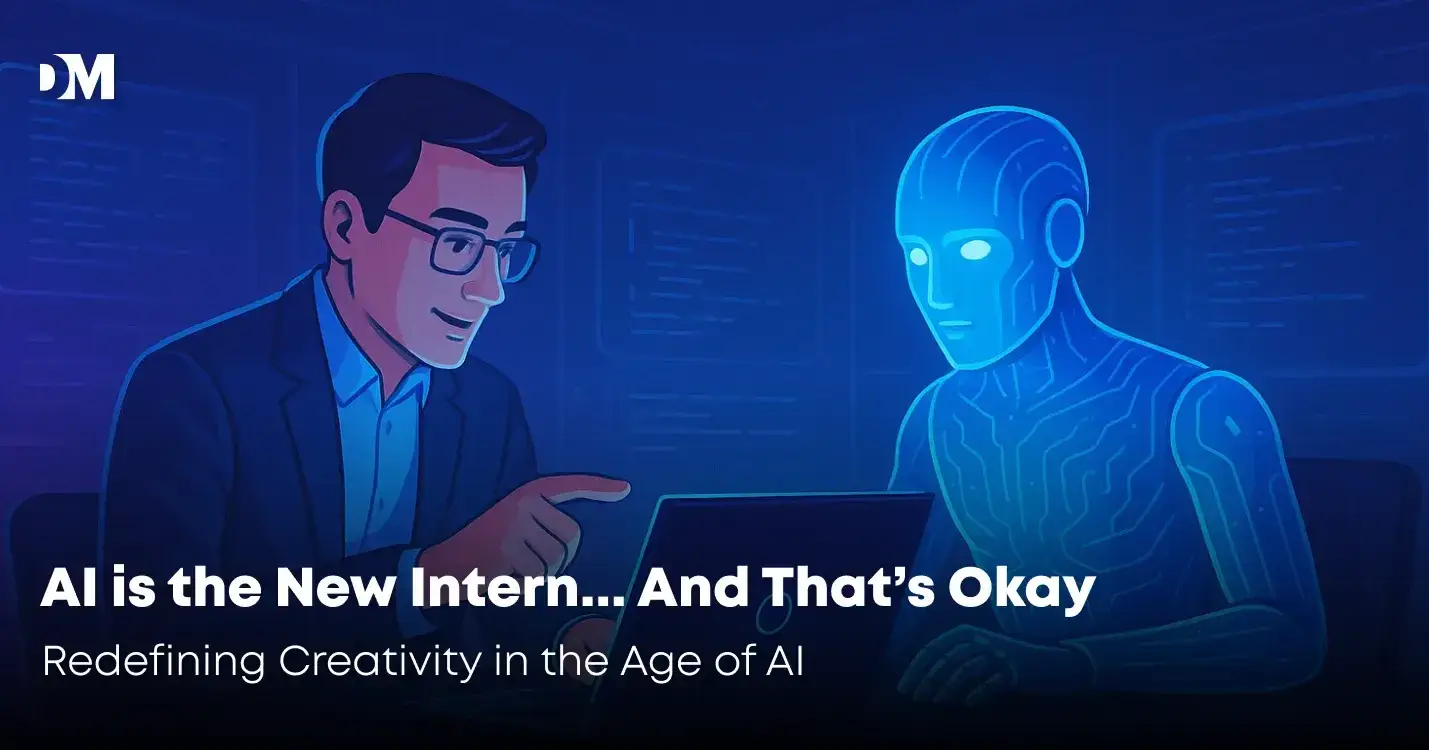
A couple of weeks back, we found that “creative haze” — you know, the one that turns your Figma document into a puzzle rather than a playground. We were stuck designing a brand identity. we couldn’t get the fonts right. Color schemes were too generic. Our brain was exhausted, but we didn’t want to quit. In frustration more than hope, we begged an AI tool for some “inspiration.”
And boom — it spat something out quickly. Clean. Nice polish. Impressive at first blush.
But the more we looked at it, the more we knew. It didn’t feel right.
It was as if observing a new intern come into the studio, ready to assist, with tutorials and impeccable Behance examples — but still clueless as to why a particular kerning decision doesn’t quite feel right or why a bold red quite work for a high-end skincare company.
That’s when it clicked:
AI is the new intern. And that’s fine.
Quick, but Not Brash
Let’s not trivialize it — AI is wildly useful. we adore it for mood boards, fast mockups, tedious resizing jobs, and even placeholder copy when our brain’s gone empty. It’s having a super sub who never tires, never grouse, and can grab references quicker than Pinterest on steroids.
But… would we ever trust it with a major client rebranding project all on its own?
Not in our life.
Because speed isn’t equivalent to finesse.
AI can obtain a logo for me. But it takes a human to know when that logo is the soul of the brand. AI can propose gradients, but it does not recognize that the founder once wept to share her brand’s purpose with us — and how that dusty rose color brought back her mother’s scarf.
No matter how sophisticated the tools become, they still miss… the messiness — the hunches. The inexplicable gut instincts that arise from years of “this just doesn’t look right” and the know-how to know when to break the grid.
Like Any Good Intern, AI Needs a Mentor
If you’ve ever guided an intern, you know the score. They’re zealous. They pick up speed quickly. But they require feedback. Context. A push in one direction, a tug in another.
AI is no exception. It needs guidance. It does better under constraints. It can spit out infinite variations but it still needs us to step in and say, “Version 3B? That one. But redistribute the weight. Add stress. Cut out the noise.
That’s where our experience comes in — not to combat AI, but to mold it.
And isn’t that what we’ve always done? We used to cut paper. Then we used Photoshop. Now we have ChatGPT and Midjourney. The tools change, but our role remains the same:
To be the eye, the voice, the heart.
The Fear is Real — But So Is the Freedom
Look, we understand. The terror of being replaced by AI is screaming, particularly when clients begin to ask, “Can’t you just AI this?” But here’s the secret:
Don’t race the machine. Refine what it makes.
Use it to find your flow. Use it when the clock’s against you. But always return with your human touch — the crooked scribbles on your notebook, the metaphor that suddenly occurred to you in the shower, the design choice that shouldn’t work but somehow does.
That’s what clients remember. That’s what AI hasn’t cracked.
Final Thought: Welcome the New Intern, But Don’t Give Away the Keys
We are not here to trash AI. We are just saying treat it like you’re dealing with a new overachieving employee. Use it smartly. Train it. Learn from it even.
But don’t lose sight of the fact that you’re still the Creative Director around here.

Join Farhan on Peerlist!
Join amazing folks like Farhan and thousands of other builders on Peerlist.
0
0
0