

⚠️ The Hidden Risks of Vibe Coding for Non-Technical Founders
An in-depth exploration of the risks, limitations, and considerations for non-technical founders using Vibe Coding to build startups.
1. Introduction
Vibe Coding and similar low-code/no-code platforms have revolutionized how non-technical founders can bring ideas to life. They allow rapid prototyping, fast iteration, and the ability to test business concepts without hiring a full engineering team.
However, this convenience comes with hidden risks and limitations. Using Vibe Coding indiscriminately can lead to technical debt, security vulnerabilities, and scalability issues that may not appear immediately but can severely impact a startup as it grows. This guide explores the contexts in which Vibe Coding is appropriate, the scenarios where it poses significant risks, and why having skilled programmers on your team is often indispensable.
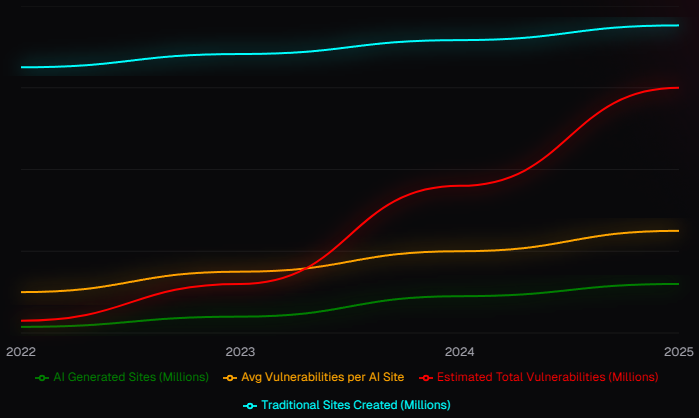
AI Adoption vs Security Risks and Traditional Sites Creation
Comparison of AI-generated sites, traditional sites creation (millions), average vulnerabilities and estimated total vulnerabilities (millions).
Source: https://blog.tpeoficial.com/posts/the-hidden-risks-of-vibe-coding-for-non-technical-founders
2. Understanding the Risks
While Vibe Coding accelerates development, it does not eliminate the fundamental complexities of software development:
2.1 Hidden Technical Debt
Rapidly built applications often lack proper architecture.
Shortcuts taken to release quickly can accumulate into long-term maintenance problems.
Refactoring or scaling later becomes expensive and complex.
2.2 Security Vulnerabilities
Non-technical founders may unintentionally leave endpoints or data unprotected.
Platform defaults may not cover all attack vectors.
Vulnerabilities can expose sensitive user information or compromise trust.
2.3 Limited Scalability
Vibe Coding is excellent for small projects and MVPs.
For high-traffic applications or complex business logic, performance bottlenecks are common.
Migrating from Vibe Coding to fully custom code later is often challenging.
2.4 Lack of Flexibility
Predefined platform components can restrict custom features.
Integrations with external services may be limited or cumbersome.
Custom behaviors often require workarounds, increasing fragility.
3. When to Use Vibe Coding
Vibe Coding is most effective when:
Testing new ideas with minimal upfront investment.
Building internal tools or prototypes.
Projects with simple logic and predictable workflows.
Non-critical applications where occasional errors are tolerable.
3.1 When Not to Use It
Applications handling sensitive data (financial, medical, personal).
High-performance or highly scalable systems.
Products with complex business logic that require future customizations.
When long-term maintainability and security are top priorities.
4. Why a Technical Team Matters
Even if you start with Vibe Coding, having at least one experienced developer can significantly mitigate risks:
Evaluate architecture choices and potential technical debt.
Implement proper security measures from the start.
Ensure integrations and future scalability are feasible.
Advise on which parts of the product are safe to build with Vibe Coding and which require custom code.
5. Summary
Vibe Coding empowers non-technical founders to rapidly launch and test ideas, but it is not a replacement for engineering expertise. Understanding its limitations and risks is crucial to avoid technical debt, security issues, and scalability constraints. Use Vibe Coding strategically, for appropriate projects and contexts, and complement it with technical advice whenever possible.
The accompanying chart demonstrates how vulnerabilities increase as Vibe Coding adoption grows, highlighting why awareness and planning are critical for long-term success.

Join Javier on Peerlist!
Join amazing folks like Javier and thousands of other builders on Peerlist.
4
10
2